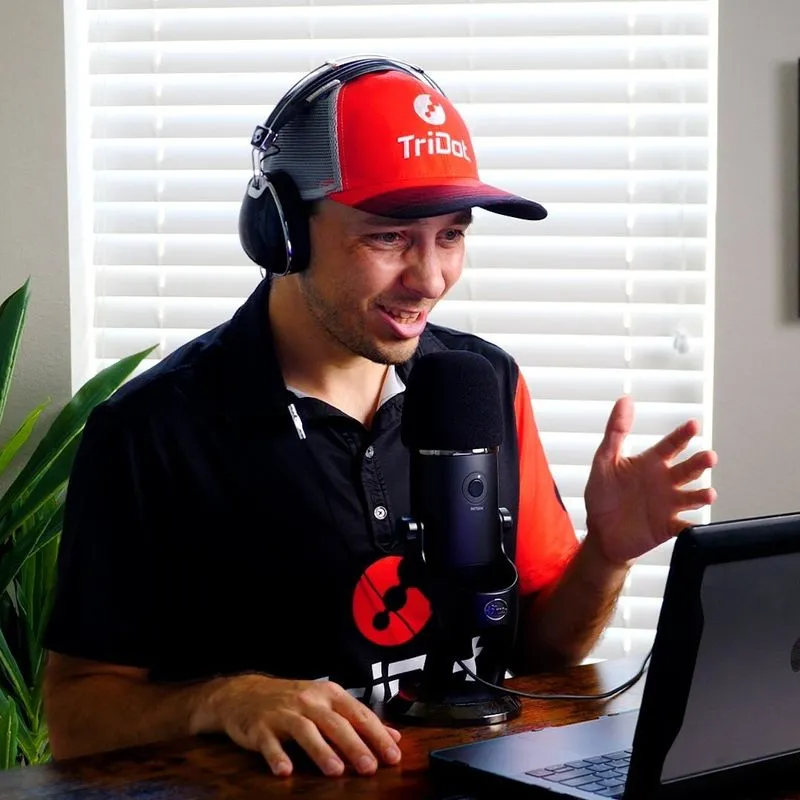

With three sports to train for, concepts to learn, and gear to acquire; Triathlon is not the easiest sport for a new athlete. But with the right guidance, getting started in triathlon does not have to be complicated or intimidating. Today Coach David Cagle from Continuum Endurance joins the show to present the 10 tips he offers to any triathlete getting going in the sport. From getting the right equipment to prioritizing consistent training and sleep; Coach David makes the transition to triathlete practical and approachable.
TriDot Podcast Episode 323
10 Tips For New(ish) Triathletes
Andrew Harley: Welcome to the TriDot Podcast. Today we have a TriDot coach presenting his 10 tips for new triathletes. If you're listening and you're new to the sport, I am so glad you're listening to us to learn more about triathlon. And if you're an experienced triathlete listening in, maybe share this one with some newer triathlon friends of yours who want to help those folks get into the sport and get rolling as strongly as they can. The coach, here, as our guide to getting started as a triathlete is Coach David Cagle, founder and head coach of Continuum Endurance, based in Arkansas. It's his first time on the podcast, and I'm very excited for you all to meet him. I'm Andrew the Average Triathlete, Voice of the People and Captain of the Middle of the Pack. We treat the show like any good workout. We'll start with our warm-up question, settle into our main set conversation, and then wind things down by having Coach David answer an audience question on the cool down. Lots of good stuff. Let's get to it.
Announcer: This is the TriDot Podcast, the triathlon show that brings you world class coaching with every conversation. Let's get started with today's warm-up.
Andrew Harley: To get you rolling, Coach David, we'll start with our warm-up question we always do. And the question I have for us today is what is your favorite, quote/unquote, ‘real food’ to use as fuel, either during a race or during a workout? And by ‘real food’, I mean not a sports specific product. So not a gel, not a chew, not a drink mix. What is an actual ‘real’ piece of food somebody who's not an athlete might buy in the grocery store, that you'll occasionally, or regularly, use to fuel your triathlon-ing? What is this for you?
David Cagle: Okay, good question. Just a disclaimer because pretty much 100% of my workouts and all my races, I use engineered food a lot.
Andrew Harley: A lot of us do. Yeah, a lot of us do.
David Cagle: So I can really dial in the exact numbers, which we'll talk about later. But make real food completely unsexy would be the old banana.
Andrew Harley: It's just a classic.
David Cagle: It's easy to eat, it digests well, and you get 25 carbs from banana, and it's always available.
Andrew Harley: Always available. They're on course at the races. I like bananas before a workout, particularly an early morning work. I just -- for me it's a texture thing. I can't do that texture while I am working out. And I know it's a very popular food, especially for cyclists to take during a bike ride. For me, I'm a big fan of these Nature -- little show and tell -- these little Nature's Bakery fig bars. I can't do the flavored ones. They've got a strawberry and a blueberry, but just the natural fig flavored one. I love these things. I'll use these on long bike rides. I'll use these if I'm playing tennis, in between sets I'll pop one of these guys. But a lot of good, just natural carbohydrate in there. They are pretty carb-heavy and sugar-heavy, so I don't use them on non-workout days. But I keep these in the pantry, just in case I'm maybe low on my gels, or just want to mix it up by having real food during a trainer ride or something -- I'll go to one of those guys. I'm like you, normally a drink mix, or a gel, or engineered food, right, because you want to practice that. But when I'm popping something real, it's one of these guys, right here. We're going to throw this question out to the TriDot audience, so find us on social media. We'll post this question all over our socials. If you're watching us on Spotify or YouTube, you can answer this question right in the comment box below. I always go and check to see what people are saying about the warm-up question. So let us know, if you're popping some ‘real food’ during a workout, or during a race, what is your favorite ‘real food’ item to use while you're in triathlon mode? Can't wait to see what you have to say.
Announcer: Let’s go.
Andrew Harley: Alright, Coach David, onto our main set where you, my friend, are going to walk us through the 10 tips you often find yourself giving to the new triathletes you're coaching. And it is your first time on the podcast. You've been coaching with TriDot for awhile now. You've been coaching triathletes for even an even longer while. But I just want our audience to just to get to know you a little bit and go back to the beginning of your triathlon story while we're talking about being new to the sport. When did you get started as a triathlete? What was your first race experience like? And how did your first race go for you?
David Cagle: Absolutely. I've never been an ‘athlete’ -- or an ‘athlete’, quote, I guess I am now.
Andrew Harley: Sure.
David Cagle: And I started about 10 years ago. I was overweight, unhappy, and just kind of needed something different in my life. And my uncle actually gave me a bike. And there's a little local lake trail around here, six miles. I couldn't ride it around that lake without stopping Andrew. So that's how fit I was at that point.
Andrew Harley: Yeah.
David Cagle: So I thought, what do people do with cycling? This is my standard story -- What do people do with cycling? Because I always want to know what the ‘thing’ is. And it was 100-mile thing, right? You want to do a century ride. I knew somebody that was into sports and cycling. I was like, “How do I do a century ride?” So he said, “Well, let me introduce you to this guy who's a coach.” And I'm like, “What do you mean, ‘coach’? There's coaches for grown people?”
Andrew Harley: For adults that run, bike, ride bikes.
David Cagle: So I started talking to this guy, said, “I want to do a century ride.” And he said, “Okay, well, how about—" he was a triathlon coach, obviously. He said, “How about doing triathlon?” I said, “Well, I can't swim, and I won't run, so that's out.” He said, “Well, maybe just give it a try.” As they say, and things kind of went on from there. Started training with him, and trying to learn how to swim, couldn't swim across the 15-yard pool. And then headed into my first race, was the spring of 2014. And it was a -- wasn't even a triathlon. It was a local duathlon. Never done a 5k or anything. And it was a 5k, 19-mile, 5k duathlon. And man, it was the hardest thing I've ever done.
Andrew Harley: Yeah.
David Cagle: And I remember going through that thing and finishing that second 5k, and I was like, “I'll never do this again. This is dumb.” And then I crossed the finish line, and my first thought that just popped in my head was like, “How do I -- where's the next one of these?”
Andrew Harley: How can I do a little bit better next time?
David Cagle: Where's the next one of these? And that's why I tell people sometime in that -- especially the beginner -- sometime in that first race, you're going to be like, “This is the dumbest thing I've ever done, and why am I doing this?” And then when you get done, you're going to think, “How soon can I do this again?”
Andrew Harley: So for you was the flip of that switch once you crossed the finish line. Okay.
David Cagle: That was it. Yeah. Me and my girlfriend -- my now wife, then girlfriend -- we went out and celebrated like I'd finished, I don't know, Around the World Run.
Andrew Harley: Yeah.
David Cagle: It was a great celebration. And that changed everything. That was the beginning of everything.
Andrew Harley: Yeah. What I love about that story, David, is that emphasis on when you first started riding that bike. I mean, six miles was a long way. And when I first started riding a bike, I remember just on a Saturday, going out -- my wife and I, at the time, our apartment, and I had this little loop I would do. And I started off riding about 10 miles at a time. And then all of a sudden, I was riding 15 miles at a time. And then all of a sudden, I'm riding 20 miles at a time on a Saturday. Whoa, look at me, I'm riding 20 miles. And now that's a standard Tuesday workout.
David Cagle: Sure yeah. You don't even think about it.
Andrew Harley: I want to emphasize, for anybody listening, or anybody who's sharing this episode with a potential somebody who's interested in the sport, who hasn't gotten started yet. I mean, wherever you are right now, that's fine. There are people crossing IRONMAN finish lines. There are people standing on the podium at a local sprint, local olympic race, that are now good, experienced triathletes that started just like David. A 6-mile bike ride was a long way. A 2-mile run was a long way. So wherever you are right now in your journey, you can get where you want to go. With the right training, and the right work, and getting plugged in with the right people. So I'm curious for you, David--
David Cagle: Absolutely. I tell everybody, we're starting where you are. So, “I can't do a 70.3.” Don't even think about a 70.3.
Andrew Harley: Don't worry about that. Don't worry about that yet.
David Cagle: Go run-- I mean, my first coach taught me. He's like, “Go run half a mile.”
Andrew Harley: Yeah.
David Cagle: And that was it.
Andrew Harley: I wasn't aware that there were sprint and olympic distance triathlons. And I was interested in the sport because I was a runner, and I was swimming in the local gym. And I met a guy at the time, at the TV network that I worked at. There was a guy in the business department who had done a couple sprint triathlons. And I was talking to him, and I mentioned, “Yeah, I'm swimming, I'm running. I'm kind of curious about triathlon. I just, I don't have a bike, and I can't imagine riding that far.” And he's like, “Oh, well, I do local sprints. The bike is 10 miles.” “Oh!” And so that, without that conversation, my mindset was, oh, triathlon is IRONMAN. No, no, it's not. You can get started at a very approachable race distance. My brother has done one triathlon in his life. He did a super sprint in Nashville, Tennessee, and that was the perfect way for him to try it out. He hated it. He's never done one since, and never will, but that's fine. He tried it, and he tried it at the appropriate distance. So anyway, definitely want people to know that. For you, David, it's so great that you saw the value in a coach right away. You hired a coach early on in your journey. I think a lot of people, myself included, I didn't think that was for me in my first couple seasons. I thought, oh, there's no point in paying for a coach, or having a coach, unless I'm a really good triathlete, really fast. And no, it's valuable for anybody. And you recognized that straight away. At what point in your triathlon journey did you decide to become a coach, and how did that lead to you starting Continuum Endurance?
David Cagle: So, yeah, that was 2014ish. So again, I just messed around and did local races and stuff like that, and just kept training, and along came Covid, right. And then I started doing -- I had my sights on doing an IRONMAN at some point. And then Covid came along. So a friend of mine was doing life coach training, and my wife said, “You should do this. This is right up your alley.” So we all do something different during COVID, right? So I went through hours of online training, of life training for life coaching. And I got to thinking, there's a place for this in endurance coaching, to go beyond, given the plan to work with people, especially beginners, to use these skills, these life coaching skills in endurance sports. And I thought, then the next piece of that, I thought there was one leg missing of the stool, and that was the nutrition part. So then I went on to get nutrition certifications.
Andrew Harley: Great. Love it.
David Cagle: Recently just became board certified health and wellness coach. So I really believe in coaches ongoing learning and getting the certifications to show -- it doesn't prove that you know anything, but it shows that you're learning that what's out there and always trying to get better. So, yeah, I did that. I had this model in my head of this three prong, endurance, life, and nutrition. And as things went along -- and then it was actually TriDot, was the thing that spurred me to move out on my own, because it gave me a vehicle, where it had a very well done individual plans so I could focus on coaching athletes, and talking to athletes, and doing what coaches do.
Andrew Harley: Right.
David Cagle: I didn't want to build a business that just handed out workouts. I wanted to create a place where people grow into the kind of athlete, and person, that they already had the potential to be. And Continuum is about staying in that, for the long run.
Andrew Harley: Absolutely. I love it. I love that you went out and got the education you needed to be able to work with athletes from multiple angles. I love the kits, the Continuum team kits. We'll pop a picture on the screen, for our YouTube and Spotify audience, of Team Continuum, what you guys look like at the races.
David Cagle: People love the colors. I don't know. It was – actually, I’ll shoutout -- my daughter, Felicia, came up with the design, and they’re rocket science kits, like we use with TriDot.
Andrew Harley: Yeah.
David Cagle: Powered by TriDot logo on the front and back. And the purple -- you can see our athletes coming down the course, and it's really cool. They pop really well.
Andrew Harley: If you see this kit on course at a race you're doing, say, hey. It's Coach David's team. And I like to remind people every so often, on the podcast, as you're listening, I mean, the coaches you hear come on this show use TriDot to coach their teams, use TriDot to coach their athletes. And if you're looking for a coach, if you really click with what you hear from Coach David today, if you really click with what you hear from a different coach on a different episode, they can become your triathlon coach. Or we have our Coach Connect, and our Coach Finder, where you can get plugged in with it with the TriDot team. And members of the TriDot team will hear your story, hear your goals, and try to connect you with the right coach for you. But Coach David, today specifically, has brought his 10 tips. We're get to business now. He brought his 10 tips that he gives to newer triathletes, and I'm excited to hear what you have to say, here. On Team Continuum, do you find yourself working with a lot of newer triathletes?
David Cagle: I do. And that's the thing is I wanted to create -- it wasn't just for beginners, or it's not just for -- we got young kids that are looking for 5-hour half IRONMANs, and then we got people that are coming in before the course closes. So it's a very inclusive team. We work a lot of para-athletes, and do some things locally with that. It's truly -- everybody's welcome. And if you don't welcome everybody, you're not really welcome.
Andrew Harley: Well, and so you--
David Cagle: I do work with a lot of beginners, because that's, again, back to my origin story. I was not an athlete, so you couldn't have told me I could do an IRONMAN when you met me in 2013. And that's the kind of -- I love that journey, and seeing and being there when they cross the finish line. And a lot of tears.
Andrew Harley: Yeah.
David Cagle: A lot of joy and a lot of tears. It's fun.
Andrew Harley: So these 10 tips have been crafted by actually hands-on, working with your new triathletes. You're very gifted, and very experienced, in getting a new triathlete up to speed. So, Coach David, let's get into the tips. What is Coach David's tip number one for a new triathlete?
David Cagle: Okay. We started tip number one with something that -- I think everybody's concerned about triathlon because it's a little bit harder to get into than running, you know, grab a pair of shoes -- so you get your gear figured out.
Andrew Harley: Okay.
David Cagle: Don't obsess over it though. You don't need the best of everything when you start. You need gear that fits, especially with a bike. You need gear that fits you, that's safe, and that works well. And there's plenty of time to upgrade that equipment later. There's endless ways to upgrade your equipment, but I get a lot of those questions at the beginning. Do I need this or do I need this? Do I need a tri bike? No. I did my first 3 IRONMANs on a road bike. You don't need anything but a bike, and shoes that are safe, and a helmet, and goggles. But I get a lot of equipment questions.
Andrew Harley: Yeah, I remember in college I learned the word obfuscate, which is, obfuscation is making something seem so complex that you just don't solve the problem. That's to obfuscate something. And I always thought it was a fun word, and so I've always remembered it. But I think a lot of people, that are candidates to become triathletes, look at it and obfuscate it. They just like, “Oh, man, there's so many moving parts. There's so many things I need. I just. I'm overwhelmed. Let me go sign up for a half marathon instead.” When, like you said, if you talk to a buddy, if you look at a list of what are the essential things I need, it's not that much. It's not that much. There's a few key items for sure, but if you get those and, to your point, get what's practical, get what's available, get what fits you, and you can always circle back and upgrade down the line, and spend more money down the line. But you don't have to straight away. So really good tip.
David Cagle: You've been into 70.3 and there'll be a $20,000 bike and a $300 bike.
Andrew Harley: Absolutely. Side by side.
David Cagle: I'm telling you more often, you will see the $3-400 bike pass the guy on the $5,000, little lady, whatever.
Andrew Harley: I've been passed. I'm usually on that side of the equation. I've been passed on my expensive bike by somebody on a mountain bike. And I’m like, “Good for you. Good for you, brother. You got an engine I don't have.”
David Cagle: I tell that to people all the time. I go, “I've got way more bike than I've got engine.” It's always fun, once you're in the sport, to upgrade. But it's not as hard to get in it. I've got people that have finished their first half IRONMAN this past year that are still using borrowed bikes.
Andrew Harley: But borrowed bikes, I had had somebody tell me -- because that was the last piece for me, was getting a bike. And I had somebody tell me, a lot of bike shops will rent road bikes for the day, or tri bikes for the day. And so I went to a bike shop thinking I was going to rent one, and they had just stopped that program, and I just ended up buying just the cheapest entry-level road bike they had in the store. But it was plenty for me, for my first two years, I think, I used that road bike. And there are places where you can rent, and I've had friends do that to get into their first tri. But yeah, so tip number one, really practical here. You've got to have the gear to do a triathlon. So get the essential gear, don't overthink it. Get what's available, and get those first races under your belt, and then evaluate what you need from there. So Coach David, your tip number two for a new triathlete. What do we got?
David Cagle: Okay, tip number two, with coaching, or watching if you're not being coached, you weren't watching for yourself, watch for red flags. Let your coach know early. So as you're training, if things feel harder, your motivation dips, your sleep gets weird, or just something starts to hurt, don't push through it. Pay attention to what your body's telling you. If you're coaching yourself, make some adjustments to your training, and then get that feedback from your body. If you are working with the coach, communicate early and often. Let them know what's going on, let them know about your schedule, let them know about things that you're feeling. So paying attention to your body and letting yourself know, or your coach know.
Andrew Harley: I think early on, I definitely -- and not early on, I mean, to this day, we have three sports we have to be fit for. We got to be able to run, we got to be able to swim, we got to be able to bike. You got to be able to complete the distances for the ratio coming up, in all three of those sports. And so there was definitely this pressure to, throughout the course of the 7-day week, spend a couple training sessions in all three sports. Particularly for me as a runner, the swim was new to me, the bike was new to me, so I felt like I needed to swim multiple times a week, I need to bike multiple times a week. And it can lead you to, “I'm feeling sore today, I'm feeling extra tired today. I feel an ankle thing coming on.” And all of a sudden, you find yourself doing training sessions that maybe you should back-off on, or skip on. You're not listening to the body whispering at you. And all of a sudden, a month into your self-training, self-coaching, you're feeling hurt and beat up. And you can't get fitter, and you can't get ready for your event, if you aren't healthy, and if you aren't taking the time you need to take care of your body. So I love this tip. I love reminding a new triathlete of that, straight out of the gate. Stay healthy, stay active, stay in the game. It's not worth hurting yourself over.
David Cagle: You’ll get people that see the plan and they just want to, “I'm going to do the plan no matter what.” And that's not what the plan’s for. The plan's a guide, and then it's always adjustable.
Andrew Harley: 100%. So listen to your body, pay attention to those cues, and if you have any questions, throw ‘em out to a coach, and ask a triathlete peer of yours like, “Hey, how would you handle this? I'm feeling this and that.” And people are absolutely willing to help you navigate staying healthy, not ignoring red flags that your body needs a little maintenance. Coach David, tip number three for new triathletes? So far, we've got listen to your body, pay attention to how your body's feeling through your training. We've got, get the gear you need without overthinking it. What's tip number three?
David Cagle: Tip number three for new people, and for old people, is trust the plan. You're on a plan, whether it's TriDot, or some other plan, or you have a coach that has a plan. Trust it. You don't need to go out and push something too hard, or do some extra. The quickest way to sabotage your progress is doing these bonus workouts or pushing harder because you feel good that day. Yeah, everybody's done it, right. Every session has a purpose. I get a lot of those questions, like, “What should I do here? Can I do these two?” It's like, no, well, this one has this purpose, and if we do those back-to-back, then it's going to throw our design off. So adding those extra sessions can cause stress that disrupts the system. So yeah, trust the plan. It’s an easy one.
Andrew Harley: I've heard Mark Allen, IRONMAN six-time World Champion, he coaches with TriDot, so we get a lot of face time with Mark, legend of the sport. I've heard him several times say, in coaching conversations, that he finds his female athletes follow the plan way better than his male athletes. His male athletes are the ones who are-- so is that your experience?
David Cagle: 100%. 100%
Andrew Harley: Why do you think that is? Why do you think we have a problem with that?
David Cagle: I've got female athletes that I could call out that are just 100%. I have a wonderful lady in California, I was coaching through TriDot for her first IRONMAN in Florida. Man, 99%, 100%, every week, every session. And I've got guys that are, like, go off and, “I ran half marathon this weekend and didn't tell you.” Yeah. 100%.
Andrew Harley: That's so funny. I'm going to start asking more coaches that, to see how universal that is. I wish that -- you and I were talking, before we started recording, about how we started the sport about the same time, we started with TriDot about the same time, actually. I think I started with TriDot a little bit before you, but when I did, it was just a revelation. Because I had this, as an uncoached athlete, just kind of training myself, again, I would try to go through -- I've got 7-days in the week, and when I get off work every day, I'm going to go for a run, I'm going to go for a ride, or I'm going to go to the pool and swim. And I would try to make sure, by the end of the week, I had done each sport a couple times. And that's really all I knew to do. And I was aware that, okay, some days I should probably go shorter and harder, some days I should probably go longer and easier. But my version of that was, my short and hard day, was I would go blitz out a 5k. No intervals in there, just a hard 5k. And then the next day, I would do 7 miles at an easy pace. My easy pace, truthfully, was probably Zone 3, and it probably wasn't doing what it needed. Anyway, so I knew that I should vary it a little bit across all three sports, but I didn't know enough to do it intelligently. And so when I found TriDot, it was a revelation, because it was like, “Oh my gosh. I open this app ,and it gives me the workout for the day, and it's smart.” And so I had very little problem following it. But yeah, exactly what you're saying, whatever you're doing -- we want you to use TriDot, and most ideally, work with a coach plus TriDot. But whatever you're doing to train in the sport, follow the plan, trust the plan. Every workout's there for a reason. Every interval is there for a reason. And so, really love this one as number three. Definitely worthy of being toward the front of the list and not the back.
David Cagle: On that, you'll find -- I think the most common thing is, especially for guys, just going too hard all the time, like you said, just doing a 5K. And you're probably putting in more time -- a lot of the people say, “I don't have time to train for this.” You're probably putting in more time than you have to.
Andrew Harley: Yeah.
David Cagle: And making it harder on yourself than you have to. TriDot’s, I mean, better training, less time, fewer injuries. And I found all that to be true.
Andrew Harley: Yeah, no, same, my friend, same. And that's why we're both still here with the company, this many years later.
David Cagle: Yes.
Andrew Harley: Coach David, what is tip number four for a new triathlete?
David Cagle: Tip number four is something I work on with, especially with new people, or everybody all the time. And people get tired of hearing it, about consistency. Consistency beats intensity every time. So you can't make up and do four workouts on Friday and Saturday because you didn't do anything Monday through Wednesday. So I try to work people on consistency by showing up every day and doing something. If I don't have an hour to do a bike, I say do 30 minutes. If you don’t have 30 minutes, do 20 minutes. But everything works better if you're doing something every day.
Andrew Harley: 100%. I find this to be most true when I'm taking some time off from triathlon, or I'm taking some time off from racing. Longtime listeners of the podcast will know, we had our first kid two and a half years ago, my wife and I, and so I haven't raced since then. I've done some training on and off, but when you have an infant in the house, a month would go by that we were just so swamped keeping the infant alive that I didn't get to train for a month. And then I would get back into it. And when I got back into it -- if I could have just kept my body moving a little bit each day in those off periods, it was so much better than if I just went cold turkey and stopped working out. But when it comes to training, this is a huge refrain over our 300+ episodes of the TriDot Podcast, that consistency over perfection in your training is key. And we have so many triathletes that are type-A. They want to tick all the boxes, they want to do all the training right, they don't want to miss a session. I want to remind people, you have that individual TrainX score, right. So when you do your session, you've got that score of here's how well you did this session. You also have your weekly TrainX score. And you could miss a session. You can miss a workout, not make it up the next day, two days later, three days later, and force more intensity into a certain day, and still have a good TrainX score at the end of the week. Because it's not about being perfect every single day. It's about that consistency over time. Or to your point, Coach David, you might have a 60-minute bike ride on the calendar, not have time for 60 minutes on the bike. You might get 20 minutes of you just spinning in Zone 2. And on that individual session, you might get a bad TrainX score, but look at your week. Look at what you did over the course of the week, and try to be good over the course of the week and not perfect every single day. Keep moving every single day. Really like this tip, Coach David.
David Cagle: Yeah, perfect. It's just, having a coach helps there, also, because sometimes being a coach allows you to give permission to somebody. I've got athletes that will see their schedule, and they just can't change it, or they can do 45 minutes of an hour. So having those conversations with them, I can say, “Alright, we'll change. We'll make these 45 minutes.” And they're like, “Oh, I can do that.”
Andrew Harley: And just, pressure off, because I'm doing what my coach told me to.
David Cagle: Exactly.
Andrew Harley: The hack I like to tell people -- a couple of years ago, this was always in the backend algorithm, but they put publicly into the app, the NTS score. So it's the score of how stressful -- not the NTS. I'm correcting myself. The XP score, the execution point score, on a session. Every single week, no matter what sessions you have, your Weekly XP is 300 points. And so those 300 XP points are spread out between all of the workouts you have. And so when you look at a session, the more XP points are dedicated to a session, the more valuable that session is to your week. And so I always like to remind people, if you need to skip a session or move some sessions, if you can't get to one the training on a certain day, skip the ones that have lower XP, because they're important, but they matter less than something with high XP. So just add that in there. If you're coaching yourself, that's a good, quick hack at which ones to skip, which ones to move, which ones to cut corners on. Try to really nail those higher XP sessions. There's a reason they're worth more XP. That's not a made-up number. It's a reflection of the importance of that workout to your training week. Anyway, we're on number five. Moving on, number five. Coach David’s tip number five for new triathletes.
David Cagle: Good. So number five kind of builds on what we're talking there, so I did that well.
Andrew Harley: Love it. Let's build on it.
David Cagle: Not every workout is supposed to feel great. I get this one a lot. “This was terrible. This this workout, I didn't feel good.” And I'm like, “Okay, that's all good.” So my rule of thumb, that I've learned, is -- and it may work out, or it may not, but it seems to help people -- a third of the workouts are going to be great. You're going to feel really good. A third of them are going to just be whatever, and a third of them are going to not be good. They kind of suck. You're always going to have them, so don't take the highs too high or the lows too low. You're going to have great workouts, you're going to have bad workouts. And it's all about, don't judge each workout, judge your consistency.
Andrew Harley: That is so good. I don't think I've heard somebody say this on the podcast. I really like this, and it takes me back. Frequent listeners will know I like tennis. I grew up playing tennis. It's my other sport alongside of triathlon. And I remember in high school, I was playing a match against a kid that I felt like, man, I should really be blowing this kid off the court. And I won the match, but it was like two really close sets. It was closer than I felt like it needed to be. And I come off the court, and I'm a little annoyed with myself, that, man, I didn't 6-2, 6-2 this kid. It was 7-6, 7-6. Whatever the score was, it was close. And my coach was like, “Okay, you got the win.” And I've even heard professional athletes say this. As professional athletes, as good as they are at their craft, at any given game, in any given whatever sport they play, you probably have 70, 80% of your ability clicking that day. They, as a professional athlete, we do not play our best every single game, every single match, every single time. And so the trick is, what's working today, what's not working today, and doing the best you can with what you got, and trying to walk away from that game, that match, that whatever, with the win. And I love carrying that over to this mindset of, okay, you're going into your workout. This workout might be awesome, it might not be awesome, but I'm going to try to do the best I can in this workout with what I got clicking for me today. And if I'm not feeling good, if I'm not nailing my intervals and my heart rate's climbing for whatever reason, if I'm feeling a little under fueled going into it and just can't catch up -- whatever the reason is that it's going askew, okay, don't panic. Don't freak out. Don't get in your own head about it. Do the best you can until the workout's done. Take the TrainX score you got. You did the best you could, with what you had today. And guess what? There's another opportunity to crush the workout tomorrow, right?
David Cagle: Yes. There's never any shortage of workouts. It gives you permission to say, yeah, then they go on and it helps them coach themselves. Later on, they have a bad workout and they go, “Oh, well, tomorrow will be different.”
Andrew Harley: If your MAV shuttles go poorly, you'll have MAV shuttles again in a month, probably.
David Cagle: That’s true. I like that.
Andrew Harley: Yeah, but you're still going out there. You're still doing the training. You're still giving your body the chance to absorb some training effect. And so it's still a win, right? It's still a positive. It's better than being home, on your butt, on the couch, not doing any of the training at all. Really like this one. Coach David, tip number six for a new triathlete?
David Cagle: Alright, now we're going to move into race and nutrition. So dial in your nutrition and hydration. Know your numbers. Get your numbers.
Andrew Harley: So crucial.
David Cagle: Train your numbers. Nothing can help you more, have more, better training sessions and perform well, and feel well, at races than dialing in your nutrition and hydration. I'm talking about knowing your sweat rate, your sodium needs, your carb tolerance, your gut sensitivity, all those things. And doing those -- TriDot has race rehearsals for a reason. I really try to get people, like, “Please, we're going to do exactly what you're going to do on race day.” On that first race rehearsal, this didn't work. That worked. Then we do it on the second race rehearsal, and then by the time we come to the race, it's not something you have to worry about, or not something you have to have any anxiety about at the race time, because you know your numbers, you know what's going to happen. You know you're going to lose a bottle every 30 minutes, and that's what you need to replenish, and how much sodium is in that, and how many carbs you can tolerate. So there's no shortage of information on the Internet, and everybody that you talk to have a different idea and thought about it. Be careful about that. And just what I'm trying to say here is know your numbers. Dial in your nutrition and hydration. Don't worry about “Oh, well, so and so, they take in 120 carbs.” You may be 130 pounds--
Andrew Harley: Not me. Yeah, not me.
David Cagle: --and can’t take that much, don't need that much, because you're not putting up 400 watts. It's really individual.
Andrew Harley: Yeah. Going back to our word of the day, something that's really easy to just not pay attention to by obfuscating it. Like, “Man, it's complicated. How can I figure this out -- between the sodium I need, the calories I need, the grams of carbohydrate I need, how much I need across the swim, bike, run, how much I need before the race starts, how much I need in T1 and T2?” It can, for a new triathlete, feel very overwhelming. The number one thing, whether you're doing a sprint or an IRONMAN, drink throughout the whole race. Take in some fluid throughout the whole race. Take some sodium in a couple times through the race. Take in some calories throughout the race. Even if it's a short-course race, your body will -- you've got to fuel your body. It took me a while, David, to realize that -- even early on, I would grab a gel at the aid stations on course, and I would drink at the aid stations on course, and I would take a water bottle with a sports drink, my first couple sprint triathlons, and I would drink throughout. So I knew I needed stuff. It took me a long time to realize that, oh, I should be doing this in my training, too. Because most of us can go out and finish a 1-hour workout not taking in a whole lot. But, how much stronger do you feel, in the back half of that workout, if you did take in some carbohydrate and some electrolytes? How much stronger do you feel in the hours after the workout? How much stronger do you feel the next day, if you fueled that workout? And that's where you get to practice. “Oh, if I take two gels in an hour, that are 30 grams of carbohydrate each, ooh, my stomach starts to feel queasy.” Okay, that might be a little too much for me. So you start figuring out those numbers by playing with it in training. And it took me a long time to realize that. I was playing with it in races. And so one race, it would go poorly because I would under-fuel. The next race, I would over-fuel, and my stomach was upset on the run. And then the next race I would, “Oh, it went well today. Great. I felt strong.” And the next race I would botch it again. But I was using my races to experiment with how much fuel to use. I wasn't using my training sessions, and it took me a couple years to realize like, “Hey, dummy, try these gels in training. Try these electrolyte pills in training and see how it makes your body feel in certain amounts in training. That way when you get to race day, you're just replicating what you do in training.” And last thing I'll say here, I'm starting to ramble, but we have some really good friends -- there's a lot of companies that do great products. So it's just finding which product clicks for you, and you like the taste of it, and your body tolerates it. But our friends at Precision Fuel & Hydration -- they're a company out of the UK. They're really good friends of ours. We see them at the races all the time. I like their products quite a bit. But they will do, if you go to their website, they will do a free 15-minute consultation with you to answer whatever questions you have about triathlon, or endurance sports, nutrition. Whether you're going to use their products or not, whether you're going to buy anything from them or not, they will spend 15 minutes with you, no questions asked. And obviously, they'll give you some coupons and some deals to try out their products. But that's a good place to start. You can definitely work with a coach, like Coach David, who has some nutrition knowledge, and they're going to point you in the right direction, as well. But at minimum, book that 15-minute call, ask a couple questions, and let them steer you in the right direction to not have this feel overwhelming as you're getting started in the sport.
David Cagle: Yes and thank you for saying that, because I did that call with them--
Andrew Harley: Nice. Yeah.
David Cagle: --when I switched over to TriDot, so they’ve become my -- we're talking about earlier, what do you eat, well, mainly I eat Precision & Hydration and that's what I -- because it's easy to dial in my numbers for the salt, and the electrolyte, and the carbs, separately. So I do work with them, and a lot of my athletes do, too. And that's what we usually try first. And then some people, for some reason their stomach doesn't tolerate that, so we move to something else, and we keep trying things in training so that we don't worry about it on race day. And just knowing what works for you.
Andrew Harley: 100%. And it's absolutely crucial. If you're new to the sport and you're listening this episode, you probably are, possibly are. You can get by at the sprint and olympic distance with not really doing this well and paying much attention to it. But you'll definitely perform stronger, if you pay attention to how you're fueling, how you're drinking, how you're getting sodium on board. And if you step up to the half IRONMAN or IRONMAN distance, this becomes absolutely crucial. It becomes your lifeline. So, definitely essential, Coach David, to have this on the list. And you did. That was number seven, right?
David Cagle: So that was number six.
Andrew Harley: That was number six. So moving on to Coach David's tip for new triathletes, number seven.
David Cagle: Number seven: prioritize sleep like it's part of your plan. Sleep is kind of like a deficiency need--
Andrew Harley: I do not do this.
David Cagle: Yeah. Sometimes it's a deficiency need. We don't really think about sleep unless we're not getting enough of it. And a lot of times, when I'm having these conversations with athletes, we have our weekly call conversation, and if things are not going well, that's my first go to. Sometimes in TriDot, you can connect your Garmin, if you have that, and it'll come through on the screen. Sometimes people don't have it hooked up. So sometimes I can see that, which is also good data for me, when I'm glancing through things. Having your sleep down is just so important. It's the cheapest, most effective performance enhancer. It regulates your mood, your power, your everything. Sometimes, again, it's not sexy, it's not a big thing. But if you're not getting it, you'll know it, and it'll be showing up in your training, and it's also going to be showing up in your work, and your relationships, and everything else. If you're not getting enough sleep, it's going to affect you. So you're sabotage-- if you're not getting the sleep, you're sabotaging your fitness that you're working on.
Andrew Harley: I know a lot of triathletes that -- and we're a spendy group. We like buying things, right, triathletes, especially the longer you're in the sport. But a lot of folks want to go out and buy recovery gadgets, massage guns that are $300, and compression boots that are $1,000, and specialty warming, vibrating massage balls that are $150. And we do all these things to try to recover our bodies, and you're not sleeping well, or you're not going to bed on time. And I've always been horrific at this. I've never been a good sleeper. I've never been a sound sleeper. I'm a little ADD and just have a hard time turning my brain off at night. When I was in college, I was the guy who could sleep four hours, and I could function absolutely fine the next day. That's caught up to me now. Now I'm 37, and if I don't get nine hours, I feel it. So anyway, love this being on here. Not enough people pay attention to this and how they're sleeping. Not enough people go through measures, making sure they have the right pillow, right bed, putting the room at the right temperature, doing the right things with our screen time, especially at night, to not be on screens, not have that blue light. And we continuously -- we need to get a sleep expert on the show and do a sleep episode, because we haven't yet and absolutely need to. But crucial to performance.
David Cagle: That’d be great. There's all kinds of things you can do sleep-hygiene wise. Like you said, keep it cool. And it's easy to find those things, but again, it's just not something we normally go to and think of. It’s just like, ”Oh, I'm sleeping enough, and it'll sort itself out.” And it doesn't.
Andrew Harley: I think for the most part, when race week comes around, all of a sudden, I'm really paying attention to what time I'm going to bed and how well I'm sleeping. But just the week, the week-to-week of training, day-to-day training, I just don't think about it enough. I don't focus on it nearly enough. And definitely something that could boost my performance, and my training, if I really was trying to dial that in a little bit better, and stay on a good schedule, and all that. Really good one to bring up-- Go ahead.
David Cagle: I'm glad you brought that up about race week, because for beginners, it's also something we talk about before race week. So a lot of times, your first IRONMAN race, or some kind of big event, you may not sleep the night before the race.
Andrew Harley: No.
David Cagle: And that's okay. If you sleep Tuesday, Wednesday, Thursday, and your race is Saturday, and you don't sleep Friday night, it's okay.
Andrew Harley: Yeah.
David Cagle: You can still function. You can still have a good day. But some people get anxious about that, and “I'm not sleeping.” If you can sleep in the middle of the week, you'll be fine on race day.
Andrew Harley: Yeah, it's so true. I try to focus on getting a really good night's -- sleeping well all through the week, and then getting a really good night's sleep two nights before the race.
David Cagle: Yes. Yep.
Andrew Harley: Because exactly what you said, that the night before the race, you might sleep fine, or you might, at minimum, you go to bed, you sleep alright, and you wake up stupid early. So you're already, you're throwing yourself out of your rhythm, but that was a question on the podcast--
David Cagle: Either way, you're not going to get a full night sleep.
Andrew Harley: Yeah. Either way, you're not getting the amount of sleep you're used to getting. And there was a question on the podcast years ago, I'm blanking on who it was, but I remember what he said. He was like, “There are world records, and world championships, and age group podiums that have been won in our sport off of horrible nights of sleep.” Sleeping well the night of your race is probably not going to happen. It's a universal experience. So really focus on the race week itself. And to your point, the better you can sleep, and the more routinely you sleep on your training week, the better your training's going to go, and the stronger you'll be on race day. But definitely something for a new triathlete to pay attention to and be mindful of because it makes a big difference. Eating your vegetables and sleeping, those two things, annoyingly, make a big difference.
David Cagle: I didn't have vegetables on.
Andrew Harley: I'm sneaking-- it's so funny. There's an app that integrates with TriDot called FUELIN. A lot of triathletes might be aware of FUELIN. Scott Tindall is the founder/CEO of FUELIN. If you're not aware of it, it's an app that -- it syncs with your training. So if you're on TriDot, you can sync your FUELIN plan and your TriDot plan, and it sees these are your workouts for the week, and it will tell you what you need to eat in your meals, breakfast, lunch, dinner, and snacks, to properly fuel yourself for the workouts you have each day. And it's basically telling you how many macros, how many grams of carbohydrate, grams of fat, grams of protein you need based on your training. Really, really, really clever concept that a lot of athletes have a good experience with when they try it. I was talking to Scott in Kona a few years ago, their CEO and founder, and he was telling me, he's like, “Nine times out of 10, if I'm talking with an athlete, and they're telling me like, ‘Yeah, I've been really feeling weak in my training lately. I haven't been able to hit the zones that I think I should be hitting.’ The first question I ask is, are you getting your 4 to 5 servings of vegetables per day?” And Scott's an Aussie, so he calls it veg. “Are you getting 4 to 5 servings of veg per day?” And he goes, “Nine times out of 10, it's, ‘No, I'm not.’ “ And it's start there, before you start with all these supplements, and before you start with all these expensive products that are supposed to help your nutrition regimen, start with getting in 4 to 5 servings of vegetables. Obviously, plus everything else you'd normally eat. But he goes, “Nine times out of 10, they don't do that.” And they're important. Anyway, Coach David, tip for triathletes -- that was a bonus tip. Eat your vegetables. But your tip for new triathletes, number eight?
David Cagle: Number eight: Strength training keeps you durable.
Andrew Harley: Yes, it does.
David Cagle: When I talk about strength training, you don't need to build a bunch of mass or become a bodybuilder. We're just talking a couple of times a week. Functional training, squats Monday, deadlift -- squats, deadlifts, some lunges. Just something to keep building that muscular endurance, especially if you're looking at a 70.3 or IRONMAN distance. You're on your legs a long time. And you want those, you want to have all the muscular endurance that you can. So it'll help you build, it'll help your speed, it'll help your power. But what it's going to help you do is go all day and be okay at the end of the day. So couple of strength training sessions.
Andrew Harley: Yeah. So for a new triathlete, you're already figuring out how to get swimming on your calendar, biking on your calendar, running on your calendar. You're already figuring it. But yeah, this is huge. It's huge for, like you said, that muscular endurance actually out on the race course and in your week-to-week training. It's also huge for injury prevention. When I start feeling banged up, when I start feeling my back is getting tight, my knee is beginning to hurt, it is seasons of my training year where I have not been staying on top of just doing some dynamic stretching after a session, not doing my five minutes of run drill warm-ups before my run sessions, not spending 15 minutes on the yoga mat here and there, stretching a few key things out, doing a few key plyometrics. And Dr. B.J. Leeper, who's on the TriDot staff and is a physical therapist, he says all the time, you don't need an hour per day, you don't need long sessions for this. You just need 10 minutes here and there, 20 minutes here and there, of maintaining your body, working on strength, working on stability, working on mobility -- should take care of you if you're doing that consistently. So yes, welcome to the sport. You got to start swimming, biking, and running. You also need to be working in a little -- pockets, right? Just pockets of some strength training.
David Cagle: Like you said, sometimes it's hard to look at your schedule and see those strength sessions, and they don't have to be go to the gym. It could be something as small as do squats while you're making coffee.
Andrew Harley: Yeah.
David Cagle: You start there. You start, again, we always start where we're at. So if you're not doing anything, we can start with 30 seconds of squats.
Andrew Harley: There's days, you mentioned earlier, your athletes will have days where like, “Oh man, I'm looking at my calendar, and I've got a 60-minute workout. I can't do a 60-minute workout. Well, crud, what do I do?” And you'll, as a coach, try to help them shorten that workout. I've had days, Coach David, where -- and I think TriDot Coach Jeff Raines is the one who recommended this to me, because he does this with his athletes -- where if I can tell, oh, I can't get my full workout in, I might not even go for a swim, bike, or run session. I might get in the driveway, or get in the road in front of our house, and just do 10 minutes of run drills.
David Cagle: Oh, I like that.
Andrew Harley: Your heart rate will get up doing run drills, right. You start doing those walking lunges, you start doing some high skips, some A-skips, B-skips, C-skips, throw a couple strides in there once your legs are warm. You'll work up a sweat in 15, 20 minutes, but you'll have really done a good job of connecting the neural pathways between your legs and your brain and your body that help you run well and smoothly. So anyway, I've done that sometimes when my schedule's overwhelmed, can't do a full workout. Ten minutes of that in the driveway, and boom, that's a form of a workout, and it's a form of injury prevention. It's a form of strength training that we’re talking about. I'm can’t take credit.
David Cagle: I love it. I’m going to take that. That's what I love about our community. It's very collaborative. It's the coaches, the TriDot coaches, from my experience, we all share these techniques, and it's great.
Andrew Harley: 100%. And it's part of the origin story of the podcast. When I started years ago, talking with TriDot CEO Jeff Booher. We were talking, I was like, “Man, there are, I know there are dozens and dozens and dozens of coaches using the training to coach their athletes that know a ton about the sport. Let's get them on microphones and start teaching people. Let's get them on microphones and start coaching.” And launched that six years ago. And here we are, still doing it today. And finally got you on, finally got you on the show.
David Cagle: There we go, and here I am.
Andrew Harley: Coach David, your tip number nine for a new triathlete?
David Cagle: Alright, we're moving into the race day, so: training's hard, and the race day is a celebration. So a lot of new athletes, they're anxious about the race. They keep talking about the race, and the race, and the race. And the race is such a small amount of time in this whole process. You think about -- I do a lot of couch to 70.3, and say it's a 6-month program, and you think you're doing six to, whatever, six workouts a week, seven workouts a week, for six months. And you're doing one workout is the race. So you've done all this work, you've got up early, you went out in the dark, you went out in the rain, you've done all this stuff, you've done all this hard part. I try to really, when that, especially on that first race, is your job is just to execute, smile, and enjoy the day.
Andrew Harley: 100%.
David Cagle: It's a celebration of all that hard work. It's not something to be anxious about. We've dialed in your nutrition, we've done that. We've dialed in your paces, and I know we'll talk about that later. Everything's ready to go. So go have fun. Smile at the -- thank the volunteers. Smile. My wife always tells me, she's like, “You were always smiling.” I said, “Well, I’m not always smiling. I may always be smiling when I see you, because I'm happy.” I am, I'm generally happy to have the opportunity to be out there and to be doing what we do.
Andrew Harley: Yeah, when I did IRONMAN Waco -- it's my one and only IRONMAN. My wife is down there, and she was hanging out with the TriDot crew who was cheering on all the TriDot athletes coming through. And it was a tough day, condition-wise -- really windy on the bike, a hot day. When I came through T2, she told me later, she was like, “Every athlete we were cheering for, when they came through T2 off the bike, just looks like death, and just looked miserable, and just looks like they had just gone through like a war zone.” And it was a tough bike course that day. And she was like, “And you came through, and you were just grinning ear to ear.” And I was like, “I was happy to be off the bike, first of all. My butt was excited to be out of the saddle.” But, yeah, at the end of the day, this is fun. This is fun. And you can have goals, and you can shoot for those goals. And some races you're going to hit those goals, some races you might fall just short of those goals, but there's always another race you can sign up for. There's always another crack at it that you can take. And, yeah, why do all this if it's not fun to you deep down, end of the day? So love this reminder, and hopefully that helps take some of the pressure off of race day. If you just know, I'm going to go out there and have fun. I'm going to do the best I can with the fitness that I have. That's all you can do.
David Cagle: I'm not going to, I mean, I can't let or not let you do it, but I'm not going to recommend you do a race that you're not prepared for physically and mentally. So, put that on me, borrow that from me, and then you just go ahead. Absolutely.
Andrew Harley: Alright, we've timed this well. We're 54 minutes into a recording, almost up at the end of our hour, and we're at Coach David’s tip for new triathletes number ten. So we've really cranked this through in perfect timing. So you're one-for-one on being fantastic on the TriDot Podcast. Coach David, what is our 10th tip?
David Cagle: Our 10th tip, another race tip. And this is the first race, again, talking about beginners, isn't about time, it's about experience. So don't focus too much on the predictions, the calculators, and your pacing. We want to know how your body reacts to racing. The different pressures and anxieties of racing, what the transitions feel like, how your feeling worked under pressure. We've done it on our own, but how did it work when you're 50 miles into the bike, and how did it work in race conditions with the aid stations, and what pacing felt like under each things? We're just learning all this stuff for the first race, right? A lot of information gathering, and then back to number nine, we're having fun. And then at the end, we take all this information, and we use it to move on. And I always – this is kind of cheesy, but like it's going to be a PR.
Andrew Harley: Yeah. You are guaranteed to have the fastest race you've ever had on your first triathlon.
David Cagle: You're guaranteed to have a PR at your first 70.3. And then we can take all that information and figure out what we want to do from there. But yeah, just don't worry about all this stuff and just focus on the day and learning.
[Transition Sound Effect]
Andrew Harley: On to the cool down portion of our show, where we’ll close the show out by asking Coach David a question from our audience, and I pulled this question off of the I AM TRIDOT Facebook group. I saw this question asked, thought it was a really good one, curious to hear what Coach David has to say. Brick asked this question. He said, “I've been racing for about five years. I recently started training with TriDot. I am happy with the training, but I have a question about racing and race day.” RaceX has a race predictor. On race day, will I be able to download a race plan to my watch or something similar to what I push to my watch for my daily workout?” And so for all of our newer triathletes listening, today we talked some about how to have a good race day. Coach David, what does TriDot do for us on race day? What's available for us, through TriDot, for racing?
David Cagle: And you can back me up and jump in on this. So my view on that is TriDot has RaceX, like he said, that's very good predictor. If you work, if you really dial in, if you do the right things, if you do the testing, it knows if you've done the assessments, and you've done the work to go along, then the and the race predictor should be pretty spot on. So I think the answer to these questions is a little bit of yes and no. You can download, if you use power on your bike, you can download segment-by-segment power zones for your Garmin device, or other device, to power your bike. Not so much on the swim and the run, like a regular TriDot workout. It's not going to tell you to go next pace at whatever, you do have in your in your race plan, and TriDot, the paces and the elevation of the race, especially if it's an IRONMAN race, or if you have the file in there if it's a local race. I don't know if everybody knows, but if it's a local race, or non-IRONMAN race, you can upload the GPX file, and it'll have all the elevations and everything in there. So it'll kind of give you a guide. In RaceX, there's a little piece there called -- before the bike plan, there's a little gear on the right-hand side of the bike and the run, and if you click on that, it'll give you the guides for basically your power and heart rate. And that's what I use. That's what I use for myself, and that's what I use for my athletes. So if, again, beginners, I have a lot of people that don't have power. Everybody has heart rate pretty much. I don't have any requirements, but I like for people to have a chest strap, good heart rate, and all that. And so we govern by heart rate. So I'll set my watch and kind of go by the paces in that. So a little bit of yes and no. Yes, you can download power zones for the bike that are exact and go directly to your device. No, on the run and swim, but you can get your idea where you want to be and what you don't want to -- basically what you don't want to go over to blow up. And that's what I've used. And I’ve found, again, over the past couple years racing with TriDot, I've had people come in within seconds, almost all the time.
Andrew Harley: It's freaky, man. It's freaky.
David Cagle: It's actually a little weird. I was looking at one last night when you sent me that question, and it was just, it was within seconds. It was a bike that was 3:33:32 and 3:33:25, or something like that. So it's really good predictor. So if you look at that, and if you don't have the chorus, or if you don't have power, look at that heart rate that RaceX is telling you not to go over, and kind of build you a little bucket in there that says, ‘I don't want to go under this or over this.’ So if I'm going under this, I'm probably not putting out enough effort. If I'm going over this, I may blow up for the run, so keep it under that. Get on the run, and a lot of times I'll just set my Garmin device to give me an alert if I hit -- I know I did Tri-cities this year, and I did something totally different. I only went by heart rate, had the best run and the best race I've ever had. I had no idea what my time was on the run. I had no idea what my total time was. I just went by TriDot, RaceX, don't go over this. And I put that in as a limiter, and every time I hit that, I would back off a little bit and keep going. And had the best thing. So yes and no. But there's really good information in there if you dig for it.
Andrew Harley: Yeah, really well answered. And in the time I've been with TriDot, it's actually evolved. Internally, we were calling it RaceX 2.0 for a while, because there was a point a few years ago, where they added in so much extra functionality in a good way, that we were like, man, on the surface it looks the exact same, but really, under the hood, there was a lot more that RaceX could do for you. And that's when they introduced that you could push your bike power plan to your Garmin device. And it can't be any Garmin device, it can't be any Polar, Suunto, Apple equivalent. There's certain devices that are compatible that have the capabilities. And so I actually upgraded my bike computer to a device that could use the power plan. Because yes, on race day, you can go in there and push your power plan to your bike. And while you're on course, it's pretty cool. It's following the GPS, and you'll hit a certain section of row that it tells you to raise your watts, or lower your watts, and it's helping to optimize your time on the bike in that way. For the swim and the run, you got to memorize it, right? You got to memorize it. And for both of those, it's not as complicated as cycling. It's not as complicated as optimizing power on the bike. And so, it's just, here's the average pace you should hold, and here's the heart rate you shouldn't go over. And so those are the two numbers I memorized. And I know, okay, for this half IRONMAN, I'm supposed to stay right around 7:15 minutes per mile for the run. And so I'll target that leaving transition. It's pretty cool.
David Cagle: I love RaceX.
Andrew Harley: Pretty cool technology there. There's a lot in there. We have a whole podcast episode on RaceX that maybe I'll tag in the description today. We can definitely do an episode like that again. But great question for today. We went a little bit long on this cool down, but good question and some good information from Coach David and myself about it. Coach David, thanks so much for making your podcast debut. We'll definitely have you on again sometime soon.
David Cagle: Thank you so much.
Announcer: Thanks for listening to the TriDot Podcast. Help us out by leaving a rating and review on your listening platform of choice. For more opportunities to learn from our coaches, check out our YouTube channel and follow @TriDotTraining on social. Ready to train with us? Head to tridot.com and get started for free. Until next time. Happy training.