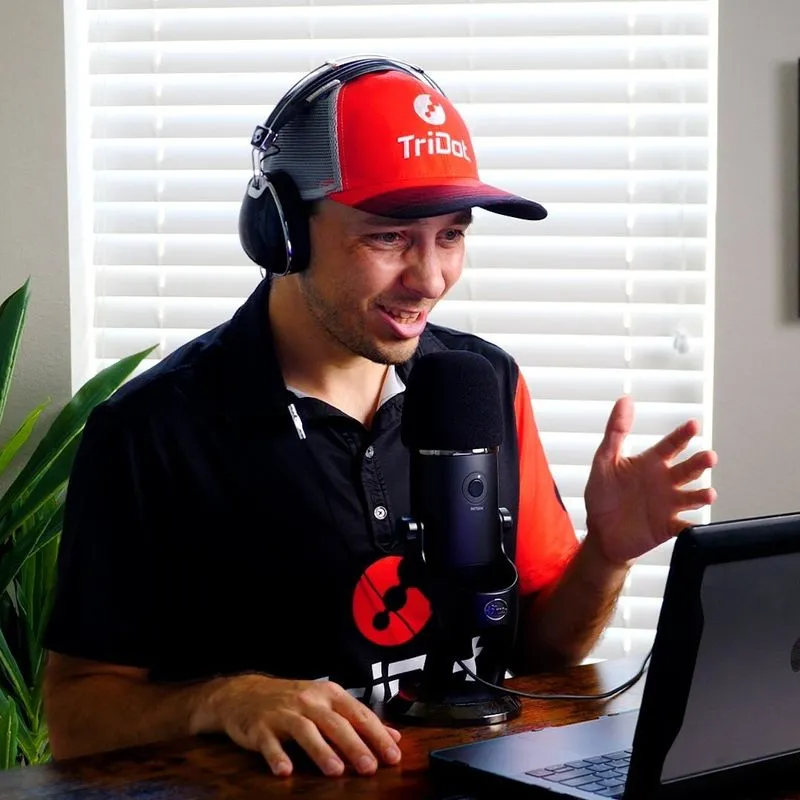

“The finish line is not a final destination, but a breathtaking view that fuels the next journey.” In this episode, Coach Stephen Horan celebrates a major milestone: completing his 20th IRONMAN. With over 15 years of endurance racing Stephen takes time to reflect on the lessons learned from each finish line. From the power of community in training, to embracing pressure as a privilege, and finding strength through adversity, Stephen shares personal stories and hard-earned insights that go beyond the race course. Whether you're an athlete, a goal-setter, or simply seeking motivation, this episode will leave you inspired to chase your own next finish line.
TriDot Podcast Episode 313
20 Lessons from 20 IRONMAN Finishes
Andrew Harley: Welcome to the TriDot Podcast. Today, I have Coach Stephen Horan, longtime TriDot Ambassador, and now the head coach of Ironmind Endurance. Coach Stephen just completed his 20th IRONMAN at the World Championships in Nice, so I asked him to come share the top lessons he has learned from his own racing experience. I'm Andrew the Average Triathlete, Voice of the People and Captain of the Middle of the Pack. We treat the show like any good workout. We'll start with a warm-up question, settle into our main set conversation, where we'll see what we can learn from Coach Stephen, and then wind things down by having Coach Stephen answer an audience question on the cool down. Lots of good stuff. Let's get to it.
Announcer: This is the TriDot Podcast, the triathlon show that brings you world-class coaching with every conversation. Let's get started with today's warm-up.
Andrew Harley: All right, Coach Stephen, welcome to the show. So happy to have you on for the very first time. And since we're talking about your race history and all the different races you've done -- we're going to hear a lot of different IRONMAN-this, IRONMAN-that, thrown around today -- I thought a fun warm-up question would be this: from all the races you have done, what has been your favorite swim course, your favorite bike course, and your favorite run course? Take it away, sir.
Stephen Horan: Oh, Andrew, thank you. This is very exciting to actually be on. So glad you reached out for me to be able to be here. So it was hard, right? When you think about ‘favorite’, you have to think about, okay, what is it? Is it the best location? Is it the fastest? You have to think through that, overall. So I've kind of hit a ‘both/and’ on those, in that sense. But swim course, my favorite, no doubt, has been Kona. That is the most beautiful water, when you go. It's hard, right? I mean I'm not the greatest swimmer. I know you’ve said similar things. I'm not the greatest swimmer, and it's non-wetsuit, but it's really beautiful. But when I think about my favorite swim, it was actually IRONMAN Chattanooga, because it's fast. It was wetsuit-legal. You can jump in the water, and you can basically float down and easily make cut off. So kind of a ‘both’. From a bike standpoint, I mean, I've done Nice twice now, and Nice is the most beautiful bike course. I mean, it is really hard, so that doesn't make it fast – really, a lot of climbing, and also the downhills, but the scenery was beautiful, and we'll talk a little bit more about that, today. But I really took the time, this year, to spend the time looking at it. I don't remember a lot from 2023 doing it. I was like, man, I just got to get through it. But just spending the time has been really good this year, to be able to really enjoy that course a little differently. And then run, that one was a hard one. And I think, there's a couple of races -- and the loop courses are nice, but also the crowd support is really good. And I had really two that I was going back and forth, because Nice, yes, very good crowd support, but it's an out-and-back, out-and-back, out-and-back, out-and-back—
Andrew Harley: Just down to the airport and back, down to the airport and back.
Stephen Horan: Exactly. But I'll tell you, IRONMAN Texas is awesome.
Andrew Harley: Yeah, that's a good run course.
Stephen Horan: It's just the crowd support, you're kind of running -- your group, that's with you, your family, can jump back and forth really easy, to see you multiple times. There's another race, though, that I was able to do, and we'll talk about it in IRONMAN Frankfurt. But that was very, very similar, and it was just the same way. The Europeans are just crazy in the sense of their amount of support. And it's just really-- it was pretty awesome, both at the finish line, also, because you go into this small area, you funnel down, and then they just have stands with bunches of bunches of people, just out there, and it was a whole party all day long. So I would say Texas and Frankfurt were the two for that one.
Andrew Harley: Yeah. And I love here, Stephen, that we're already getting a glimpse of some of the races you've done, and we're going to talk about all those races in the main set a little bit more. This answer for me, the swim course was the easiest decision. This swim course is undefeated for me, and will probably remain that way. IRONMAN New Zealand, if anybody's been there, it is crystal-clear lake water. I'm sure it can get choppy on a stormy day, but for the most part, it is just a tranquil, peaceful, flat lake. It is just the easiest. You can see everybody around you. You can see the buoys, you can see everything so easy. The temperature is perfect in a wetsuit. That was my very first IRONMAN event, and it spoiled me for the rest of them. I have done the swim in Kona. I obviously haven't raced Kona, but while I was there, representing TriDot, we went, and days before the race, got in the water at Dig Me Beach, swam to the Coffee Boat and back. So that is a great swim venue, that I have not raced, personally. But yeah, IRONMAN New Zealand is my swim. For the bike, all the IRONMAN events I've done, I've never loved any of the bike courses. I've liked some of them. My favorite bike course I've done is the bike course at Clash Daytona. You cannot beat spending the first few laps of your half IRONMAN just being on your bike, on Daytona Motor Speedway, doing laps around the NASCAR track. Such a cool experience. We rave about it, and rave about it, and rave about it, because it's just a unique one. So I'm going to give a shout out to that one. Once you're off the racecourse, the rest of the day is kind of boring, but it's flat and fast, so no complaints there, on flat and fast. For my run, I'm going to give a shout out to two races. My favorite triathlon run ever was probably the run at Escape from Alcatraz. It's just such a unique experience. You're on and off trails, you go through tunnels, you go up and down the sand ladder, you're on the beach, you're off the beach, you're climbing a hill, you're bombing down a hill. The Golden Gate Bridge is always right there. Just so cool. That's not an IRONMAN event, so to give a shout out to an IRONMAN event, I'm going to say 70.3 Greece. I really enjoyed that run course. They've moved this race since when I did it. So if someone goes and does IRONMAN Greece, and they hear me say this, it's probably a different run course now. But when I did it, it went through this protected marsh land, that was on the coast, and so it was just this really cool gravel trail-running, just always by the ocean, always by the bay, and it was just really beautiful. And when you weren't by the water, you were going through these rustic, Grecian, small villages, that had some crowd support out, cheering for you. So really cool run course, there, in Greece. Those are my shout-outs; IRONMAN New Zealand, Clash Daytona, Greece, Alcatraz. We're going to throw this question out to the TriDot audience. Make sure you answer this question. You can answer it either on YouTube, watching the YouTube video of this conversation, you can answer this question on Spotify, watching the Spotify video version of this conversation, or you can answer this question on our social media accounts. We'll post the question everywhere, because I want to hear from you, from your own personal triathlon race experience, what's your favorite swim course? What's your favorite bike course? What's your favorite run course? Can't wait to hear what our audience has to say.
Announcer: Let's go.
Andrew Harley: We're going onto the main set, where Coach Stephen is going to walk us through the 20 IRONMAN events he's done, specifically pointing out, from each race, one lesson that he learned. And Coach Stephen, it's your first time on the TriDot Podcast, so before we get to that, I do want to give our audience a chance to get to know you, who you are, what your history in the sport is, and then we'll rip through those 20 lessons. So let's just start here, where did you even start as a triathlete, and what has been the short version of your journey, from new triathlete to 20-time IRONMAN finisher?
Stephen Horan: You really have to think about-- so my background, I'm a Marine, so I was in the United States Marine Corps. I was more of a runner by trade. And I think a lot of people have transitioned from running into triathlons, and I'm really that same story. So it made it a little more challenging, for me, going into, hey, how do I swim? How do I bike? And I started in 2001. I got recalled back to the Marine Corps, just for a period of time, after 9/11. And one of my other Marines that was with me, he challenged me to do something a little bit different, more than just running. And he motivated me to be able to go back and say, hey, let's go do a triathlon. And I returned back home, bought my very first road bike, and signed up for my very first pool swim. Probably similar to most people, I barely could swim across the pool without stopping. And thank God it was a pool swim, because I did have to. But it was funny, I went back and looked at some old pictures before, and I was wearing the typical tight run shirt, and I really didn't even have tri shorts. It was just regular shorts. But that created that movement for me, in saying, hey, how do I do something different? How do I challenge myself? And as the typical runner, I was always running, and I just couldn't continue doing it. And that motivated me to say, hey, let me go to that next step within triathlons. And once I started, you start forming that community. And it was the community that drove me along to my very first IRONMAN. And I was doing a little bit of 70.3 distances. White Lake is one of the local races, here, in North Carolina, that I did multiple times. And then I started the 70.3 series, within IRONMAN, and I did 70.3 Raleigh, which is not around anymore. But my very first IRONMAN was an Iron distance race. It was 2008, with the Beach to Battleship in North Carolina. And my friend, that I was training with, was actually taunting me, saying, “Hey, let's go do this together.” And the funny thing, is he actually did not even go and race. He dropped out of training. But I formed that community, because I started grabbing on with other people that were training. And I learned more about the IRONMAN brand. I learned more about those races. And immediately after Beach to Battleship, I signed up, the day after, for IRONMAN North Carolina. And this is the time, in 2008, when you went to go register for a race, if you weren't on the next day it opened, you would not get an entry. And it was just really excited to be able to go do that. But continued on through, and to be able to go do that, and realizing that, hey, what does that take? What is that community? And we'll go into a lot of those details with some of those different races. But it was really a whole aspect of just starting at the very beginning, and saying, hey, can I go do this? Learning how to swim, learning how to bike, forming that community, and really jumping forward to be able to taking those steps as I progress along.
Andrew Harley: So, Stephen, I'm curious, where in your training and race history did you start racing with TriDot? You're a TriDot Coach, now. You coach your athletes through TriDot. You've been a longtime ambassador for TriDot. I've known you for a number of years, met you a couple times at races. You're already rocking the TriDot polo, here, in the podcast video. How did you discover us? When did you start using TriDot? And what difference has it made for your journey?
Stephen Horan: Yeah, so most people don't know, I did my very first dance with TriDot in 2014. It was before all the apps. Everything had to be printed off. I remember meeting with Cindy, and having my first discussions with Cindy, and in the Pre-Season Project, one of the things that you ended up having to do, very different than where we are today, is you had to submit a paper at the very end about all the stuff and all your learnings. I decided, at that point, and it was mostly probably due to timing, for me, and when I ended up doing it, it was not right for me. I ended up doing the Pre-Season Project over Thanksgiving and over Christmas, and I'm like, it was killing me. And I'm like, this isn't flexible enough or anything. So I did not take on TriDot at 2014, but I came back to TriDot in 2020. I started the whole process in 2019, and 2020, I came back to TriDot full time, in the sense of trying to say, hey, how do I want to do that? And probably like most people that have been in the triathlon, and continue doing it, you start going, and you do all these different things. And I wanted something different. It wasn't because I was injured. But I wanted something, because I felt like I was very stagnant with my overall fitness. And so for me, getting the TriDot, really trying to do and being very focused in the training becomes very important for me. And my kids were a little bit older at the time, in 2020. I mean, my kids today are 21 and 18. But, in that sense, it just gave me the opportunity to be really focused. And we'll go through, I mean, really, I'm starting set bigger goals. I wanted to ensure I was going to to Kona, and this was an opportunity for me to go and do something different.
Andrew Harley: Yeah, absolutely. I love it. So I want to get us to the heart of our episode, where we're going to hear from you on your 20 IRONMAN events, and you have one takeaway lesson from each of them. I'm just going to let you go race by race and share what the race was, what the takeaway was. You can share the moment, or the race story, behind your takeaway, and we'll just see how our conversation flows for the next 40 minutes. But I'm excited to get into it. So let's start with IRONMAN number 1, and lesson number 1. It was IRONMAN Florida in 2009. What was your takeaway there, Coach Stephen?
Stephen Horan: Yeah, my big takeaway is find your reason. And I know a lot of people talk about you got to understand your ‘why’, and this first race really taught me the most fundamental lesson of that. I was improved a little bit, but there was some community behind it. But it was really, I had to start understanding that and understanding that it was my loved ones. I'm setting the example for my family, what those overall aspects. And I think you need to make sure, as an athlete, that you really do understand the ‘why’. And I gave some stuff, and Andrew, as we were talking earlier, it's like, every race is hard, no matter how many I've done. And so you have to understand that, because that's what's going to help you get through those toughest miles. And for me, yes, I had done a race in 2008, the Beach to Battleship, but really going to Florida, getting out into the ocean for the very first time, I mean, it was just very, very challenging. And it just, I had to understand that I was setting the example for my kids, to be able to go do that, that I wanted to be able to continue thinking about being healthy, and setting those overall examples to be able to get through all of the training and the overall race. But you got to have that, and that becomes the basis, I think, that led. And I'm not saying your ‘why’ doesn't change, but it's what led me every single race, is understanding that why. And so I'm glad I did learn that early on, because it became that basis to be able to move forward.
Andrew Harley: Yeah, when I did my first full distance IRONMAN, and only full distance IRONMAN to date, my ‘why’, honestly, was just to have it on my resume, as a triathlete, that I had done a full distance IRONMAN. I wanted to be able to call myself an IRONMAN. I wanted to be able to put an IRONMAN window decal on the car, and have people be like, “Oh, you did an IRONMAN?” and not have to say, “Oh, I did a half.” I wanted to just know that I'd done one full, and I've only done the one full, frankly. I mean, people, longtime listeners will know, I just enjoy the middle distance more, and so that's more what my target is. I think I will do a full again. But yeah, I got to find that reason, I got to find that ‘why’. And honestly, I think that reason ‘why’ will probably be, eight years from now, seven years from now, when my kid is old enough, for her to realize like, oh, dad is chasing something hard, he's doing something hard, he's putting in a time and effort to do something hard, and that's what it looks like to dream and work towards a dream. And that will probably even be my ‘why’ on IRONMAN number two, and that will probably be a long time from now. But I love this being your very first one. You had to find your reason on race number one. And I love that you mentioned that, in the 20, it's changed from race to race, but each time you've identified what that reason is, correct?
Stephen Horan: Yes. And I'll tell you, no doubt, my family is fully behind, and my daughters, even as old as they are now, love going to races. And my oldest ended up not being able to go, because she works now, but we FaceTime her in while I'm actually racing. And she said, “I know this was hard, and congratulations.” And so that example, I think, makes a big difference. And I think you can have multiple ‘whys,’ also. And one of the things, as your daughter grows up, I think it's just awesome to be able to continue setting that example.
Andrew Harley: So, IRONMAN Wisconsin 2011, this was race number two. What was your lesson from that race?
Stephen Horan: Yeah, it was train with community. And a little bit of background, I mean, you got to realize that racing and doing all of this is not really a solo endeavor. It makes it hard if you try to do it that way. And I was, during that time, I decided to go back and get my MBA at the same time.
Andrew Harley: Oh wow.
Stephen Horan: And it was this community, that we had originally formed in 2009, that helped pull me along to Wisconsin. And they're like, “Oh, Wisconsin's an awesome area. You got to be able to do that.” But finding that group, and working with them, they helped bring me along, get me prepared for Wisconsin. It was Wisconsin, and it has been my slowest of all my races, because I did not prepare as much because of school. But really understanding that, and sharing that passion with a group of folks, just made the biggest difference overall, to be able to continue trying to say, hey, how do you make this happen. And again, I mean, I went from 2009 to 2011, I did a bunch of 70.3s in between. But it was that same community that we were able to be able to go and do Wisconsin with.
Andrew Harley: Yeah, I love this one. I think my first two or three years of doing triathlon, I would roll up to a local sprint or olympic, I wasn't in a tri club, I didn't know anybody else who was doing this. And so my wife would come support me, so we would hang out. But I think finally, my third or fourth year in triathlon, I got plugged in with a tri club that was based out of a local triathlon store in my area. And it really just brought my experience in the sport to life. Like all of a sudden, you're on Saturday group rides, you're at Wednesday track runs, you roll to races, and there's 20, 30, 40 people wearing the same kit as you. And it just really brings the whole experience to life. So I love that that's a lesson you caught so early on in your race career, as well. Race number three, IRONMAN Chattanooga in 2014. A 3-year gap, Stephen, a 3-year gap from Wisconsin to Chattanooga. Maybe you were finishing your MBA, I'm not sure. But what was your lesson from Chattanooga in 2014?
Stephen Horan: It was really, I mean, and again, it's about that time in between, but it was around setting goals and really being able to go do that. Now, I really transitioned at that point, because it was Chattanooga and pre-Chattanooga that I set the goal to go to Kona. And that's kind of the background, was, hey, how do I go do this? And I got to give you the story, it’s like, this group that I had been training with Wisconsin, there were two folks in my town that actually got lottery slots. Now, IRONMAN used to do lottery slots to go to Kona. Two people, that did not know each other, got lottery slots the same year to be able to go to Kona. And that just started motivating, like, how do I go do that? Well, that's when Kona ended up, or excuse me, where they got rid of the lottery slots. And basically, I think it was 2015, they ended up doing that. But Kona became that bigger goal, and having that goal in place to say, hey, how do I go do that? And again, working really hard in between on 70.3s, loving life, realizing I can run pretty well, still need to work on my swim, but, really trying to think about, how do you set those goals, and really making them in manageable segments. IRONMAN Chattanooga, that year, ended up being my fastest race out of all of them. And even though it's -- officially, at the time, IRONMAN Chattanooga is 114.6, so there was two extra miles on the bike. It is a fast swim. But realizing that that was something that I was working really hard for, right? And really saying, hey, how do I move forward? How do I set that into place? How do I go qualify to be able to get to Kona? And that was really what I started setting my eyes, for my overall goals, to go move forward.
Andrew Harley: Yeah, and goals in this sport can be all sorts of things, right? It can be to finally crack the top 10 in your age group, to land on the podium in your age group. It can be qualifying for Worlds, are similar. My current goal, in this sport, is I really want to go under five hours at the half IRONMAN distance. I went 5:02 in Daytona, a number of years ago. I don't have that fitness now. I'm trying to get that fitness back, and I'll get there, thanks to TriDot, but yeah, I want to go under five hours at the half IRONMAN distance before I think about going long again. So anyway, yeah, there's a number of quality goals somebody can have, and I love that that's lesson number three, here. IRONMAN—
Stephen Horan: There’s IRONMAN Dallas right around the corner, that’s right next to you, right?
Andrew Harley: Stephen, it's so funny you say that. Yesterday, in our company chat, Coach Ryan Tibball put out the post that it is officially sold out. It is officially sold out. A lot of triathletes in Texas, and I'm sure they knew that. And so it sold out pretty quickly. I was toying with the idea of doing it, and I just didn't jump in in time. Did not jump in in time. So I do have a 70.3—
Stephen Horan: I will be there. You got to come up and see me. I’ll be there.
Andrew Harley: Okay, Stephen. The swim start is 21 minutes from my house. So I was like, how could I, I have to go do this race. It's so close to the house. But I will be there cheering, for sure. That's absolutely certain. If they release more slots, I'll think about it. But yeah, I'll be there for sure. IRONMAN Louisville, 2015. What was your takeaway from that? This is number four.
Stephen Horan: Pressure is a privilege. Again, got to give you a little bit more background. I had a bike wreck about five weeks before IRONMAN Louisville. I separated my shoulder, and I was pretty dinged up. I couldn't go outside. I couldn't run, and it was a lot of pressure going into that race. I was really trying to think about how do I get to that race and be able to compete? And again, I now have this goal to get to Kona, and I signed up, still a little bit conservative, and cheap, and didn't want to lose the money, and not be able to go. I really had to say, hey, how do I go and reframe my mind, and have just a race to get completed? And so really taking that pressure, and saying, hey, how do I do it? And really being able to be agile, and saying, hey, how do I go and still train? I was actually sitting on the trainer with my arm in a sling, and just making sure-- couldn't swim. But it's one of those things to be able to make happen. But what you have to do is reframe that pressure, right? And saying, hey, what is it? What am I able to go do? How am I able to go and celebrate what I do have the ability to do? And we always say control what you can control. I couldn't control that I couldn't go swim, but I could control making sure that I was taking care of my arm. What I did go do, was I went and did kick drills in the pool. So you have to do those things, and to be able to take that pressure, and really realizing that you can still go and perform, and really take yourself to that next level.
Andrew Harley: And to put it in a different way, just the fact that we get to do this, the fact that we get to line up and do triathlon is a privilege. We have the health, we have the body. And in your circumstance, here, in Louisville, even though the circumstances were not ideal, even though your body was not 100%, the fact that you could go toe the line, knock out that race, enjoy the day-- it's a privilege to get to do this. IRONMAN Frankfurt, in 2016, you finally went overseas. You went international for a race. All of our European listeners, Stephen finally came your way, in 2016, to Frankfurt. What was your takeaway from Frankfurt?
Stephen Horan: Yeah, it was make it fun. My group has continued to grow all through these times. And you can see I'm starting to do a little bit more. I went from 14 to 15 to 16, and with that I had a group. And we actually went as three other families, with me. This was the first time my family got to go over to Europe. I had been there for work, personally. But it's like, how do we make it fun, right? And this was a brand-new country. I mean, Frankfurt is an amazing area, right. And again, I think the Europeans do a great job. And I highly recommend, for those in the US, you got to go take the opportunity and go race overseas at least once. It’s just a very different experience. I mean, the roads are 100% closed. I mean, that was awesome. You're going through these beautiful towns. But really taking that as an opportunity. And I think we have to remind ourselves, in all the midst of the hard training, in all the midst of it, the race, the actual race and the finish, is about really being able to celebrate. And being able to take my family over to Europe, being able to go spend a little bit of time, and we went from Frankfurt down to Paris, afterwards, on the train. But you got to make it fun. A lot of people talk about it's not just racing, but going on these race-cations, right? And be able to have fun when you able to go do it. But it's also kind of, it's not just race day, and it's not just at the race. You got to have fun, also, during the time while you're training. And I think this was really good, because we had a few people-- there was actually five of us racing, all together, there. Again, it was only three other families, but five of us were racing. And it was just fun to be able to all be training for the same exact race. And again, I think that you'll see that as a theme, overall. You've got to find your community, right? And I think that's what makes it fun. And bringing your family along, and having those abilities, just really make the difference for all your races.
Andrew Harley: I think of an age group athlete, in particular, we're not going to the races and earning money. This isn't our livelihood. And I imagine for the folks that it is their livelihood, it's probably fun for them because they're fast, and they get to be fast. But for the rest of us, you can have goals, you can have aspirations, you can have nerves going in the race day, because you want a certain outcome. But if, in your day-to-day training, or your race weekend, or your race day, if it's not fun, if you're not enjoying it, you've kind of lost the plot, right? And so I love that reminder here, and it reminds me of-- there's a TriDot Ambassador, who's coached by Brandy Ramirez, his name is Chris Tubbs. Shout out to Chris Tubbs, wherever he is. I'm not sure if he's a podcast listener or not, but we follow each other on social media. Anytime he posts about his triathlon training, or triathlon racing, on Instagram, he always puts the hashtag “I love this S H - T” And I love that mindset, right? I won't say the word on the podcast, but I love that mindset. That just, like, “Man, I just got done with a grueling workout, that was wild. TriDot had me do what? Man, I love this bleep.” Yeah, it should be fun, Chris, good job, good job. So Chris gets it. IRONMAN North Carolina, 2016. What was your takeaway?
Stephen Horan: The bigger picture. And I talked a little bit about the Beach to Battleship in 2008, and going back to IRONMAN North Carolina, just was looking at the bigger picture. The other thing is if you look at just the dates of everything that I'm doing, this is the first year of doing two races in the same year. So I went from Frankfurt, turned back around, I went to North Carolina. And just realizing that, yes, it's a beautiful area, but remembering this bigger picture of where I started from to where I am now, and then also realizing this bigger goals that you end up having. So it's kind of a tie back of, like, really take the time, and realizing it's not just the specific race that you're doing, but it's more about what you've done, and what you've been able to accomplish, the people that you're impacting. I mean, it's all of those things that I think are the bigger picture of these races. I mean, I'll just use Nice, just as a quick example. I mean, Kurt Madden, I work with Kurt Madden, saw him in the CMG, and I was able to find other athletes that did not even know that we're going there. And it's just like realizing that it's community. And it's an important part of, not just your local community, but the broader community of the IRONMAN events, and all of these other pieces. But again, it's not myopic. It's not just finishing your finish time. It's not just being able to go do it. It is that bigger picture of where you've come from and what you're doing. And again, it goes back to the privilege that we have to be able to go do these races.
Andrew Harley: And I think expanding that picture and making race weekend, making the experience of being a triathlete, about more than just the race itself. That's what helps people stay in the sport longer. That's what brings people back again, again, and again, like yourself, because it just enriches the experience, both on race weekend and day-to-day. So really, really good one there, from North Carolina. And for folks who, I didn't mention this in the intro, Coach Stephen is based in North Carolina. So easy for him to go do that one every single year, I imagine. IRONMAN Maryland, in 2017, was your next race. What was the lesson from that?
Stephen Horan: I put this one as one race at a time. And again, you got to look at the bigger picture a little bit here, too. I went from IRONMAN Maryland to Florida, and those were going to be my closest races, and they were, at that time, six weeks apart. Maryland was in October, Florida was in November. Sorry, it was five weeks. But so I had to think about this very differently. And it also ended up being my anniversary weekend while we were going to IRONMAN Maryland. So we had a good anniversary, but it was just, you got to make sure you're backing away and realizing, not thinking so far out. And again, we just talked about the bigger picture. That's what we want to go do. But you don't want to get ahead of yourself either. You got to make sure that you're keeping what's right in front of you, at that period of time. And so, this one, IRONMAN Maryland, if you haven't done it, I mean, it's a really good race. It's a little out in the edge of Maryland, in the sense of where it is. But you got to make sure that you're continuing to focus on where you are, being currently focused versus trying to think ahead. And I'll give just a real quick example why I also thought it was one race at a time. I show up race morning to be able to go check on my bike, to be able to go do it, and this is the first time I ended up going into transition -- IRONMAN seven -- that my bike tires were flat, both of them. And I'm pressing, and it brings that in. And again, it's like dealing with, not just the race, but what you have, what you can control, and to be able to go do that. Like I said, the bigger picture here, why this was one race at a time, is like I was really stressing about doing these both back-to-back, with Maryland and then Florida turning around. And then it's like, I had to make sure I was staying, in that sense, again, just focused, and not jumping ahead of myself, and saying, hey, how do I go do this? How do I make sure I can get to this next one? I'm like, deal with what I have right now in front of me.
Andrew Harley: IRONMAN Florida in 2017. What was your lesson from that one?
Stephen Horan: Yeah, it was helping others. And again, you got to understand a little bit about the background is, in the midst of doing Maryland, I was doing it, and did it, by myself. I didn't really train with anybody for it. And immediately, when I came back, I was able to connect. It was a local tri store, at the time. They're not open. They connected me with a guy doing his first IRONMAN in IRONMAN Florida, that same year. And he lived in my community. So it was just like, man, how do we connect with each other? And one of the things is, he was a really good athlete, but being his first, he didn't know what he was really doing. And so in that sense, I think that was the first time I started working closer with folks, to be able to help mentor, and to be able to go do that. He was a really good swimmer, good cyclist, and he was struggling, and it was one of the things that I gave up some of my race to be able to support him. I helped him cross the finish line, and to be able to go do that. And again, I'm not saying you're always going to want to do that, but it really just makes a big difference. Are you going to stop when somebody's hurt on the side of the road? Are you going to give them a tire, if they have a flat? Are you going to -- I've given, multiple times, in a lot of races, salt, when people are cramping. But really, trying to think about helping others. And I tell you, it helps me, also, as an athlete. When you're helping others, it takes the pain away from you. So I think there's an added bonus of not just helping those others, but also helping yourself, to be able to go do that. So it's really about how do you help lift people up? How do you help bring them along? I mean, one of the things I do on the runs all the time is I try to highlight and help motivate people. “Hey, good job,” when I'm passing them, to be able to say that, because it really just helps them, and you don't know that overall impact all the time. And so I just think it's a great thing to remember. We always say thank the volunteers, but help the other athletes while you're out there.
Andrew Harley: Yeah. So it took you eight IRONMAN events before you were officially the old codger who could help a baby along. IRONMAN Texas in 2018, you referenced this as one of your favorite run courses. What was your lesson from IRONMAN Texas?
Stephen Horan: Hard work required. There's no shortcuts in the sport. Texas is great, but the time of the year, it's hard. Depending on where you live, I mean, you end up having to really think about how are you going to train and be ready to go. And it really tested my discipline. I mean, I had to spend a lot of time on the trainer getting ready for Texas. When you're doing 6+ hours on the trainer for your long rides, it even hurts more. And so it really takes a lot of hard work to be able to continue thinking about that. Also with Texas, I mean, you can get a lot of wind out on the Hardy Tollway. You end up being pretty hot. And you just got to realize that every race, it is hard, and you got to go into it in that mindset and being prepared. Because it really is, right, I mean, going through the finish line, it's about a reflection of your consistent work that you're putting in when no one is watching. And that's the hard part. You got to do the work, no one else can do it for you. And it really takes the other amount of time.
Andrew Harley: Yeah. IRONMAN number nine doesn't care that you finished IRONMAN one through eight, right. It's a new race, it's a new day, and you got to go earn it just the same. And it's easy to take that for granted. I've taken it for granted at shorter events. I'll roll up to a local sprint, or a local olympic, thinking, oh, it's just a local sprint, local olympic. And then it ends up kicking my butt, because I just didn't take it seriously enough. And IRONMAN especially, you've got to do the work for every single one that you do. So very, very, very good lesson, here. IRONMAN Chattanooga in 2018, what was your takeaway?
Stephen Horan: Challenges happen, right? I think you got to make sure, as an athlete, that you're preparing. I faced two flat tires on the actual bike. And because the swim was canceled at Chattanooga, which I love the swim, and I wish they wouldn't have canceled it, but because the swim was canceled, I still ended up going out early. I ended up having almost a 2-hour wait to get tech support out there. And for me, it's like, how do you pivot when you're two hours behind? And I'm worrying about getting to the cutoff time, and you're always looking at your watch, okay, am I doing it? And it's always based on when you start, and all these other pieces. And I come running into the—or not running, but riding into the bike finish, and I'm yelling at my wife, “Did I make cut off? Did I make cut off?” Because I did not want to run the full 26.2 miles and get a DNF, right. That was not what I wanted, because I'm working towards legacy, at this point, and I just needed a complete. And so I did make it, was able to get it completed. Barely made -- it was like four minutes before cutoff to be able to have it. But it was a challenging race, and because I pushed, ended up being so hard on the bike, to try to make up time, that it really punished me on the run. And so again, challenges happen. You got to be prepared for them. Whether you drop water bottles, whether you have flat tires. You got to really think about that as an athlete and prepare in advance. And that really taught me, and it goes into this mindset aspect of how do you prepare? How do you visualize? How do you do those different pieces? Because understanding that, and knowing that they happen, and you can't control them, you need to make sure that you're trying to put yourself in a position to control what you can control.
Andrew Harley: Yeah. Jeff Booher, CEO, Founder of TriDot, he always puts it this way. On race day, expect three things to go wrong. And if they don't, great, they don't. But when they do, instead of getting frustrated about it, or instead of saying, “Oh, I just got a flat tire, and I got to wait,” it's like, well, okay, there's thing number one. I knew it was going to come. I didn't know it was going to be, but I knew it was going to come. And it just changes your mindset about it, right?
Stephen Horan: It does.
Andrew Harley: IRONMAN Lake Placid, 2019. Lake Placid, first time there. I haven't been there, yet. I've heard great things about the swim there, in particular. What was your takeaway from Lake Placid?
Stephen Horan: Lake Placid was enjoy the race. I mean, I'm going through, you can see, I'm building this whole repertoire of all the different races. And I'm like, I haven't done Placid yet. Let me go and enjoy it. And that's one of the iconic races to be able to go do that. But again, I'm trying to work towards Kona, also, and knowing that Lake Placid was a pretty challenging race, even though very iconic, it's like, how do you go and prepare to be able to go do that? And so, I had the position, because again, you got to look a little bit at what I had already registered for. I got Mont-Tremblant, that's actually two weeks after Lake Placid that year. And so again, I really needed to position, okay, where do I want to race versus where do I want to maybe set back just a little bit. But this is about being present, again, in the moment and enjoying that area. I mean, Lake Placid, beautiful place and highly recommend to go, if you have an opportunity, whether racing or not. But it's a site. Go and enjoy that area and realizing that, hey, you got to make sure you're able to do it. And again, it's funny, because I talked about my two girls, but this was a great opportunity, and I just love all the photos of my girls at all the races. And we actually spent the time there, they were able to meet Mike Reilly. He had his book out at that point, and we got the book signed. Just being able to go in and do those things and having the time with the family was just also really enjoying for that specific race, that year.
Andrew Harley: Your next race is also one that I've heard is fairly hilly. IRONMAN Mont-Tremblant in 2019. What was your lesson from Tremblant? How different is Tremblant from Lake Placid? They're kind of in the same vibe, I think.
Stephen Horan: Yeah, they really were. I mean, the lesson was ability to push through. Like I said, it was three weeks apart to be able to go and to do those. But I mean, beautiful area. I mean, I hate that they don't have the full at Mont-Tremblant anymore. It's only the 70.3. Because honestly, that, if I was to pick a race to say you got to go do, that would be one. I mean, go to Tremblant.
Andrew Harley: Wow. Huge endorsement.
Stephen Horan: Really just an amazing area. But, the ability to push through, realizing I had just come off of Placid, I was actually being coached, getting feedback via Crowie, at the time, for Lake Placid. And I was like, okay, how do I recover? And I had to really learn that whole aspect of recovering to be able to turn right back around. And it was just, like, pushing through, and I ended up having a really good race, but my body shut down on the run. And I had to figure out how to look at it closely, and say, hey, how do I push through this, and push through that pain, overall? Because I had to dig deep. And that was probably, again, the run on that course, I just remember, specifically, because it hurts so bad to be able to go and finish the second half of that. But also, I also remember very -- it was amazing finish. Mike Reilly was there, also. Just an amazing finish, and just great opportunity, in Mont-Tremblant. But I think you got to, as an athlete, really determine how deep can you go? How can you continue forward? I mean, we talk about resilience with Nice this year, but that ability to push through is hard, and I think you got to make sure you're able to do it. And you got to train hard, too. If you think you're going to only do it on race day, you're probably not. And I think that becomes an important part to push through.
Andrew Harley: Yeah. It's amazing how -- it's so funny just what moments from a course, what parts of a course, stick out in your memory 10 years later, 5 years later. And so just you recalling the pain you were in on that run course, yeah. It made an impression on you, for sure, it sounds like. So IRONMAN Tulsa, which I think this is where I first met you. IRONMAN Tulsa, 2021. What was your takeaway?
Stephen Horan: Yeah, by the way, I remember you yelling after coming off the bike in Tulsa, to be able to go do that. I was able to realize -- this is in 2021 and delays happen. And realizing, going from 19 to 20, with Covid, and then 2021, I mean, I think Tulsa maybe was the very first race back after Covid. I mean, I remember going into the IRONMAN Village and there was nothing, and you're wearing masks all the time. But just really, to realizing that delays happen. And whether it's, I mean, Covid was a big delay. I mean, I went from -- and I got to back up a little bit, because Mont-Tremblant ended up being my 12th race for legacy. That was the other thing that was important for that. And so I had already submitted my legacy slot to be able to go to Kona, and I had to—
Andrew Harley: So then you have to do an IRONMAN every single year to stay eligible.
Stephen Horan: That's correct. So I'm stressing in that sense, but they gave us the waiver because of 2020, and I'm like, I got to go sign up because 2021 ended up being the date they gave me, at the time, to be able to go to Kona. So I got to do a race. I got to at least register for it. And Kona, by the way, ended up getting delayed another year, because of Hawaii was a little bit more restricted. And so I had to go do a race. I had to go race Tulsa. And this was the first year for Tulsa. Only my oldest daughter went with me with Tulsa. But it was like, how do you continue doing that and realizing that delays happen and things are -- it goes back to controlling what you can control and realizing that we all had those challenges. Everybody is in the same position, but you have to adapt. And that becomes the big part for all of us to take into consideration. Because we got to be flexible, we got to be patient. We got to make sure that we're continuing to accept some of those things, whether it's, again, delay in races, or something changes, or they cancel the swim, right? I mean, all those different possibilities. And I think that's just important for us, as athletes, to continue trying to think about and making sure that we take into consideration.
Andrew Harley: We do. I think we have seven or eight left. We're going to try to blitz through these to finish the list. Great takeaways from all these. Des Moines, 2022.
Stephen Horan: Yeah. I mean, so one of the dirty secrets is IRONMAN says, hey, you got to do 12 for legacy, but then, really, you got to sign up for another one. And so, this one, Des Moines was the one more. I had to make sure that even though I had the goal, had Kona already on the books, what does that look like? And it just made a big difference, because I had to be able to take that next step. And I think the value for us, as athletes, it's like, can you go one more? And I kind of use BPN, if you're familiar with BPN, Bare Performance Nutrition, he's like, go one more. And that whole concept of going one more. And I think that's -- we got to think about it like one more stroke, one more step, one more pedal stroke, in a sense. That really has to help us to be able to get through. And I think it's a good mantra, keeping in, and realizing that you can continue to go further than what your mind actually is telling you. And I think that's an important part.
Andrew Harley: We've talked in the podcast before -- physiologically, in your workouts, if you have five intervals of Zone 5, or four intervals at Zone 4, that last interval, particularly the last few minutes of that last interval, is where the biggest physiological adaptations take place. Go one more. Go one more minute, one more interval. See the workout through to the finish line. Great mantra for our sport, for sure, Stephen. So you finally go to Kona, IRONMAN Kona in 2022. I saw you there, as well. What was your takeaway from finally making it to Kona?
Stephen Horan: Yeah, and again, it was the finish line doesn't mean finished. And you really have to think about that. Yes, we hit a finish line, but that really is just the close of the chapter of the book. And Kona, no doubt, was a very, very big goal for me, but as I built this up, it came out lifestyle now. And that's really the difference. That, for me, it's like, okay, what do I want to go do next? How do I go do that? And this is where, you asked the question earlier about coaching, and I was like, okay, this is the bigger view for me, saying, hey, how do I go help the next area? How do I go and do that? I mean, I actually am still working to try to be a guide. I want to be a guide to be able to help people. And it's like realizing that, yes, Kona was there, but that's just that a stopping point for you to go to that next step. And that's really what it means. It's not just a finish line. You're not finished. You can continue, as we talked about, go one more. You can continue to be able to do that.
Andrew Harley: So for 2023, you combined two races here, on your list. IRONMAN Texas and IRONMAN Coeur d’Alene, 2023. Why are these combined in your notes, and what was your takeaway?
Stephen Horan: Yeah, so the theme was adapt and overcome. And that was part of the reason I combined them. So I decided to go back to Texas again, and I had a bike wreck. It was my very first DNF, in Texas, out of all my races, at this point. And I tell you, it was hard. It was on the Hardy Toll Road, and there was expansion gaps in the toll road, and my tire dropped into the expansion gap. It threw me over. I hit my head. I was bleeding so bad from that -- not so bad, but I was bleeding from the head. And they said, hey, we can't let you continue. Which was fine, but I wanted to be able to go do that. But I had to figure out, what do I do? How do I continue to adapt and overcome? And again, that's one of the things with, as a Marine, that's like, hey, how do you adapt and overcome to be able to go accomplish your mission? Well, one of the missions was, it’s like, we knew Nice was coming around and I'm like, hey, I really want to go to Nice. And one of my buddies, that was racing with me, qualified for Nice in Texas. And so I basically got bandaged up, got everything set apart, and went right back, and then jumped right back and signed up, the day after, to Coeur d' Alene to be able to go do that. And if you haven't been to Coeur d'Alene, I mean, again, good training for Nice for sure, because of the climbing. But it really -- it was unexpectedly hot, and for me, a little more hilly than I expected, also. So, I had to adjust for what that plan ended up being. So that whole year, for ’23, was adapt and overcome, because how do I go and shift from having something that I didn't complete, DNF for the very first time, mentally, it was hard -- how do I overcome that and push myself to that next level? But this is where, as athletes, we got to take that step. Don't be fearful of it. Realizing that an outcome does not define you. And so that's the important part for us, to be able to say how do we overcome some of those outcomes? And we're all going to have them. And I think that's one of the realities, that is, out of all these races, you're going to have good races, you're going to have bad races, and I think you can overcome all of those other pieces.
Andrew Harley: I absolutely love it. If you're in this sport long enough, maybe if you're in this sport for a race or two, you will encounter some obstacles, you will have some things go wrong. You got to press on. You got to adapt and overcome. Absolutely, love it. IRONMAN Nice in 2023, this is the first time you went to Nice. You did qualify and you went. What was your takeaway from going to France and racing on the French Riviera?
Stephen Horan: Yeah, celebrate and celebrate the outcome. I mean, again, I had really tough with Texas and Coeur d’Alene, and I was just ecstatic to be able to go to Nice for the very first time, get another World Championship. This was the first year of Nice, so no one really knew what to expect. But, again, I went with a buddy, that also qualified in Texas. It was good for our family. But really just took the time. I mean, Kona was, no doubt, inspiring to be able to go and do, but Nice was different. And again, being able to go overseas, understanding the history of Nice and with triathlon, I mean, it was just something to be able to go celebrate. And I think one of the things that I would give as feedback for athletes in general, it's like, celebrating your outcome -- maybe it's not perfect, but you still got to celebrate it. And realizing that, there's a quote that I ended up saying. It's not just about what you've done for the outcome, but did you do it well? And I did it well. I was happy with it. And being happy with it yourself, and acknowledging all the work that you end up putting in, is really the important part. And I think sometimes we forget that as all the stuff that happens. And so I think that's just something you want to do. The other thing that's behind this is being able to celebrate with my family. And it was really good to be able to do that, again. And it was just, again, great experience overall.
Andrew Harley: Coach Michellie Jones, regular on the podcast -- for people who don't recognize the name, she is a IRONMAN World Champion, Olympic silver medalist in her pro career, now coaches through Giddy Up Racing, powered by TriDot. And I've heard Michellie, a number of times, say to athletes, celebrate the race you had, not the race you wish you had.
Stephen Horan: Exactly.
Andrew Harley: And it's that same notion, you can wish it went a certain way, and sometimes it's going to go the way you want, sometimes you're going to nail it, but sometimes you're not. And, okay, well, you had the race you had, and you got to the finish line, you did the best you could with the way things went down. And every outcome deserves to be celebrated, because again, it's a privilege to be out there. So I love that Michellie says that. The other thing, Stephen, I was thinking as you were talking, and I know you've been at these IRONMAN events -- a lot of times we have TriDot coaches there, and if there's TriDot coaches on site, for an IRONMAN, often there's a shakeout run led by TriDot. And a number of times where I've been at these shakeout runs, a question that we go around and ask the athletes is, what IRONMAN is this for you? Is this IRONMAN one or IRONMAN 20? And it's so funny, because you have a group of 40, 50 athletes circled up, just very quickly, what's your name, where are you from, what number IRONMAN is this? And then we go for a run. And people really clap really hard for people who say it's their first IRONMAN, that gets big applause. If someone says it's their third, fourth, fifth, sixth, it's kind of like a polite golf clap. And when you get athletes saying, oh, it's number 10, number 20, number 15, you get into those high numbers, and people clap really hard for those. And it always strikes me that no one really claps hard for the people that it's their third, their seventh, their sixth. And it takes me back to that, one, every IRONMAN finish, whether it's -- even if it's those middle numbers, it's worth celebrating. Like, you went out, you accomplish something. Because like we said before, no finish line is guaranteed. You have to go out there and earn every single one of them. And whether you do it for the fifth time, or you're doing it for the 12th time and legacy-ing it, it's worth celebrating. So that's the other thing I thought about, here, that I wanted to say. Anyway, I’m rambling. We need to get through these last couple. IRONMAN Lake Placid, 2024. You went back to Placid, talk about it.
Stephen Horan: Yeah, it was be with friends. I mean this was the 25th year for Lake Placid, so it was a pretty big deal. For those that maybe were just getting into the sport, Mike Reilly had already retired. He did go back to Lake Placid and do an announcing. And so I had a couple of friends that were there. And so that was just really a highlight, to be able to bring them along, share that experience. Neither one of them had been called by Mike Reilly before, so pump that up. And so it was just really the ability to train together and race together was just, again, just continuing to build that bond that would last beyond that finish line. So again, just awesome to be able to go back to Lake Placid, celebrate the 25th year, and also get called in one more time by Mike Reilly.
Andrew Harley: He loves that race. He loves that race. That's one, I'm sure, we'll see him turn up for again and again. IRONMAN Ottawa. We're now into the current year, 2025. IRONMAN Ottawa. Brand new race in Canada this year, I think, first of that race.
Stephen Horan: It was.
Andrew Harley: What was your takeaway from Ottawa?
Stephen Horan: Yeah, it was train and help others. I officially started coaching right at the beginning of this year, and so I've started bringing a few people on that I'm continuing to coach, and I had a coached athlete that was there with me, and he trains in my area, so we did a lot of training together. He ended up having a PR on his race. So that was awesome. Leveraging TriDot where he wasn't before, taking him to that next level. But really trying to be able to go out there and help. And so that just, again, becomes very important for me, to be able to be with community, to be able to continue to do that. And so Ottawa was just one of those, but it was more around an athlete that was with me, going to Ottawa.
Andrew Harley: Yeah, no, super cool. I know a number of coaches that will try to find the races where they have a number of athletes racing, and that's how they pick their races. Because it does really enrich the experience for our coaches. They get to see their athletes racing like that. Okay, number 20 on the list. We made it to the end. And Coach Stephen, bang up job to you. Huge kudos for really keeping these concise but rich in detail, rich in stories, rich in learning opportunity for our listeners. What was your 20th takeaway from IRONMAN Nice in 2025?
Stephen Horan: And it goes to the theme that Nice had this year, or the IRONMAN had for this year, for resilience. And no matter what race that you've done, what race that you're doing, it's going to challenge you. And I think it becomes really important that we got to continue to build resilience ourselves, as athletes. And it took a lot of resilience. I mean, I'll be very honest, I almost quit after the swim. I mean, I was shivering that bad. My wife looked over at me, and there's a lot of gates in Nice because of security, and she looked over and was like, I'm surprised you were able to even get your bike, because I was shivering so bad. And it was hard, right? But realizing, and it goes back to the whole aspect of understanding your ‘why’, understanding the community ,and the impacts that you end up having, but really pushing yourself and realizing that resilience is something you got to train, and you got to continue to go and push. And so I think it really was awesome to be able to be at Nice, really, as my 20th IRONMAN. As I stated before, it was not something I had planned exactly that way, but it was just, it was awesome to be there, because Nice, also, being very much a global race, I mean, it was 86 countries were represented for 2500 people. And yes, the US was the biggest. But being able to be there. I mean, I'm standing in line, and you're talking to all these other athletes about where they've come from. And it is, I mean, I look at the 20th, really still, as just a stepping-stone. And it's both the resilience of completing all the races to the resilience of just completing that specific race. And it's important, right? Understanding all these, what I would call lessons, but just insights that I can bring from all these different races that I've been able to have.
Andrew Harley: So, Coach Stephen, last question for our main set before you answer an audience question on the cool down, what's going to be IRONMAN number 21?
Stephen Horan: I am thinking, right now, for Jacksonville, Florida, that is probably 21. So still working through it. I have a buddy, a couple of buddies, racing Chattanooga next weekend, so looking at maybe Florida for next year -- excuse me, Jacksonville, Florida, next year, which is early in the race. That's one that's out there. Still got to push it across with my wife, too, make sure that she's okay. So I may get in trouble here, now, but that's okay.
[Transition sound effect]
Andrew Harley: All right, onto the cool down of the show, where Coach Stephen is going to answer an audience question, and then we are done for the day. And today's question, I pulled this from the I AM TRIDOT Facebook group. Michelle asked this question, “How to train for hills when you don't have any hills around you? What do you do? Do you use Zwift, do you use Rouvy?” She expands, saying, “I'm decent on the bike, but hills are where I really lose steam.” I am very much the same way as Michelle, so I totally get this question. It is a little tricky. So, Stephen, you're based in North Carolina. There's definitely some hills around you, but nothing like Nice, France. I picked this one for you, because on your list you have some pretty hilly races. So what would you say to athlete Michelle, here?
Stephen Horan: Yeah, I think there's three areas that I would recommend for if you don't have hills to build and do it. But I would remind you, power is power. It doesn't matter if it's flat or if it's on a hill. But really, there's still this mindset that you got to go practice on some hills, and I do recommend that. And the smart trainer really is a good opportunity. I used Rouvy, specifically, getting prepped for Nice. All I did was use it, number one, visually, so I could see the actual course. So that was very helpful. So really do recommend using a smart trainer. I, personally, like Rouvy, because it has very good course, not just profiles, but also visuals to be able to do it. Since you're on TriDot, you hopefully should see some of these, but Big Gear workouts. That is really, really good.
Andrew Harley: Big Gear, Power Builder, Power Intervals. Step-Ups.
Stephen Horan: Exactly. Focus on that low cadence and high torque intervals. That really becomes very important. I think that's really big, and I think the Big Gear workout, which goes to my number three, is really work on your strength training off the bike, because that makes a big importance to be able to go do that. Focus on those. And if you're using TriDot, do those lunges, and those squats, and those step ups. I think they make a very, very big difference as you get prepared for hills.
Announcer: Thanks for listening to the TriDot Podcast. Help us out by leaving a rating and review on your listening platform of choice. For more opportunities to learn from our coaches, check out our YouTube channel and follow TriDot Training on social. Ready to train with us? Head to TriDot.com and get started for free. Until next time. Happy training.