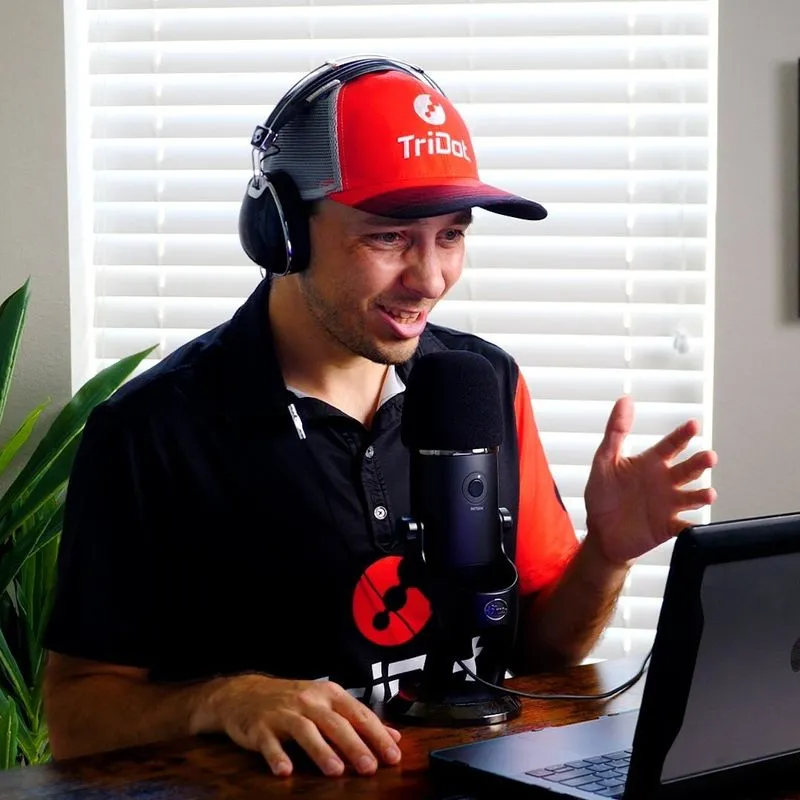

70.3 grueling miles of swimming, biking, and running can feel intimidating, but it’s absolutely within reach. Fresh off his 12th 70.3 finish, Coach Ryan Tibball joins the podcast to share practical, proven tips for tackling your first (or next) middle distance event. Built around the mantra “nothing new on race day,” this episode dives into what you can dial in well ahead of time from choosing the right race and building a strong support system to studying the all-important athlete guide. In a distance where pacing and nutrition can make or break your day, preparation is everything. Learn how to practice your race-day strategy so there are no surprises when it matters most. Consistency is the real secret to success in a 70.3. Start your season with this episode, apply these insights to your training, and set yourself up to cross the finish line ready to celebrate everything you’ve accomplished.
TriDot Podcast Episode 340
8 Tips for Racing Your First 70.3 Triathlon
Andrew Harley: Hey, everyone. Welcome to the TriDot Podcast. Today we are walking through our eight tips for racing your very first 70.3. It's quite a distance. It's quite a distance. I was extremely nervous and anxious the first time I took on the half IRONMAN distance. And so today, we have a coach with us who is going to give us eight huge tips for having a great day out the first time you take on the half IRONMAN distance. Our coach today is Coach Ryan Tibball. He is the founder and lead coach of Ascend Multisport. He has 12 70.3 finishes on his personal racing resume. He's gone longer than that plenty of times. He's gone shorter than that plenty of times. But importantly for today's conversation, he has coached hundreds of athletes to their own middle distance finish lines and has learned plenty that he can offer us, today. Coach Ryan, welcome back to the show.
Ryan Tibball: Hey, thank you. I'm very excited about this. Fresh off a 70.3. It's such a fun distance. I can't say so much more about it, but I will. That's coming.
Andrew Harley: Your most recent 70.3 was the inaugural Little Elm just outside of Dallas, Texas. I was there. I cheered you on. I said, “Go, Ryan,” I think twice, when you went by on the run course. How was your day out there?
Ryan Tibball: It was -- everybody's going to talk about it. Everybody has talked about it. It was windy. Really, really windy, to say the least. You really felt like you were in a air tunnel that was throwing out about 25, 30 mile per hour winds and 45, 50 mile per hour wind gusts. And so it definitely lent to a very challenging day, on the bike in particular. But yet it was, that was mitigated by seeing all my friends. It felt like a North Texas championship race, just because it brought out everyone from Texas, there.
Andrew Harley: Yeah, no, it sure did. And I enjoyed all the TriDot folks I got to see. But anyway, I'm Andrew the Average Triathlete, Voice of the People and Captain of the Middle of the Pack. Today on the show, we'll start off with our warm-up question, settle into our main set, where Coach Ryan will give us his eight big tips for conquering this distance for the first time, and then we’ll shut things down with our cool down, where I will ask Coach Ryan a question from our audience. Lots of good stuff. Let's get to it.
Announcer: This is the TriDot Podcast, the triathlon show that brings you world-class coaching with every conversation. Let's get started with today's warm-up.
Andrew Harley: For our warm-up question today, Ryan, I want to know what was the most recent sports-related skill that you learned, either by teaching yourself, by maybe watching a video on YouTube -- I watch a lot of how-to videos on YouTube. I've learned everything about bike maintenance that way, as many of us have -- or maybe by working with a coach. What was something, whether it was swim, bike, run, or another sport, what was something, recently, that you learned in the world of sports? Go for it, my friend.
Ryan Tibball: This is an easy one. I've had the privilege of being around Bobby McGee quite a bit. Big-time running guru of the world. I mean, just so knowledgeable. And the things that I learned from him were these little tweaks to my run form, and I feel like I'm at that point where I want to work on those fine-tuning items, and taking all those notes from Bobby, it was amazing. A huge shout out to Bobby for that, because now, it just feels like my running has become much more fluid, and honestly stronger, and faster, and more resilient to injury. So I haven't had, thank the Lord, no injuries. So yeah, absolutely. That was the big thing, taking that and then putting it into action, and really being conscious and intentional on all my runs as of the last six months, for sure.
Andrew Harley: We love having Coach Bobby on the RunDot Podcast, in particular. We bring him on as a voice there. He's been on the TriDot Podcast a few times, for sure, but legendary run guru. Ryan, if you can say this as succinctly as possible, because it is our warm-up question and not the purpose of the episode, but I am just curious, as a friend and someone who likes to run, what tangibly did you tweak in your run form from working with Bobby a little bit?
Ryan Tibball: Yeah. What I really worked on was my body in space, basically. And you know what, being conscious of what my arms were doing, to be honest with you, because a lot of times when you see folks who are running, you see their arm just crossing over their bodies, and you know, of course that's a result of a few other things, so it forced me to be more conscious of that and really bring my arms into the better position. And just made running felt so much more smoothly, and I was actually going the right direction when my arm swing was going forward rather than counterbalancing myself in bad ways. So that's kind of one of the big things I've been focusing on.
Andrew Harley: Yeah, no, very, very cool. Cool to hear that. This answer for me, the most recent sports-related skill I’ve learned, I'm playing tennis a little more regularly now, alongside of my triathlon training. I'm not actively swimming a ton right now, Ryan. I'm basically like running, cycling, and tennis-ing. So if there was a triathlon where you could play tennis and then bike and run, that would be like perfect for me, in this season of my life. But anyway, where I live, I don't live super close to a proper tennis facility, tennis center, pro shop. And so I kind of was getting sick of driving 30 minutes each way every time I needed to get my rackets restrung. And so I bought a tennis stringing machine and taught myself, from YouTube, how to string my own rackets. I actually, I'm not a do things with my hands kind of guy. I don't like working on my own bike. I don't like working on my house. I'll do it when I need to, to save money, but I really enjoy stringing a racket. I find it kind of relaxing. It took me about three hours per racket when I first started, and now I'm down to about 30 minutes, each string job that I do. So I'll throw on a podcast and knock out a racket, and that's the latest sports skill I've taught myself. And I imagine, when we throw this out to our audience, there's going to be a lot of triathlon answers here, as there should be. There's so many skills to master, from your run form, to doing things on your bike, to transitioning, flying mount. Maybe it's something from a different sport that an athlete has learned. I'm curious to hear. So find this post on our social media. If you're watching us on YouTube or on Spotify, drop a comment right below, in the comments, letting us know. Brag on yourself a little. What'd you teach yourself? What was a sports-related skill you have learned recently? Can't wait to hear what our audience has to say.
Announcer: Let's go.
Andrew Harley: On to today's main set, where Coach Ryan is going to walk us through eight tips that he has come up with for how to race your first ever 70.3. Coach Ryan, to ease us into this conversation, we said at the top of the show, you just finished your 12th half IRONMAN. And I'm curious to know what was your first half IRONMAN, and how did it go for you?
Ryan Tibball: That goes way back, obviously. That went back to 2009, and it was the Longhorn 70.3 down in Austin, Texas. And obviously, it's no longer around, so if y'all try to look it up, you're not going to find it. But it happened at Decker Lake in Austin, Texas. That was a cooling lake, so it actually was wetsuit-legal, and I remember that very vividly, because this surprised me. At the time of year, you're like, this cannot be wetsuit-legal, but that lake is really, really cool. So obviously, some spring-fed, there. But the bike course was definitely a challenging bike course. I’ve never forgot it. It was a bit -- they needed to fill some holes, let’s just say that. And then the run was actually a little bit of a cross-country-ish course, happened in that Decker Lake Park, and you kind of went off road a little bit and back on the roads. And I can tell you, when I crossed that finish line in 2009, and I hit that, I was, I mean, blasted. I was done. I was spent. And I thought, wait a minute, a full IRONMAN is twice this? Oh, timeout, man. Not happening. Not happening anytime soon. Well, I turned around and registered for a full IRONMAN the next year. So, that thought went way out the door. But it was so exhilarating though, knowing I could push myself and dig that deep for that long. And you know what, I love it. I love the 70.3 distance. That is like my go to, in all honesty.
Andrew Harley: Yeah, this is my favorite distance. Because what I tell people is it's long enough that it feels like a really big challenge. You're out there for a while. It takes proper training. It takes proper preparation, planning, execution, but it's still short enough that I feel like I can race it. I feel like I can push my body wire to wire. I feel like I can be a little more aggressive with the pacing I'm putting out. Whereas when I did my first full, I just felt like I was just trying to complete the thing without bleeding time on the course somewhere. So absolutely my favorite distance, as well. I remember -- it took me longer than a year. So if it took you one year to go from 70.3 to a full, it took me many years before I was finally ready to make that jump. But I remember, Ryan, I was coming in on the bike course, and my first 70.3 was half IRONMAN New Zealand. And in New Zealand, they do the half and the full on the same day, on the same course. And so they just start the full athletes in the water first. They start the half athletes right after. They swim much farther out into the lake before turning around. We swim half the distance out before turning around. They do two loops on the bike course. We did one loop on the bike course. And so I'm coming in towards, like, back towards transition on my bike, and I am almost done with my first ever 56-mile bike ride. And I'm seeing in front of me, on course, there are athletes around me that are turning around at a U-turn to go out and do the whole fricking bike course again. And I just, I remember how ready I was to get off my bike, how ready I was to start running, how I didn't want to be out there, in the saddle, for another second. And I'm watching athletes turn around to go do the whole thing again. And I'm like, I'm never going to do an IRONMAN. That is madness. And sure enough, years later, I finally did an IRONMAN. But I remember that moment very clearly, that you're describing, of that was plenty. That was plenty of race.
Ryan Tibball: That was plenty.
Andrew Harley: Yeah. Now, for me, Ryan, that very first one, 70.3 New Zealand, I just remember, obviously, it was a big trip. We were flying halfway around the world and making a vacation out of it, and there was a lot more to it. But I remember being very intimidated by that experience, being very intimidated by that distance. I, as a triathlete, I knew I wanted to try a half IRONMAN, but I wanted to do a couple years of sprints and olympics before I made that jump up to those longer distances. And I did. I did a few years of just the local tri scene, several sprints, several olympics, dabbling with those distances before I registered for that first half. And I've seen athletes do this both ways. I've seen athletes jump straight in, to a 70.3, and that's their first ever triathlon. I've seen athletes play it how I did, where you get your wheels going in the sport, get a little experience, and then try that longer distance. As a coach, do you recommend one way or the other, or is it just kind of do what calls to you? What do you think?
Ryan Tibball: That is a great question and something I have fielded often with athletes. And I can honestly say, from my experience, really, was that 70.3 was not my first race. In fact, I went many years -- in fact, I started doing triathlons in 2001.
Andrew Harley: Wow, so eight years, yeah.
Ryan Tibball: Yeah, eight years. And I turned into this sprint and olympic junkie, of sorts. And I would do, I felt like, I think it seemed like six to seven events throughout the season, and it just got into that mode of that. And then finally I just, I don't know what sparked me to go ahead and sign up, but I really valued all that experience from doing it, practicing transitions, understanding the feeling of going from one discipline to another, the swim to the bike, to the run. But, again, with that said, I do recommend starting off with a sprint triathlon. Even as a first timer, you know that sprint, so you truly understand the sport on a much smaller scale, but you still get the full experience of the swim, bike, and run. And I think many find that they get hooked on this healthy, crazy sport of triathlons with a sprint. They hit that first sprint finish line, and like, well, this is fun. Let me step it up. And then they keep going for a very long time, much like myself, 25 years into it, now. And now, on the other hand, I have successfully coached many athletes to their very first 70.3 finish line as their very first race. In fact, I had three first timers at Little Elm, and they're pumped, they're jacked, they want to do more, thankfully. So that's great. But again, I think if you do pick a 70.3 for your very first triathlon, you will have tons of questions and would most certainly benefit from some valued information, such as a coach. A coach would definitely be a high-value, great investment. Otherwise, you may get super frustrated at the 70.3, as you get through the training. And be -- honestly, I've seen it a lot this way, and I hate saying it -- but people are under prepared for their first 70.3, their first event they've ever done. And it puts a bad taste in their mouth when they hit that finish line, and they're like, “I'm not doing this anymore.” And they bought that expensive bike, they may have done a lot of other things, and they're like, “Erm.” So I lean towards, hey, go do a sprint. Get that under your belt, and then definitely, beyond that, hey, go for that 70.3. Why not? It's such a sport, it's a lifestyle for me. So I have my own opinions there, obviously.
Andrew Harley: Yeah. And thanks for that feedback. And at the end of the day, I think an athlete should do what they feel called to do. If you just have the itch for a certain race, and you have some friends doing it, and you want to do 70.3 as your first race, you absolutely can. It's going to be more challenging, and there's definitely more that can go wrong the longer you race. But you can do it, and you can enjoy the day and have a good day. You just need to probably temper your expectations. But the wiser route -- I'm not going to say the smarter route or the better route -- but the wiser route is, Ryan, I think exactly what you're saying, like, just dip your toe in that water. Put your body through the motions of swimming, and then biking, and then running, and going through the race motions, setting things up, tearing things down, getting ramped up, getting cooled down. Putting your body through that at a shorter distance before is the wiser move, for sure. Okay, Ryan, enough chit-chat. We're going to get to our eight tips, as we promised our people, and huge shout out to you for putting this list together, really thinking through what does an athlete need to know before they do their first 70.3. Two weeks ago, on the TriDot Podcast, we did this same thing for a sprint triathlon, and Coach Ben Sommerville brought eight tips for the first time sprint triathlete. And in that conversation, Ben and I both, I think we kind of assumed that the athletes this episode is for is probably brand-new to the sport, or semi-new to the sport. Because I don't know who would do -- I don't think many athletes are going long and then circling back to do a sprint, right? So in Ben's tips, he kind of, wisely, geared them towards a newer triathlete, or even a brand-new triathlete. I say that to say, I think in today's tips, there certainly can be a new athlete to the 70.3 distance, but I think we're assuming that athletes have some multi-sport experience, some, maybe even just run event experience. So I do want to throw that disclaimer out. Ryan and I are both gearing the conversation towards someone who has dabbled a little bit, at least. Right, Ryan? So tip number one for racing your very first 70.3 triathlon is to find your support crew, whether that's family, spouse, significant other, very close friends and involve them. Coach Ryan, talk to us about this.
Ryan Tibball: Yeah, well, triathlon, it's just you. It's a solo sport, but it's not. I can't emphasize the value and the importance of, hey, your spouse, your family, your significant other. I'd like to say that pretty much all my athletes, at even Little Elm, had somebody there that I have never met, but you could just tell the excitement from them, and how they proud they were. And I think having those super close family support, whoever it is, on board, because from the get go, they're going to be there. They're going to be there to support you. And you know what? They're also going to be there to tell you, hey, you know what, we got a family event going on next weekend. You can't go long ride tomorrow, all right? It's not going to happen. But at the same time, they're there in the end. And I think, I think it's always a great idea to -- I always look at Monica, and I can't thank her enough, all the time, my wife, that she's there for me. She puts up with me. She's there to support everything I do throughout this long training for a 70.3. And again, I tell you, when you're out there on the course, you're thinking about those people, too. You're thinking about them. And that's, to me, that's just motivation, and it's a sense of gratefulness, too, because you know what, that's why this is probably my number one thing, is like, I can't do this without my wife and my family that's there for me on race day.
Andrew Harley: Yeah. And I love starting with this. I would not have thought of this, to include in this conversation. And as soon as I saw it down, first thing, it was, oh my gosh, Ryan is so right. That's why you're the coach here, and I'm just picking your brain. Because this is the-- to be a triathlete, you need, it's good to have family buy in, close friend buy in, because we're training for three sports. There is some financial purchases that be made to be in the sport of triathlon. And so at all levels, having your family on board with you doing this as a hobby is good. But this is the first race distance where it becomes a big event, it becomes a big deal, it becomes a weekend excursion as opposed to just, hey, I'm going to be gone two hours on a Saturday to do a sprint. I can go down the road, and race a sprint and olympic, and come back, and the family's in the middle of breakfast. And that's all I've missed, is a couple hours of the family morning. I don't have to have the family there supporting me to help me do that event. Now, my wife hates missing a race. Like she tries to be at everything I do, whether it's a sprint or a full. But if she can't go to a sprint, it's no biggie. If she can't be there to help me through a 70.3 weekend, it's a biggie. It helps having somebody there with you, going through the motions, logistically helping you get all your stuff around. Taking on a 70.3 is an event. They're usually multi-day experiences. So yeah, I love that you included this, because before you even sign up -- I can throw a sprint on the calendar and tell Morgan afterwards, “Oh, hey, by the way, on this weekend I'm going to do a sprint. Okay? Cool, thanks.”
Ryan Tibball: That's a ‘ask for forgiveness rather than permission’ kind of event.
Andrew Harley: Yeah, I mean, but you got to really plan and make sure you get that weekend cleared, that week cleared. There's going to be weekends you're training where you're going to be out of pocket a little bit. So. Yep. Great to start with this, a great point for our TriDot athletes to know. If you've done nothing but sprints and olympics, a 70.3 is biting off a bit more of a chunk of an experience, and it's good to have your support crew on board, lined up, ready to go for your race weekend. Tip number two for racing your first 70.3 triathlon is to pick the right race for you. Ryan, hit us.
Ryan Tibball: Yes. As we've said, this is a big race. It is a big deal. And why not choose your first race that is more suited for you, for your success. And when I talk about that, it’s like, well, you don't want to go after this and pick the most challenging course where it might be exposing your weaknesses tremendously. So think about this. Think about the swim, for example. Do you feel comfortable in a river versus a lake, versus an ocean swim? How about the bike? How about hilly bikes versus flat bikes? Maybe you're a flatlander, lived in Florida all your life. It may not be a good idea to pick Nice as your first 70.3. And think about the run, as well, from that perspective. Also, hot versus cold. Yeah. Some races have a tendency to be more on the hotter side of things versus a cooler, more pleasant kind of race experience. And so those are big factors there, that you might want to really look into before you put the money down on that. Something that you can definitely use as a TriDot athlete is you can use RaceX to help determine your predictions, as well. So you can look at this. You put the race into your calendar, and now TriDot's going to give you what your expected finish time is way in advance. Now, of course, as you work out, that finish time should, if you continue hitting your marks, is going to come down, and you get to watch that happen. So you can also just throw it in as a simulation. This is a fun little thing that I do with a lot of my athletes, is put in simulation races, and they'll go, hey, the difference between doing this course versus this course is you're out there an hour and a half longer or shorter. It's amazing what RaceX will do for you in being able to just throw it in as a simulation. It's not going to change any of your programming until you activate it. Another thing about RaceX is it's definitely going to help you and give you some ideal pacing -- your exact pacing, not ideal, rather -- exact pacing. It's going to take into the conditions of that race. So when I say picking the right race for you, it's going to give you your temperature, humidity, and elevation of the course, and it's going to give you real expectations, and it updates as you get closer, and closer, and closer to race day. So that's why I say pick the right race for you. Throw it in your calendar, consult with your loved ones first, and then look and say, all right, this is a good race for me. And you can definitely utilize TriDot and RaceX to help you out with that.
Andrew Harley: Yeah, really good point, Ryan. And I think just to give people probably the things they should think about the most. There's plenty of factors you can consider. When it comes to the swim, it's what is the body of water? Do you care? You might be comfortable swimming in any conditions, but maybe not. And so look at, is it a pretty, calm lake versus something in the ocean with some chop? What is the water temperature? Some athletes are down for whatever. Some athletes want it to be a wetsuit swim, because they want the buoyancy of the wetsuit. Some athletes don't want to have to swim in a wetsuit. They don't have to. That just adds another logistical thing to get there. So maybe you're looking for a warm body of water. So on the swim, it's that, right? What is the water? What is the conditions? What is the temperature? And then I think for the bike and the run, a lot of it is just, what is the temperature outside? How hot or cool is it going to be? And then how hilly is it? Those are the main things to think about, here, when Ryan's saying this. I know for me, the one thing I was the most concerned about when I was stepping up to this distance, from doing local sprints and olympics, was the bike course. I'm down for whatever on the swim. I'm down for whatever on the run. I know I'm a weaker cyclist. I got these little, skinny, chicken runner's legs, and I just can't push the watts that a lot of other guys can. And so I wanted to make sure, when I was stepping up to this distance, that it wasn't too hilly. Since my first one, I've taken on some hillier courses and managed okay. But for my first one, there was a couple of them that I pulled up, because my wife and I, we wanted to build a big vacation around my first half IRONMAN. And so I pulled up a couple courses that, oh, we would love to vacation here. And I'd pull up the bike course, and say, “Ooo, I don't want to climb that much.” And so we ended up in New Zealand, because it was a country that we were interested in vacationing in, and the bike course was pretty friendly. So anyway, that's what Ryan's getting at when you're actually thinking about what are the tangible things I'm looking for in that course. You can run the simulations on RaceX, for sure, and look at your projected times, but those are the environmental factors, when you're looking at a course, to think about. And then for my full, I agonized over where to go for my first full, because same thing, I want it as easy as a bike course as possible, but that's a different story. Tip number three for racing your first 70.3 triathlon is to read the athlete guide before your race. Oh my gosh. Veteran triathletes are so bad at this. But it's such a good point. Tell us about it.
Ryan Tibball: Yeah. One of my favorite race directors, shout out to Nancy Goodnight, who puts on Waco and Little Elm. She's such a huge-- I think she has a shirt that says this, read the athlete guide. You learn so much from this. It doesn't matter whether you're a first timer or a veteran, and especially for first timers, you learn about the rules, the aid stations, how they're set up. And again, I always look at it from the perspective: the more you know, the better off you are. So that athlete guide is going to tell you about the course. It's going to have the layout of the transitions -- or transition, or transitions -- sometimes on these races, they have two.
Andrew Harley: The schedule for the day.
Ryan Tibball: Yeah, the schedule. Exactly.
Andrew Harley: What products are going to be at the aid stations.
Ryan Tibball: Right. So there's so much valuable information in that athlete guide, and I just tell everybody, just read that, because it's going to answer 10 questions that you had about the race itself. And you can look at last year's, in fact. You can look at last year's athlete guide, even though, let's say your race is not until the fall, you can still look at last year's athlete guide, and there will be some minor tweaks that they'll make out for the next coming race. But at the same time, you're going to get the majority of the information, there, as a first timer. So 100%, read the athlete guide, guys. And again, it's such a helpful thing for you.
Andrew Harley: And oftentimes, Ryan, great point about looking into last year's guide, because they're normally published online, especially through the major race producers. At the time you're considering, “What am I racing next year?” -- you're thinking about throwing your first half IRONMAN on the calendar, whether it's an IRONMAN event, or a Clash event, or a Challenge Family event, or an unbranded event. When you're doing that scouting, the latest, greatest, following year athlete guide probably isn't available, but the previous years is. And it's often very close, if not the same. I think, Ryan, as you're talking about the race directors, I bet race directors, six months out from the race, 90% of the questions that they're fielding from athletes and coaches are in the athlete guide, hence Nancy Goodnight's shirt. But it reminds me of college professors that just say, “Read the syllabus.” Because probably 90% of the questions they're getting are covered in the syllabus. And it shows. You're telling on yourself that you didn't actually read the material. But this too, Ryan, when you've done a lot of races, sometimes you start neglecting that, because you feel like you know how to go through the motions of a triathlon. But there's always something unique, there's always something different. There's always next level information on what's going to be at aid stations and where are those aid stations. There's oftentimes, there's certain road conditions that, oh, there's going to be a no passing zone from here to here, and here's how that works. There's always quirks to every event, and it's good to know them before you go in, especially at a 70.3, where the race is that much longer, that much bigger, and has that much more going on. This next one, Ryan, this would have been tip number one for me. This is the first thing I would have said to somebody about stepping up to the next distance. And your tip number four for racing your first 70.3 triathlon is to dial in your nutrition long before race day. Yes, yes, yes, yes, yes. Talk about it.
Ryan Tibball: Yes, absolutely. Practice, practice, practice, guys. Specifically, know how much carbs, how much sodium you need, how much total fluids you will need. And you have all these opportunities well before the event, and utilize that time. You need to be able to have that ready for your gut. Your gut needs to know about this, right? And you can't just start throwing everything at it on race day and going -- yeah, your gut's going to be like, “Hey, timeout. You did not practice this. Yeah, this is coming right back out.”
Andrew Harley: “What is this? This is a foreign substance I've never seen before.”
Ryan Tibball: Yeah, but you do want to give your gut, seriously, give your gut time to progressively adapt throughout your training, all the way up to race day. You will have race rehearsal practices, is what we call them, built into your TriDot program, as well. And it gives you that perfect place to replicate race day scenarios. And let me encourage you. It's like, get that nutritional side thing established. You might have your favorite gels you've been using. Well, stick with them. If you think you need to change, change them. But nonetheless, give yourself time to adapt. I call this a little bit of a pro tip, here. You will go through a lot of nutrition in your training, no question about it. It's its own budget. Just go ahead and start budgeting for it. And your training ramps up, you're going to go through more and more. One thing I always tell my athletes is two months out from race day, take a look at what you have on hand. I said two months out from race day, look at what you have on hand. Set aside your race day nutrition right then and there. Put it in a box, label it, and don't touch it until packing for race day. And now you have, set aside -- now you look and go, “Oh, this is what I've got for the next two months. Yep. I need to place an order.” And you've given yourself time, you've given yourself that insurance time to place another order, and restock, and get yourself set up for your race rehearsals that are incoming and also your other long training session days. So I can't emphasize this enough. Dial it in, get your gut ready, be prepared. If you want to experiment, then do it way early on, so that way you can adapt and change, if you need to, as you continue to train and get up to race day.
Andrew Harley: Yeah, this is -- when you do an olympic distance, when you do a sprint distance, if you're going to be on course longer, you might need to take some fluids, some sodium, a gel. But it's not as crucial as it is at the half iron distance. At the half iron distance and longer, your body does not have enough carbohydrate on board at the start of the race to finish the race. So you've got to take stuff in as you go. I love giving a shout out to our friends at Precision Fuel & Hydration. There's a number of wonderful companies in the space that have quality products, and everybody's gut and taste buds will get along with something different. What I like about Precision Fuel & Hydration is if this is new to you, or overwhelming to you, you can book a free 15-minute call with them, and they will talk to you about -- and you can tell them, “This is the race I'm doing, this is what I am using right now.” And whether it's their product or not, they will talk to you for 15 minutes about what your next event is coming up and, maybe, how you could or should think about fueling it. And that's such a great resource. The people on their team taking those calls are triathletes and runners who go through the motions, know how to do it. But Ryan, what I love here, is you're not just saying, like, have a race plan and nail it. You're saying, have a race plan that you've worked out through training far in advance.
Ryan Tibball: Absolutely.
Andrew Harley: And that's, too, I love telling newer triathletes -- it took me a long time to realize, if I go for a 45-minute run, or an hour long run, I might not need a gel to finish that run feeling okay. But if I take a gel with me and pop it at the 30-minute mark, it's a good chance at practicing, how does my body respond to this product, and my body's going to benefit from the carbohydrate in the back half of the run. So it's, you can try some products out in workouts that aren't crucial, or don't necessarily need that, and that lets you know what jives with your body and what doesn't. And then when you do your race rehearsal workouts -- before a half IRONMAN, TriDot will give you two race rehearsal workouts, and you can practice, how does my body respond to my fueling plan before race day in a race rehearsal? So anyway, lots of great stuff here, Ryan. So crucial for this distance. Absolutely have your plan dialed in, and practice before you get to race day. Tip number five for racing your first 70.3 triathlon is to have the right equipment. We did talk about this at the sprint distance episode, because if you're doing your first sprint, you probably need to buy all the equipment for the first time. But your equipment needs can change when you get to a middle distance and longer. Coach Ryan, talk to us about what we mean, here, for having the right equipment to go 70.3 miles.
Ryan Tibball: Yeah, so I'll start off with a swim. Obviously, the crucial piece of equipment here is goggles, right? And while you might be training with a set of goggles throughout all your training and stuff, you really do want to make sure that, hey, are those goggles still in great shape? Are you experiencing any fogginess in those goggles, as well? And then know how to treat that before maybe race day. There's a lot of products out there that can help you out with that, or maybe you just want to flat out replace them. Nonetheless, if you do replace them, don't make the first swim your race day swim. Do practice with them, once you get those goggles in place. Now, as far as the bike, the bike is going to go through a lot of miles, a lot of time in that saddle, right? And that's preparing for that 70.3. You really want to make sure your tires are good, your tubes are good, your chain is good. Your bike fit -- oh my gosh, can't emphasize that enough, guys. My gosh, if you haven't had a bike fit, and you're going to go ride for 56 miles, you know what, you're going to find out in a very rude way that you probably needed to do that.
Andrew Harley: And Ryan, we can say, too, while we're on this, we can say, too, if you've had a bike fit, but your bike fitter, at the time -- a good bike fitter should ask you, what are you racing? And if you're saying, “Oh, I do all the local sprints and olympics,” they're going to give you a fit that is appropriate for your local sprints and olympics. And when you jump up to longer course, depending on your body, your flexibility, your fitness, you might be able to hold that same position longer, but if your fitter knows you're going to go longer, they're probably going to adjust your fit a little bit to give you a little bit more of a comfortable position, knowing you have to hold it much, hours longer. So great thing to bring up here, while we're talking about gear.
Ryan Tibball: Yeah. And again, you don't need the Lamborghini of bikes, guys, but you do definitely want a bike that is going to sustain this training, and then obviously, the 56 miles on race day. And so I do suggest something with gears and something that is reliable. And that goes for, hey, go get a tune up and say, you know what, the guys at the shop say, “This bike is not going to make it,” then you might be an investment time, right there, for that bike situation. Moving to the run, you're going to put a lot of miles on your shoes. And if you have that luxury of being able to separate out race day shoes versus training shoes, then do that, for sure, and give yourself that chance on race day to have your nice, fresher running shoes. Because you're not just going to practice with those on race day, or run with those on race day, but you're going to practice with those prior to race day, just to make sure your feet are adapted to it. But when I talk about shoes, guys, you're going to go through a lot of miles, and keep track of those miles. Because at some point, and depending upon the shoemaker and the type of shoe you're using, they might only last 200, 300, 400 miles. And if you're not keeping track of this, suddenly these little twingy injuries might come up. So this goes down to have the right equipment, replace the equipment when it needs to be replaced, and again, don't be afraid to do that, because again, you want to stay fresh, you want to stay healthy for race day.
Andrew Harley: Yeah, just to go quickly through swim, bike and run. I mean, you covered that so well, Ryan. For me, this is, I'm a new goggle on race day fan. Local sprint and olympic, maybe not. I'll just rock the pair I've been rocking in training. But when it comes to that longer distance, just like you said, I want to make sure it's a fresh pair with a fresh band, good clarity on the lenses still. I do always make sure I swim with that pair once or twice in the pool, just to make sure I've dialed in the fit, where it's not going to leak. But past there, all of the anti-fog stuff, properties, the clarity of the lenses, like, everything is as pristine as possible going into that race day. For me, at a half IRONMAN, I'm in the water for 38 to 42 minutes, and so I want to make sure I can see well for those 30 to 42 minutes. On the bike, Ryan, something that you didn't touch on, because you're, I'm sure, trying to be brief. We could talk for four hours, and we're trying to keep it to one hour. But when I went to this distance, that's when I started thinking about a power meter for the very first time. That's when I started considering how aero is some of my equipment. So, if you're still fairly new to the sport doing your first 70.3, probably don't worry about all that kind of stuff. But if you've been in the sport for a couple years, like, Ryan, you and I had, and you're jumping up to 70.3, it's kind of a good excuse to think about getting a more aero helmet, a more aero bottle holder, more aero nutrition holders. Because when you go to these longer races, each of those gizmos and gadgets promises to save you 4 watts, 5 watts, 2 watts, 7 watts, and you add a couple of those watts up, and suddenly, you're off the bike course 6 minutes faster than you would have been otherwise. This is the distance where those aero gains really start to show. If you do have some money in the bank to spend a little bit on triathlon, this is a good time and reason to start considering upgrades. Again, I got my first power meter for my first 70.3, to have that watt number there for the very first time. Do that, buy that. The mistake I made, Ryan, is I bought my power meter right before my trip, so I hadn't trained with my power meter. So I get to New Zealand, and on my Garmin, I've got this power number. I didn't know what to do with it, so it wasn't helpful at the time. Get that power meter during your training so you know what that number actually means. But anyway, I'm going long, here. But yep, love the tips here, on thinking about some of these gear decisions for the very first time, at the longer distance. When it comes to the running, I went sockless my entire triathlon career at the sprint and olympic distance. Never put on socks, never had any problems with blisters. This was the first distance where I put on socks for the run, just to make sure. Just to make sure. And I didn't put socks on for the bike, but I had made sure in training that I was fine. No blisters, no hotspots, no nothing without socks on the bike for that long. Anyway, moving on to tip number six for racing your first 70.3 triathlon. Consistency is everything. Ryan, what do you mean, here?
Ryan Tibball: Yes. Oh my gosh, guys, you're getting ready for a big event. And when I talk about consistency, it’s, first off, be patient with yourself, number one. But let me break down and talk about the swim, the bike, and the run, and those disciplines. And when I say consistency, talking about the swim, guys, you got to get in the water and keep it consistent. And that means, hey, go to do open water practice. Go find those groups out there that might have some open water practice together so it's safer. But again, you want to be able to practice that, because every 70.3 is definitely going to be an open water of some sort. And so if you're consistently doing something, you become more familiar with it, and therefore, on race day, you're much more comfortable with that, in the open water situations. And one thing, I have to say this, I'm going to plug it here, is TriDot Pool School. As a witness of myself to those that have attended, the amount of confidence that these athletes are coming out of the water with once completion is amazing. They are not only physically getting better in the water, but they're also mentally more confident now, because they're ready to put this into action in the open water, as well. So yes, I'm plugging that Pool School. Definitely go for that, if you guys have it in your budget. And this will help you if you struggle with the swim. Now, the bike -- bike handling. You do want to spend some time going outside. I do love my smart trainer, guys, and many who know me know that. You see me on Zwift quite a bit. I love my indoor trainer, but there is time that you need to make and put it out there and go outside, safely ride outside, and work on your bike handling skills. Work on the terrain changes, the gear changing that should happen. It's really rare that you're going to find a super flat course. Even if it is, you're going to have some wind. I always call that the invisible hill, and you better change gears in those situations. But that goes back to bike handling and having that experience outside. Pick one workout a week that you choose to do that. That way you can have that opportunity and be consistent in working those situations and understanding it. Again, familiarity is everything. And then the run, don't avoid running challenging terrain, either, in training and those conditions. So when I say that, again, as we're warming up right now, things are getting hotter throughout the year. You got to be smart. You got to be smart with the temperatures and the humidity changes that are happening. But don't avoid those situations, as long as you're fueling right, and doing the right things, and consistently getting out there, and adapting to those changing conditions, the terrain, and understand -- your legs get that understanding. So don't get stuck on that treadmill, guys. Get out on the open road, and get that done out there. So that comes back to consistency. So you're going to have -- and I will tell you this about that consistency thing. You're going to have great weeks of training. You're going to have bad weeks of training. You're going to have great days, and you're going to have bad days. But in the end, that is still consistent. And give yourself grace at all times, guys. It's not going to be perfect. And never expect perfection, ever. I also like to think about what is really fueling my passion. In other words, my ‘why’. When you establish your ‘why’, write it down, post it on your mirror, your fridge. This will feed your consistency. You want to feed that. In training, no matter how bad you are feeling, you will always remind yourself of your ‘why’. So be consistent, guys.
Andrew Harley: Yeah. What I like here, Ryan, a lot, there's a number of podcast episodes where the message from our coaches is be consistent in your training. Consistency over perfection. Not every day can be perfect, not every session can be perfect. Not every interval is going to be perfect. Not every time you go out can feel perfect. But it's just consistency over time leads to good performances. And you're championing that here, in terms of getting ready for our first 70.3. But the added layer, that I liked what you're saying, is to also be consistent in those triathlon skills and making sure you're practicing them, making sure you're deploying them, making sure you're using them. I think a habit of mine is, when I do have a bigger A-race coming up, whether it's a half or a full, I'll wait until that last month, and then all of a sudden, I'm getting outside on the bike a little bit. I'm getting in open water a little bit. I'm getting on run terrain that, maybe, matches the race course a little bit. And I'm not doing that 2 months out, 3 months out, 4 months out, 5 months out. I usually do that the month of, 3 weeks before, 2 weeks before, depending. But I'm not historically very consistent in that. And sometimes it goes fine on race day, and sometimes I'm out on the race course saying, “Man, I'd be holding aero a little better right now if I'd gotten outside a few more times.” And so I love, Ryan, that added layer of, for any of our experienced triathletes listening, be consistent in keeping those skills freshened up. If you haven't ridden outside in a couple months and you go right outside, you're going to tap into some muscle groups you haven't tapped into on the trainer, that's for sure. But especially for our folks that are brand-new to this distance, it's all the more important to put yourself in those more race-like training sessions months, and months, and months out, instead of just two weeks before, one week before, three weeks before, like Andrew Harley usually does. So really love that message here, Ryan, especially for our first time 70.3 athletes. Tip number seven for racing your very first 70.3 is to focus on recovery. Man oh man, that matters no matter what you're training for, but it especially matters when you're going farther. Talk to us about this one.
Ryan Tibball: Yeah, guys, doing the right training, the consistent training, for 70.3 is no joke, but neither should your recovery. You need to be just as intentional about your recovery as you are about your actual training. So when I say this, I'm talking about doing your mobility, doing your timely stretching. When I say timely stretching, I'm talking about dynamic mobility prior to your bikes, prior to your runs, prior to your swims, and doing it afterwards, as well. So giving yourself that window, hey, give yourself that extra 10 minutes before, 10 minutes after every session. And also, when I talk about recovery, I'm not just talking about the stretching and mobility. I'm talking about eating, as well. Eating in a timely manner after.
Andrew Harley: Let's talk about eating.
Ryan Tibball: Oh my gosh, guys, you got to -- I call it fueling the machine. You are the machine. And again, your machine just did a lot of work. And if you delay putting in food, putting in the good recovery items back in your body right after a workout, you're delaying your recovery. And in turn, that next day, or next couple of days, might feel really bad. And so you want to allow yourself to be intentional about recovery. Sleeping, that's probably the best place that your body's going to absorb and adapt all that hard work you've been putting in in preparation for this big 70.3. And it's definitely nothing -- you should never overlook that, guys. So look at your sleep schedules. Work that out and then include recovery as part of your training.
Andrew Harley: It's so annoying, Ryan, how much recovering properly helps triathlon performance. It's so annoying. Because this is the stuff that is not as fun to do. It's not as glamorous to post on social media. We want to post, “Look at this 2-hour run I just went for.” We don't want to post, “Look at these 30 minutes I laid on my floor, looking awkward and feeling awkward, doing awkward things and holding awkward positions.” But it is so annoying to me how much it actually makes a massive difference. The seasons in my triathlon journey where I was on top of this stuff have been all of my biggest performance gains, all of my best performances, all of my best assessment times and critical powers. It's the best I've felt. And when I start neglecting these items -- all the items you're talking about: sleep, dynamic mobility, stability work, strength work, recovering properly in my nutrition intake. When I'm on top of these things, I feel so much better day in and day out. And it annoys me, because I'm not good at staying on top of these things, and that's a me problem. And a lot of folks listening can probably relate. But yes, when you step up to the 70.3 distance, this is just that much more critical. You're putting different training stresses on your body. You're going longer in certain workouts, especially the run ones and the bike ones, and it makes a big difference to really fuel it properly, recover properly, have your body ready to go, each and every single day. So well done, Ryan, for bringing this one up and rubbing my face in the fact that I'm probably not on top of this right now, as much as I should be, because I'm normally not. I'm normally not. But it's, yeah, it's so important. I mean, it's exercise physiology, right? In exercise physiology, when we think about what's happening when you're working out, when you're training, all you're doing is breaking your body down. That's not where we improve. We improve when our body recovers and our muscles rebuild after being broken down. And so making sure your body is primed in that recovery phase is actually where your gains are happening. And that's annoying, to go back to my theme of my rant, here. Tip number eight, Ryan, for racing your first 70.3 triathlon is to get a coach. Coach Ryan, talk about it.
Ryan Tibball: Absolutely, guys. I couldn't leave this one off the table. I see, in various social media groups, that I hang out in the background looking at a lot of posts, and quite frequently, these athletes are asking questions, and that's great. I'm glad they are. I want them to. But unfortunately, a lot of times they're being answered by people who don't know, and they are given the wrong answers. And all it does is actually create additional confusions to those new into the sport, getting ready for this big distance 70.3. That's why, guys, get yourself a coach. Having a coach for that big investment of a 70.3 is absolutely a great investment in yourself and your sanity. I can tell you that. A coach will add the accountability, deliver the intangibles, like recovery techniques, mobility, and stretching. I do this with all my athletes. It's like, this is the mobility work. I give them that stuff. I give them all that stretching work. I give them the injury prevention tools. I give them the strength tools, as well. And I give them that regimen, so that they know how to follow it. And then, we also work on their fueling strategy, not just for training, but for the day to day and race day, as well. So I highly recommend, and last, again, like I said, race day strategy and support. Your coach is there. Your coach is -- I've heard many times from my athletes, “Coach, I heard you in my ear. I know you weren't with me here, but I just heard your voice.” And so it adds that accountability, there, and support. And lastly, guys, I have to add this one in here. It's not necessarily about getting a coach, but enjoy your finish line. Figure out your champion pose, practice it at home in the mirror, with your loved one, whatever it is. Do it on race day. You earned it.
[Transition Sound Effect]
Andrew Harley: On to today's cool down question. I always love getting to ask our coaches a question directly from the audience. And today's question comes from Dennis, and he's asking a TriDot related question. He wants to know, Ryan, “Is it possible to add an easy or a recovery week manually? The thing is, I feel like I'm overreaching, and my body desperately needs a lighter training load this week. How do I handle that in TriDot?”
Ryan Tibball: Wow. Great question, Dennis. You, as an athlete, you can't add workouts manually, such as an easy week. But let me give you this, you can certainly take a week easy. Absolutely. Listen to your body, buddy. That's what I would say. Listen to your body. And if you need that rest and recovery without intensity, absolutely take it. I, honestly, I do it. There's been times where, you know what, my body said, “Hey, Ryan, you just take care of yourself after those last few hard workouts. This one ain't happening for you today or tomorrow.” I would, honestly, I would still move. I always believe in a body in motion, stays in motion. And so if you need that, Dennis, do it. And let me add to this. This is also maybe a good time to take a look at what you are doing as far as nutrition before, during, and after workouts, because this can most certainly play a role in how you feel. I know we talked about fueling and recovery. But looking at how did you fuel for the day? How did you fuel for that workout? How did you fuel for your post workout? And look at your sleep patterns, too. Are you getting enough sleep to allow your body to heal, to adapt, to absorb your training? Sleep is super critical in your recovery effort, Dennis, and for everyone else out there that's listening. If it's time for your body to take it easy for whatever reason, take it easy. It's absolutely okay. But stay in motion, do that mobility, do the recovery efforts, and keep pushing on.
Andrew Harley: Yeah, great reminder, Ryan. And for people that may not know this, that are using the TriDot platform to train, the way the tech is working for you in the background to design your training, it's allocating your training stress in a way that you don't technically need a day off or a week off. And a lot of athletes come to TriDot from other forms of training, or from even just training themselves, and they're surprised after a few weeks when they haven't seen a day off. And they're like, “Hey, wait a second, where's my rest day? I'm used to my old coach giving me a rest day.” If training stress is allocated properly, you don't actually need a full-on rest day. That said, TriDot knows a ton about you, but there are certain things that it can't know. Like for me, it knows in my genetics that I'm an easily injured athlete, but I can't quantify for TriDot how does my left knee feel today after absorbing the training it's absorbed the last few months. It knows what my training stress has been the last few weeks, but it doesn't know what my life -- it can't quantify how stressful has my life been chasing my three-year-old around the house the last couple weeks. And so there's going to be times where there's just an absence of data that TriDot does not have about how Andrew Harley is feeling. Where I might feel like, man, I need 2, 3, 7 days off, to just take a step back. And sometimes it's a mental load, right? The mental -- especially when I'm in the development phase, and you're just hitting those hard workouts all the time, sometimes mentally, I need a couple days training, where my body's fine. And so I love what Coach Ryan is saying, here. If you feel like you need the time off, take that time off. You don't even have to delete the workouts in TriDot. The fact that no data is coming in on those workout days, TriDot sees that, and says, “Okay, he has no training stress this week. He hasn't done workouts in X number of days,” and it's going to adjust what your next upcoming workouts are accordingly. So you won't actually see a day off, a week off, because you don't need it, scientifically. The data shows us that. But if you feel the need for it, absolutely take it, for all the reasons Ryan said, and some of the reasons that I said.
Ryan Tibball: Absolutely.
Announcer: Thanks for listening to the TriDot Podcast. Help us out by leaving a rating and review on your listening platform of choice. For more opportunities to learn from our coaches, check out our YouTube channel and follow @TriDotTraining on social. Ready to train with us? Head to tridot.com and get started for free. Until next time. Happy training.