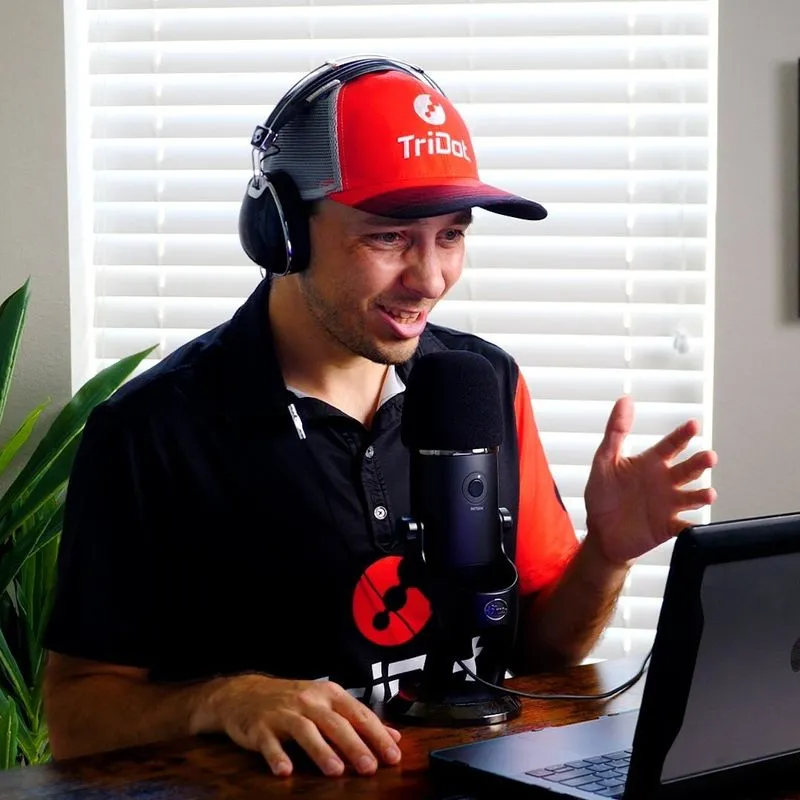

This week, we’re diving deep into protein intake! Discussing how much you really need, which sources are best, and how to get it right for your training goals. Andrew is joined by Advanced Sports Dietitian Taryn Richardson to unpack the science behind protein and its crucial role in athletic performance. Together, they explore how to adjust protein intake for different workouts, the pros and cons of various protein types, and how to seamlessly add more protein to your daily meals and snacks. Taryn also shares her insights on common protein myths, unnecessary supplements, and the biggest mistakes athletes make. Every athlete’s needs are unique, but this episode will give you the tools to fine-tune your nutrition for peak performance.
A Triathlete’s Guide to Protein
Andrew Harley: Welcome to the TriDot Podcast. Today we are talking all about protein. How can we determine the amount of protein we need as an athlete? What should we look for in our protein sources? And so much more, with our subject matter expert, Advanced Sports Dietitian Taryn Richardson. She's the founder of the Triathlon Nutrition Academy where she helps empower age group triathletes to eat smarter, train stronger, and smash new personal bests. I'm Andrew the Average Triathlete, Voice of the People and Captain of the Middle of the Pack. We treat the show like any good workout. We'll start with our warm-up question, settle into our main set conversation about protein, and then wind things down by having Taryn answer an audience question on the cool down. Lots of good stuff. Let's get to it.
Announcer: This is the TriDot Podcast, the triathlon show that brings you world class coaching with every conversation. Let's get started with today's warm-up.
Andrew Harley: Alright, Taryn, very excited to have you back on the show. I always have a good time talking with you. We can just go on, and on, and on about food, and snacks, and nutrition, and triathlon, and to get us rolling today, this might be a scary question to ask in front of a dietitian, but I'm going to give it a go. I want to know, Taryn, me and you will share our stories, we'll hear what our audience has to say, what is the closest, Taryn, you have ever come to bonking? Whether it was in a race, or in a training session, or a workout, talk about it. Have you ever come close to bonking?
Taryn Richardson: Hey Andrew, thank you so much for having me back on the podcast. It's been a hot minute, but I'm really looking forward to talking all things protein today. I have been doing triathlon for a long time; I was a triathlete before I was a sports dietitian. I've done all the stupid things that you've probably done as well, like under fueling significantly--
Andrew Harley: I was counting on that, with this question.
Taryn Richardson: Not doing recovery very well, just doing a terrible job, because I didn't know anything, and I was a dietitian at that point. So I ate well, and I understood that kind of stuff, but I had no idea how to eat like a triathlete. And so I used to go and do 100-kilometer rides with a bottle of sports drink and a couple of gels. So yeah, I've never bonked, bonked, but geez, I've got pretty close on some of those rides, trying to chase the boys, and then you've got to pull over to the gas station, get a coke to get yourself home or suck a wheel the whole way back, as well. So it's not a good feeling. And honestly, I wish I knew what I knew now about nutrition to go back and do those triathlon years again.
Andrew Harley: Yeah. If you can believe it, Taryn, I have a high school friend of mine that, in the last couple years, tried his first 70.3 half IRONMAN, and as a non-- he was a runner, but as a non-- he didn't do a bunch of races, didn't do marathons, didn't do anything long before, just, “Hey, I want to try a Half IRONMAN.” And he didn't realize that he needed to fuel for this.
Taryn Richardson: Oh my God.
Andrew Harley: And so literally, the only thing he did, he came across the finish line, I wasn't there, but he was talking about it later, he basically collapsed across the finish line and was like, why did this destroy me so bad? All he did, Taryn, was have water and Gatorade at the aid station the entire way through the Half IRONMAN. And now he knows better, because we've talked about it. But anyway, the closest I've come to bonking is I used to do a group ride with a bicycle shop in my area. And they have two group rides. One starts at 6am on Saturday, the next one starts at 7:30am on Saturday. And they do the same loop for both kind of 90-minute windows. And so if you want about 50 miles, you can show up to the 6am and stay for the 7:30am. Both rides start and end at the shop. If you just want about 25 miles, you can just show up to one or the other. And there was one particular day that I was only planning on doing one loop, the 25-mile first ride. So I showed up at 6, we do the ride, I'm having a good time, I'm feeling good, it's nice weather, and some of my buddies are like, “Hey, let's just stick around and do the second group ride.” And so we stayed on, and we go a little bit longer, just refilled our water bottles at the store. And so it was just a day that I went longer than I intended. I didn't bring enough nutrition for that big of an effort. And we were probably in the last three or four miles, heading back to the bike shop to call it a day. And I just felt-- it wasn't-- you see videos of people having a true bonk, and their body just stops cooperating and fall over. It wasn't like that, but I could just-- I'm on the back of the group, and I'm giving it all the power I feel I have left on my legs, and I'm watching everybody just kind of ride off into the distance. And I know I've got three or four miles back, left to the shop, there's a decent uphill, and I'm just like, “You know what? I'm done.” I don't want to-- could I make it? Probably. Do I want to try? No. I'm not that far from the house. I just pulled over the parking lot. I texted my wife. I was like, “Please come get me. I'm tired.” She came and got me. Yeah, she sagged. Yeah, she sagged for me, impromptu. But that's the closest I've come to bonking. Just took on, literally, double the miles than I was planning on for the day and didn't have the nutrition, and the fueling, and the salt, and all that good stuff to back it up. So that's this answer for me.
Taryn Richardson: As long as you learned something from that.
Andrew Harley: Sure did. Sure did. And honestly, now--
Taryn Richardson: Be prepared.
Andrew Harley: --when I head out on a day like that, you just take extra, right? You take extra. You take more than you think you need, especially just for a training ride, group ride with friends. We're going to throw this question out to our audience on social media. I'm curious to hear your stories. Was it race day, and you just didn't know what you were doing? Was it a training session where you just kind of got in over your head? Let us know in the comments, if you're watching us on YouTube, if you're watching us on Spotify, you can comment right below on Spotify and YouTube. I always check these videos out throughout the week to see what you guys are saying. We're going to post this question on the TriDot social media accounts, because we want to hear from you, what is the closest you've ever come to bonking? Can't wait to hear your stories. I'm going to send them all to Taryn, and she’s going to judge you.
Taryn Richardson: Yeah, awesome. I look forward to rating those.
Announcer: Let’s go.
Andrew Harley: Alright, on to our main set, where Taryn is just going to answer every question I could think of on what does a triathlete need to know about protein? We've had some episodes in the past talking about balancing the different macronutrients, we've had some different fueling conversations. But today, I just wanted her to unpack this one macronutrient and see what we could learn. But Taryn, before we get into that, I just got to ask about the Triathlon Nutrition Academy. It's one of my favorite things in triathlon. It's got the best name of any brand in triathlon, in my opinion. And most importantly--
Taryn Richardson: Thank you.
Andrew Harley: Literally, since we first started bringing you onto our podcast, I know we've had a lot of TriDot athletes go through the program, and everybody that does absolutely raves about it. I think they become bigger Triathlon Nutrition Academy fans than they are TriDot fans, even. They're just rabid fans of what you do, and for good reason. But even recently, I saw on social media you had a really cool ambassador camp for some of your ambassadors, in Brisbane, Australia. Here's these pictures of your ambassador crew, and I think half of them were TriDot-ers from the United States of America. I just thought that was so cool to see our people kind of connecting with you and learning from you. So what's going on with the Triathlon Nutrition Academy? For anybody listening today that isn't familiar with what you do? Catch us up to speed.
Taryn Richardson: There's so much going on at the moment. I feel like we've got this massive momentum going, and we just had our annual event. Every year we do a race somewhere around the world, and we did that at Sunshine Coast 70.3 this year, in Mooloolaba, Australia. And we had 22 athletes come and race from all across the world. And you're right, a lot of the North Americans were there. There was a bunch of TriDot athletes, and we do have a bunch of TriDot athletes that come through the program, and even a bunch of TriDot coaches, too. But it is a nine-month education program that I help my athletes turn nutrition into their secret weapon. It's really personalized to your training, your goals, and your race calendar. And what sets it apart is that I'm going to teach you everything that I know. I've done more than six years of university-level study to understand sports nutrition, and I only work with triathletes, but once you're inside, there's no gatekeeping. Everything that I know and have learned over that time period of two decades working with triathletes, I'm going to impart on you, so that you can understand the ‘why’ behind why we do things with our nutrition, rather than just being dictated, “Here's a plan, see you later.” You're going to understand how to actually manipulate it, and evolve it, and tweak it over time, which I find is so much more valuable for triathlon, when people want to do it for a long period of time. People want to do it in the 80s. How cool was that lady that just crossed the finish line at Kona in her 80s? A lot of people have those goals and aspirations. So if you can understand nutrition for triathlon, because it's quite complicated, then that's going to give you much better longevity in the sport, as well as set your health up for the long term, too. So it's very exciting, and I think it's a good combination with TriDot, because you guys have all the training sorted, and people invest in that training side of things. I help athletes layer in the nutrition to support all of that training, so that you can get all those beautiful adaptations that we get from the training program.
Andrew Harley: Yep. Doing the training is just part of it, a big part of it, but there's so much more to it. And at TriDot, we love what you do, and we love, most importantly, that when we have athletes come your way, they have a great experience, and that gives us the confidence to bring you on our show. And we love the wisdom you share here. And you can listen to Taryn on the Triathlon Nutrition Academy Podcast. Check that out. You one up me, Taryn. You've got your logo on your microphone, logos on the microphone. I am logo-less on my microphone. I should change that, I guess.
Taryn Richardson: I thought you were going to say that I upped you in the ranking of the podcast, because that's not something I really check regularly, but I know that you do.
Andrew Harley: So there's not a way-- and this is, we're taking a tangent, maybe one that's interesting to our listeners -- in the podcasting world, you can't notate yourself as a triathlon podcast. When you're telling Apple, and when you're telling all these distributors, “Oh, I'm a health podcast, I'm a fitness podcast.” If you're saying that you're a sports podcast, you can check running, you can check swimming, you can check cricket, you can check basketball. They don't have triathlon on there. And so all the triathlon shows, you got to pick something. And so some of us have checked running. Some of us have just -- the TriDot Podcast is just under health and fitness, to be honest, which is a pretty competitive category. There's a couple of them that have themselves in the wilderness category, for whatever reason. Maybe it's easier to rank, but anyway, there's not really a way to know where we all rank alongside of each other, but all I know is that when I go on Apple or Spotify and type in triathlon, our show is there, your show is there, and that's what I love to see. So anyway, getting into our stuff about protein today, let's just start at the top. Obviously, we all hear protein, we know it's a macronutrient, but past that, what actually is protein? What are we putting in our bodies? What is this nutrient?
Taryn Richardson: Good question. So protein is one of our four macronutrients. We've got carbohydrate, fat, protein, and alcohol. Alcohol is a macronutrient. Not saying that you should be consuming it every day. Yeah because it's not a micro, it's actually a macronutrient.
Andrew Harley: I would have told you, I would have told anybody, going into this conversation that there's three macronutrients. So my mind is slightly blown already. Anyway, please continue.
Taryn Richardson: There you go, there’s four. But we can ignore the fourth one. Yeah, we can ignore the fourth one, because it's not that great for us. But it technically is, yes. And so all protein foods are broken down into single blocks called amino acids. And you can think of those as a Lego block. When you're building a big structure, it's those individual little, tiny blocks that make up the whole thing. And they have lots of functions and roles in the body. But there are 20 common amino acids, and there are nine that are essential to us, which means that our body can't make them, so we need to get them from our food. We get protein from animal foods, as well as a bunch of plant-based foods. But when we're talking about quality, then we need to make sure we're getting that full range of essential amino acids from our diet, because we can't make them. So unlike carbohydrate and fat though, the other macronutrients, you can't actually store protein anywhere in our body. And you need to make sure you get enough each day, because of that reason. Do you want me to keep going into what it does?
Andrew Harley: I'll ask a follow up question first, just to make sure I understand. Because part of, I mean, just in full honesty, part of why I wanted this conversation is when I am in the grocery store, or a sports store, or I'm online looking at this protein powder versus that. There's so many different words that are on the packaging, and we'll get into a little bit of what some of the additives, and different terms, and different types of protein are later on. But when we see amino acids, you'll see BCAAs, branch chain amino acids, listed on packaging. That just is shorthand for a type of protein? Amino acid is just the building blocks of protein?
Taryn Richardson: Yes. The amino acid is those single unit blocks that make up a protein. So they've got different structures, but think of them as Lego blocks. I think that's a really good analogy to understand what an amino acid is. It's those single little Lego pieces that go to make a helicopter.
Andrew Harley: Okay, so we eat protein to get all these variety of amino acids that our body needs. What does that then do for our body?
Taryn Richardson: So protein has lots of roles and functions in the body. I think most people will identify and know that it has a role in muscle protein synthesis and repair. But they really are the building blocks of life, and have all these vital roles that, if we don't get enough, our body's not going to work properly. So things like acting as enzymes and hormones is a big one to help regulate a whole heap of our body's processes. They're going to help support your immune system, as well, by doing things like forming antibodies, which is really important when we do triathlon, and we swim, bike, run, and have quite a big stress load, just from exercise itself. They're also important for transporting nutrients, like oxygen around the body, on hemoglobin, that's a protein. And as well as they provide lots of structural support and can be used for energy. The body doesn't like to do it. But if you under eat chronically, then the body will start breaking down your muscle, the protein, as an energy source, which can happen if you don't have enough protein in your diet, or you go and do a big 6-hour ride and then don't have any protein afterwards, for instance, or you do a terrible job of your recovery nutrition. I've had to take some muscle mass off a couple of athletes in my career, and it's just not pretty when you've got to do that. You kind of under-fuel, under-starve somebody to do that, to strip away muscle. And protein, as a food source, is going to help you feel more satiated from food, and help to regulate your appetite, too. So if you're just chewing back straight carbohydrate, you'll feel quite hungry regularly, particularly if you do a lot of exercise. So protein can help us feel fuller for longer. That is just a couple of the functions. There is lots more than that.
Andrew Harley: Yeah. And probably plenty for our understanding today. And I'm sure—
Taryn Richardson: That’ll do.
Andrew Harley: Yeah, somebody who takes your 9-month course, they're signing up to learn a lot more and for good reason. But definitely helpful for this conversation today, to kind of set the stage of what we're talking about. I think, I hope, most of our audience already has an understanding that all of our needs, when it comes to how much we eat, how much protein, fat, and carbohydrate, we all have different needs, right, based on our biology, based on our activity levels. I don't need the same amount of protein as somebody who's probably twice my size and weight, for example. And so how can an athlete that's listening today determine for themselves, meal to meal, snack to snack, day to day, how much protein they need to be taking in?
Taryn Richardson: Yeah, you're right. It is a really unique thing to you and your body, and all of your nutrition is unique to you. So it's really hard to give specific guidance in a general way, but a good initial number, and this is quite a wide range is 1.2, to even 2.2, grams per kilogram of body weight a day of protein. Now, I did the conversion for you, because I work in the metric system, and I have to apologize, but the science is also in the metric system, which equals about 0.5 to 1 gram of protein per pound of body weight, if you work in your imperial system. And your needs are very unique and they will increase as you get older, as you become more of a master's athlete. We get a bit of protein resistance as we age, so it means that you don't extract as much protein out of your food as you did when you were younger, which is pretty cool. As well as we're just fighting this age-related sarcopenia, or muscle mass decrease, or it's really hard to maintain what you've got. So more protein can help through that. As well as our vegetarian and vegan athletes, they might need a little bit more, because they're relying more heavily on our plant-based protein sources, and they are, generally, incomplete. So they don't contain that full complement of amino acids that our animal-based proteins do. The other groups that we might need to think about is thinking about what your medical, and previous medical history, is though. So that is a wide range. Because somebody with kidney or liver issues, you have a very unique amount of protein that you need for you. We don't want to put too much pressure on our kidneys, but also, depending on what type of kidney issue, sometimes they need even more protein. So it's really hard to be really specific, and be like, “Hey, everyone have this amount of protein a day.” It is based on your body size, because you have a unique amount of muscle compared to somebody sitting next to you. And the other main group that will kind of change our protein needs across a week, or a season, might be the type of training that you're doing. So obviously, everyone listening is doing endurance-based training, we're triathletes, and if you're doing strength training, which I hope you are, then you're going to need some protein to support that. If you suddenly change your training and do a heap of heavy strength training, then that will increase your protein needs. Or if you have an offseason, because does anyone have an offseason? Probably not.
Andrew Harley: Yeah, take a break.
Taryn Richardson: Yeah. Maybe, maybe not. Nobody has a break. But if you go from not doing a lot of training to suddenly doing a lot of training, that might change your protein needs. So it's not a set and forget number, it’s something you want to check in with a professional to understand what your unique needs are. And then that's not a set and forget number either. It might kind of evolve over time, depending on what age group you're in, or what's happening with your medical history, and things like that.
Andrew Harley: Already super helpful. And so just to do the math with my body weight, I am 150lbs at the time we're recording this podcast episode. So just based on those guidelines—
Taryn Richardson: Pre-Christmas.
Andrew Harley: It's not quite the holidays, yet. We'll see when we get there. When I'm training and racing regularly, I'm usually 138, 140. So considering I'm a dad, who is holding on to my fitness as well as I can, I'm doing okay at 150, I think. But anyway, so at 150 pounds, my body, just on a general day, probably needs, going by the 0.4 to 1 gram, 75 to 150 grams of protein over the course of a day. Is that correct?
Taryn Richardson: Yeah. But I would talk to you and understand what your training is, what your goals are, get your medical history, understand what we're trying to achieve, and give you a specific number to meet each day.
Andrew Harley: Yeah. And so then if somebody-- that's a great starting point, and you got to consider a lot of other things about yourself and your activities. So if we know that ballpark, and we're looking at each day we have coming up, we're looking at our training calendar, we're looking at how busy we are, what we're going to be doing in each day, how can we figure out how to spread those grams out through the course of a day? Do we need there to be a certain amount in each meal? Is it okay to just kind of have a big protein-y meal and some lesser protein-y meals? How do we apply that ballpark number to what's going on in our 24 hours?
Taryn Richardson: Yeah, great question. So previously, we thought that you needed to spread it out very evenly across the day. And I still think you should do that, because they thought that we had a threshold of muscle protein synthesis rates. Because when we eat protein, it is, one, the building blocks of muscle protein synthesis, and repair, and recovery, but there's also an amino acid in protein called leucine that is the switch that turns on muscle protein synthesis, as well. So we thought that you needed to turn that switch on, 4, 5, 6 times a day to really maximize our muscle protein synthesis. And any excess, because we can't store protein anywhere, any excess just gets broken down and peed out. Now, back in 2023, there was a new randomized control trial that just blew all of that out of the water. They called it the barbecue study, because it was comparing 0 grams of protein, 25 grams of protein, and 100 grams of protein to see if that 100 grams, did anything. Did it actually increase our muscle protein synthesis, or did it just do what we thought it did, and increase how much you pee out through your kidneys? And the barbecue study had its name because 100 grams of protein is often what people will eat at a barbecue. If people have a sausage, a chicken kebab, bit of steak, they have a few different options, maybe some chicken wings, you end up eating a lot of protein in one meal. And what they found, they did a very cool study, they must have had a huge budget. They bought the cows, labeled the milk protein that the cows were consuming, then used that milk protein into the study. I don't know where they're getting the budget from, but they could trace, basically, the amino acids from ingestion to where it went. Did it actually get stored in the body? Did we just pee it out? And what they found that 100-gram dose increased muscle protein synthesis by 19% higher over the first 24 hours after ingestion, compared to the 25 gram dose, which is just massive. And while they had higher rates of muscle protein synthesis, not all of it got wasted like they thought it would. About 85% of it stayed, and remained, and only 15% was lost. While I probably don't recommend you have those huge serves of protein regularly, like, you're not a snake. You don't eat once and then leave it for multiple days. In practicalities, like that is quite a lot of food. 100 grams of protein is about 16 large eggs or 850 grams of firm tofu. It's 4 scoops of a whey protein isolate. And if it's steak or something, it's – I don’t know what this is in pounds -- but 320 grams of steak and 350 grams of chicken. So it's quite a huge portion size. And we don't tend to eat like that, particularly as triathletes. We need to prioritize, I guess, eating around training. You're going to have the biggest bang for your buck with what you do before and after your sessions. So some sessions need protein before, but not all. Like particularly thinking things like strength training, want to have those amino acid building blocks kicking around in our bloodstream while we're doing strength. But prioritizing recovery is a big one, and you'll have your own unique needs around protein there. But I would start there, which for a lot of us is the morning breakfast, recovery breakfast. And then get your total number of the day and kind of spread it out evenly. Just from a practical perspective, like, while we might not waste as much as we thought we did with doses above 20 to 30 grams, eating that amount multiple times a day, or every day, like, that is just really difficult, because you're going to feel full for a long time, and you won't have space to eat the rest of the food that you need to for the day to meet your needs outside of just protein.
Andrew Harley: Yeah, it's kind of like you eat a big meal, or you eat a certain snack, maybe too close to a training session, and you get out on the training session, and you're like, “Oh man, I feel like a bowl of spaghetti, because I had a bowl of spaghetti 40 minutes before this session.” Yeah, I can imagine having that much beef or chicken and then going out for a hard bike ride might not feel great. But Taryn, that study is really interesting, and it reminds me of -- and this literally was a story I was going to bring up to ask you, is this true or is this false. When I was in college, I would go to the gym late in the evening with a buddy of mine that lived on campus. And there was one time, after a gym session, where we were at a gas station and both getting a little muscle milk, protein drink, and some snacks to take back the dorm rooms. And I didn't know a whole lot about this kind of stuff. I've never been a gym rat. I'm a little scrawny guy, and so we're grabbing these drinks, and in this particular brand, there was a 15 gram, a 25 gram, and a 40 gram of protein bottle. And I just was like, I assume more is better. And so I reached for that 40 gram. And he said, “Hey, don't get that. Get a 25 one. Our bodies can't process more than 25 grams of protein in one sitting, anyway.” I'm like, “Okay, that makes sense. You're more of a gym rat than I am, so I trust you.” And then looking back years later, when I'm an adult, and I'm training for triathlons, I'm like, okay, I liked that friend of mine. I respect that friend of mine. He's not the most academic friend of mine that I know. Did he just hear that somewhere? Where did he get that information? I just trusted him when I was a college kid. Was he right? Was he wrong? And so the answer seems to be—
Taryn Richardson: He was right.
Andrew Harley: --that the general thinking for a long time is that he was right. And only recently we found that that was wrong. So that's really interesting to me.
Taryn Richardson: Yeah, it was always a sweet spot. There's a lot of research in protein. There's a guy called Luke Van Loon that just must have a huge budget, and he does a lot of research in protein. He's like the protein man. But they've tested different doses, they've tested different types of protein, all sorts of things. And the sweet spot used to be sort of 20 to 25 grams, because we have this increase in muscle protein synthesis rates that kind of plateaus at about that level. And anymore it didn't kind of increase muscle protein synthesis rates. But this new research, I'll link it. I'll give you the link so you can put it in the show notes so--
Andrew Harley: Yeah, sure.
Taryn Richardson: --if anybody does want to get nerdy. I also did a summary episode, on my podcast, that kind of explained it in easy to understand terms if anybody wants to listen to that, Episode 141.
Andrew Harley: We can link that, too.
Taryn Richardson: Episode 141 of the TNA podcast. But super interesting. And that's just, science does evolve, right? Somebody asks a question, they've got to get money from somewhere to fund the research, and then we get answers, which is very cool. It's almost difficult to keep up with the pace of sports nutrition at the moment, but I'm trying my hardest.
Andrew Harley: Yeah, no, we appreciate it, and that's why we bring you on the show. Something that is a question very applicable to endurance athletes. I mean, there's days I fire up my TriDot app, and my training for the day is a 25-minute easy Zone 2 recovery run. And there's days I fire it up, and I've got 2 and a half hours on the bike with some really killer intervals in there. I imagine that on one of those days I need more calories than the other. I need more grams of protein than the other. What's the best way for us, just in our training rhythm throughout the week, to make those adjustments correctly, based on what our training session is for the day?
Taryn Richardson: Yeah, your protein needs are actually relatively stable.
Andrew Harley: Are they? Okay.
Taryn Richardson: Yeah. Out of the four macronutrients, protein stays relatively stable. If your training changes that much, we want to periodize our nutrition to training. But you would do that primarily with the amount of carbohydrate that you consume. Because obviously, a 30- to 60-minute easy run is going to use way less carbohydrate as a fuel source than a 6-hour bike ride. So that's the main macronutrient that you would manipulate, as well as your fat. It does go up and down; it can help us to periodize. And I guess overall calories, too, because your calorie burn is obviously so different in those two different types of sessions. But your protein needs stay quite stable, because we've got the same amount of muscle mass. That doesn't really change. All of your body processes still need to happen, right? So your protein needs are actually relatively stable. They don't go up and down on a day-to-day basis. They stay stable. And you need to prioritize eating enough on the daily, as well, because we can't store it anywhere. So you can't have a day where you under-eat. So say you did have a 6-hour bike ride, you still need to get the same amount of protein in that day, despite being out on the bike for six hours, that you would a day that you are just doing a 60-minute run, and you've got more time, or more opportunity, to eat protein.
Andrew Harley: Very interesting. I literally did not know that. So that's why we had these conversations. Yeah, I knew I needed more calories on a bigger training day. I didn't realize that the protein is relatively the same, and it's more the carbohydrate needs that change. So very interesting. As an athlete begins to plan ways to get the right amount of protein into their diet in the right moments, spreading that throughout the days, what are your thoughts, Taryn, on trying to make sure it's real food sources? I imagine you're a fan of that—
Taryn Richardson: Yeah. How did you know?
Andrew Harley: --versus using shakes, bars. Sometimes those products we all know serve a place in time, in just helping us get through a pinch, or a moment, or a snack, or just get enough. But anyway, just break down for us why the nutrition world values real food sources versus supplements.
Taryn Richardson: I guess I'm a dietitian, and I have a very food first philosophy. Because when you think of food, say as an example, even if it was a high protein yogurt that we're eating to get enough protein, it still comes with some carbohydrate, it comes with fat, it comes with calcium, and a whole heap of other nutrients that you're getting from that food source, that you're not getting from a protein powder. You are literally just getting protein from a protein powder. So if we're trying to meet all of our needs as a triathlete, we have high needs for vitamins and minerals when we do a lot of exercise, because all of that stuff just mops up the stress of the exercise that we do, as well as we've got carbohydrate needs that we need to meet, and that's periodized to whatever your training is in the day. And fat, too. We need to think more broadly about our nutrition than just taking a pill, or a powder, or a supplement, or something. Because they are a supplement to the foundation of a good diet. They're not the baseline. And I love to teach athletes how to eat from kind of the ground up. If we talk about nutrition as a pyramid, it's the big bottom, rock solid foundation that is going to give you the biggest bang for your buck out of training. And then it's the tip of the pyramid, I call it the sprinkles on the icing on the cake. They are the little 1 percenters, the supplements that we can add in once you've got the foundations dialed. And they will have more impact if you have something for them to stick to. Whereas most triathletes start with the sprinkles first. They start with the tip of the pyramid, and if you're putting sprinkles onto nothing, there's nothing for them to stick to. So it's almost just a waste of time and money, if you haven't got the foundations right. So, same as protein. Try and focus on real food. It's actually really easy to meet your requirements, just with real food, without needing to do heavy supplementing. Like you said, I think there is time and place for some of those more convenient options, but it's making sure that they aren't your sole protein sources of the day. Maybe they're little sprinklings here and there, but it's not a heavy reliance on that. Use it for convenience.
Andrew Harley: Yeah, no, super helpful. And a few years ago, and we have some podcast episodes about tracking your macros, and I think the episode was called Bite it and Write it, and it was talking about when you eat something—
Taryn Richardson: Great name.
Andrew Harley: --and Elizabeth James, on our team, came up with that title. She was doing the titles, back then, for the episodes. But Bite it and Write It, something about macronutrients. And I know you've met Dr. Krista Austin, who comes on our show, sometimes, as well. And she's a fan of tracking nutrition in certain seasons. Like, she doesn't like an over-reliance on that. You can become obsessive with it, for sure. But just in that vein of, I've never actually really tracked what I'm eating in a day. I'm mindful of it. I'm mindful of making sure I end the day with a few different veggies, a few different fruits, a few different protein sources. But I've never actually tracked my macros, and so I was kind of curious, and so I downloaded Chronometer for a couple weeks. I was just obsessive about logging everything, just to kind of see. And Taryn, the thing I struggled with the most was protein. I can easily double, triple, quadruple the carbohydrates I'm supposed to have. I can easily double the fats, or come to my fat, the amount I'm supposed to get. I found it challenging to get enough protein in every single day. And I found, Taryn, that for me, I know it's going to be different for everybody, it would be like noon, lunchtime, and I'm finally having protein for the first time, depending on what I had for breakfast and a mid-morning snack, because it's so easy to wake up and just have a couple handfuls of cereal and start the workday. But anyway, so just what are some of your tips? You just said, okay, if you're approaching this right and you're being mindful, it shouldn't be extremely difficult to get enough protein in. What are your tips for doing that, over the course of a day, to help us hit our numbers?
Taryn Richardson: I think tracking can be a really useful tool in your toolbox. But I don't think triathletes should track everything all day, every day, unless you're that way inclined. We have a few athletes inside the Triathlon Nutrition Academy Program that are that way inclined. Spreadsheet lovers. They're the accountants—
Andrew Harley: It’s fun for them.
Taryn Richardson: --they're the finance-type people. They love it. And other people feel more sort of safe when they do do that. But for the majority of us, it is just a burden. And it can be really eye opening for things, like yourself. You go, okay, I am nowhere near my protein needs, so it can highlight some gaps like that. But I prefer to teach athletes how to eat from a practical perspective, and maybe use tracking as a tool that we can lean on to give you some insight, but not a day in, day out thing. So if you struggled, and you didn't have protein until lunchtime, then the first thing I would do would be to get you to start earlier in the day. You can't, you're not a snake. Maybe you’re going to a barbecue that night and eating a lot of protein for dinner, but even then, you're probably not going to meet your protein needs for the day. So start early, so you've got some protein in the morning for breakfast. If you're training in the morning, then you need to make sure you've got protein in that first meal afterwards to hit your recovery targets. That's really important. So starting early, so you're not trying to chase your tail at the end of the day. As well as if you do struggle, just try and spread it out evenly. While we know that more than sort of 20 to 25 grams of protein at a meal is not a complete waste anymore, it's still really easy to take your total number and then split it across however many main meals you're having. And if you can't meet it in three main meals, then look at adding a little bit into your snacks, too. So you could have 10 to 20 grams in a morning tea. Although, you don't call it morning tea, a morning snack and an afternoon snack. I've had to learn American working with a lot of North American athletes.
Andrew Harley: Sorry, we're that way. Yeah.
Taryn Richardson: That's okay. So thinking things like high protein yogurt, like Chobani, or I don't know if I say this right, but Fage, or Total. There's lots of different brands around the world that are a protein source that is normal yogurt, they've just strained it a few times to get rid of the extra things and try and increase the protein per serve. There's muesli, or granola bars, that are more protein focused, that have about 10 grams of protein in them. You could do things like edamame beans, they're high in protein. Chickpeas, can of fish on some crackers. Like just thinking more mindfully about the food choices that you're making to try and meet your needs across the day.
Andrew Harley: Yeah, no, super helpful for sure. And along those lines, earlier in the episode, you said that there's nine different amino acids that our body doesn't make on its own, so we have to get them from food sources.
Taryn Richardson: Yep.
Andrew Harley: Is that something like, if we're just having the normal go-tos that people usually tend to have to eat protein throughout the day, are those, is there enough variety there to probably cover those nine? Or is there something special we should know about how to make sure we're getting all the right types of protein into our body, in any given day?
Taryn Richardson: Yeah, great question. So all of the animal-based protein sources, so meat, fish, chicken, dairy, those sorts of things that come from an animal, eggs is another one, they are complete. They contain those nine essential amino acids that our body can't produce. When it comes to plant-based proteins though, those guys are incomplete. They're missing one, or a couple, or they don't have very high amounts of some of the things that we need. So if you are fully vegan, so only plant-based foods and no animal, then you need to be much more clever around combining different plant-based sources of protein to get that full complement of essential amino acids. You're going to probably need to get some help, if you are fully vegan and don't know how to do that, because it's really important we get them in our diet.
Andrew Harley: No, super helpful, Taryn, to know that, and just kind of learning, if we see the word ‘complete protein’, that's what that means. It's got everything that we need. Boom, right there, versus incomplete. I'd seen those terms on things before but didn't know what it was. So again, that's why we're having this conversation.
Taryn Richardson: I love that the podcast is your own personal questions answered.
Andrew Harley: A lot of times it is. A lot of times it is. There's some episodes where, I'm a USA Triathlon Certified Coach. I've been through the ESCA certification. I could be, if I wanted to be, a proper triathlon coach myself. I'm not. And then hosting 300, over 300 episodes of the TriDot Podcast, I've learned a lot about triathlon. So very often, I'm asking questions, and I kind of know what the coach is going to say, because I generally know the answer, and I know the coaches that come on the show. But sometimes, episodes just become just me wondering things, and that's what today is. So thanks for amusing me, and hopefully, the rest of our listeners are learning about protein alongside of me. But I know there's folks, and I am one of them. I have, Taryn, I have a coffee protein powder. It's got, like, one serving has three shots of espresso, like the same amount of caffeine.
Taryn Richardson: Oh God!
Andrew Harley: Yes! I love it. To be fair, I combine it with other things, like in a smoothie, and I'll do half a serving. So it's only an espresso shot and a half.
Taryn Richardson: Yeah.
Andrew Harley: Anyway, so I have this coffee smoothie, that I make myself, with banana, and some nuts in there, and--
Taryn Richardson: Peanut butter.
Andrew Harley: Peanut butter, and all that good stuff. So anyway, there are times in my week where I have some protein powder, or a certain protein bar, in my day. It's, for me, it's not trying to get a ton, but it's getting a little bit here, and a little bit there. Sometimes, I mean, you have kids, so as a dad and you're on the go, like, I'm going to be out of the house for the next couple hours. Let me grab one of my bars and hit the road. So when I--
Taryn Richardson: You pack snacks for the kids, but you don't pack them for yourself.
Andrew Harley: I always do. That's the difference between me and my wife. My wife will forget to pack snacks for her, because she's selfless. I am more selfish. I will pack snacks for me, as well. But anyway, so when we're in the grocery store, or we're shopping for something we know we're going to use. Okay, so we hear you. We learn on the podcast, let's use real foods as much as possible. But when we are going to mix in a protein powder, or a bar, or something, our athletes will see different types of protein at their disposal. I mean, there's products that advertise that they're whey protein. I've seen soy, I've seen casein, I've seen pea protein, recently, popping up. Those are the main ones, I think, I see on the store shelf. As we're shopping, and as we're selecting our products, what's the differences between these different types of protein?
Taryn Richardson: Yeah, there's so many. And please don't go into a supplement store and ask the person behind the counter what you should have, because they will sell you into something that probably isn't right for you. So whey is the most common one, which most people will see. There's whey protein concentrate, WPC, or whey protein isolate, WPI. And the main difference between those two is that the isolate has just gone through an extra filtration process to get rid of the extra carbohydrate and fat. So it's more just the protein. But the difference in cost between those two, honestly, is huge, generally. So I'd probably just go the whey protein concentrate, because it's far cheaper, and you might be getting one extra gram of protein in the whey protein isolate, with one less gram of carbohydrate, so that the difference is just not worth the—like, usually, in Australia, they're about $20 different.
Andrew Harley: My personality, I would just look at it and say, “This one's more expensive, so surely it's better. Let me buy it.”
Taryn Richardson: Yep, most people think that. Just go the whey protein concentrate, if you want to save some money. There's a couple of instances where I might really lean on a whey protein isolate, but not really for triathletes, because we have a bigger energy budget than people that might need to do that. So whey protein, as the name probably suggests, it does come from milk. It is a rapidly digested protein. The protein’s broken down into those amino acid building blocks quite well rapidly. Whey, as a source, is also rich in leucine, the amino acid that I spoke about earlier. That is the trigger, the switch, that turns on muscle protein synthesis. So if you can have dairy, and you tolerate dairy no problems, go for a whey protein. It is superior to the other protein sources in muscle protein synthesis, and strength, gains and stuff like that. It's supported by the most research, great for post-training recovery, as you know, a convenient option, or add it to your smoothie, and if you can have normal milk, maybe you go a cup of milk and half a scoop of your protein powder to get a good amount of protein rather than overdoing it there. So that's the main one. And then casein is the other one that you mentioned. I call it casein. What did you call it, casein?
Andrew Harley: I'm probably wrong. I've never heard it said out loud. I called it-- it's an E-I, and so I just, “-ein, casein”. Casein protein. That's the right way, people. You heard it here.
Taryn Richardson: Yeah, although I'm very Australian, so we say things differently. It is also from milk, and it's the main milk protein. But it is slower to digest, just the structure is more difficult to pull apart in our stomachs. And so it kind of is marketed to drip-feed protein for a longer period of time, because it does take longer to break down and digest. And so you will see it as the main protein source in nighttime proteins. That one to have before bed to help drip-feed amino acids overnight while you're asleep. But probably about 15 years ago, there was a paper on that to compare what happened overnight with whey versus casein. I can dig it up if you do want to link it, but the pH of the stomach changes overnight, so that clots the whey protein anyway, forming the same sort of slow drip that the casein does. So you don't actually need casein. There you go. Fun fact.
Andrew Harley: Okay, perfect. This is great.
Taryn Richardson: And then we've got lots of different types of plant-based protein sources, and you'll have to have a look at the ingredients to see what is in them. Whether they're soy-based, they're pea-based, they're rice-based, they're hemp-based. There is just so many different things at the moment. Ideally, you're looking for, if you don't tolerate dairy, maybe a soy, because it is actually a complete protein source. So it has those nine essential amino acids that our body can't produce. Great for vegetarians, vegans, and obviously anyone that can't do dairy. If you can't do soy, there's people that can't do soy, then a pea protein might be the next one. It's made from split peas, not green garden peas, but split peas. And it is technically complete, because it does have all nine essential amino acids, but it is really low in the amino acid methionine. So if you are doing pea, then you would still combine it with something like a rice, which will bump up that amino acid, methionine, to make it better.
Andrew Harley: I learned a lot through all of that. One thing I wanted to bring back around from the very beginning, when you're talking about whey protein, is it leucine? Is that what you called it?
Taryn Richardson: Yeah, leucine.
Andrew Harley: So I've seen products on the store shelf that will say ‘X amount of leucine.’ And so that was kind of one of my questions here, was just to kind of ask about the different terms I've seen on packaging. And so when we see something say it's got that, that is the amino acid that is responsible for triggering the protein synthesis in our body. Is that correct?
Taryn Richardson: Correct.
Andrew Harley: And anything that's complete has that. It's just, if we see that, that's what that means.
Taryn Richardson: Yeah, and in varying amounts. But you do need a certain amount after exercise. You can get leucine from things like eggs. They're also a great source of leucine. So let's bring us back to the whole food scenario, so that we can get all the nutrients, as well as just the protein. And yeah, lean on-- I take whey protein isolate, or concentrate, most days after I go to the gym. I'm a sports dietitian. I eat really well. But there's times where it's a fight here in the morning, excuse my French. But getting kids to school after the gym, getting everyone ready for the day. I make a post-training recovery smoothie, and it's got half a serve of whey protein in it, as well as a whole heap of other foods, to make sure it ticks my recovery boxes perfectly for me and my body.
Andrew Harley: Yeah, very practical. I love that. The one other term I wanted to ask about, because I've seen this a lot lately, just on social media, people are talking about collagen in protein powders. There's a lot of things, all of a sudden, on the grocery store shelves, that in really big words are saying, “We've got collagen in this product, come buy it.” I have no idea what that means, and I have no idea why-- I know what collagen is, but I don't know anything about it in relation to protein. So is that desirable? Is that something that a certain population needs? Is it helpful? Is it just something that we're paying more for? Please tell us.
Taryn Richardson: Yeah, we could do a whole other podcast on collagen. In fact, I might put one on my podcast for you. Collagen is getting a lot of limelight lately, because there's more research coming out about it. We didn't think it did much before, but new research is showing that it does do stuff, particularly for skin. There's a lot of collagen supplements marketed to women. So collagen is made from connective tissue. It's not actually a complete protein. It is very low in leucine, as well. So it's not going to stimulate muscle protein synthesis pathways, or anything that we've been talking about today, that whey or animal products will do. But it is beneficial in rehab situations, when we're trying to rehab ligaments, and tendons, and things. But you need to align that with an actual loading protocol to get the benefit. Have the right dose in the right time frame and combine it with vitamin C to help that absorption into the tendons and ligaments. It's kind of the building blocks of those. So it's not doing any of the recovery nutrition stuff that we have talked about. It's more for injury prevention and rehab programs. It's great for connective tissue, but it's not going to build your quads.
Andrew Harley: I won't go buy collagen protein. Got it. That's all I need to know, for myself anyway.
Taryn Richardson: Unless you have an Achilles tendon issue, or hamstring tendinopathy, or something like that going on, then you could use collagen, strategically, to help with that rebuild. Yeah, but it needs to have the—the tendon needs to have the stimulation and the loading, so that it's receptive to absorbing those building blocks itself. You can't kind of just eat it and expect it to go to the right place.
Andrew Harley: Gotcha. Very interesting. So one question I wanted to ask you, before we wrap the main set here, is I know you see stuff, we all see stuff, on social media. We see stuff on different corners of the Internet. Sometimes, unfortunately, fairly reputable sources can post all sorts of wack-a-do nutrition this, nutrition that. And so I'm just curious, when it comes to protein specifically, what are just the biggest mistakes you see athletes making? What's the biggest fads, or pieces of misinformation, you see out there all the time, when it comes to protein, you can debunk for us, so we know not to go down that route if we see it?
Taryn Richardson: Oh, there's so much, isn't there? It really is the wild west out there. I feel like my job is just bull-busting all day, every day. There's so many products, right. And you can get protein waters, protein supplements, like, protein this, protein that. I think really the crux of it, if you can just put your blinkers on, the main two things you want to do is meet your protein needs across a day, and consistently do that without getting sidetracked by other random shiny objects. Because we don't store protein anywhere, remember? So you need to meet your needs day in, day out, and not have a day where you suffered and did nothing and then tried to play catch up the next day. And the other thing is really do focus on getting your needs from whole foods first, and then you can supplement and use some of those convenient sources if you need to, if you're really struggling. And I'm probably looking at more plant-based athletes there, because they are the ones that struggle to meet their needs the most. Lean on something convenient but try and do it maybe once a day.
Andrew Harley: Taryn, so much good stuff about protein today. Thanks so much just for coming on and answering all my selfish questions. Thanks for answering all the general questions that everybody else learned from. But really interesting, just to take one specific macronutrient, especially one that, gosh, these days you walk down the cereal aisle, and you see every cereal is telling you how many grams of protein they have, and it's a term you see all over the place that can be a little mystifying, if you don't listen to a conversation like this. So thanks for taking the time. For our athletes listening, again, we love what you're doing with the Triathlon Nutrition Academy. Genuinely, every athlete that I know, that's gone through the program, raves about it. For athletes listening, you did not ask me to do this. You did not ask to come on the show. I asked you to come on the show to talk to me about protein. But just for our athletes who might be interested in learning more, and just kind of getting that 9-month program from the ground up, how can they learn more? How can they get plugged in? And what are the opportunities to kind of learn more from you?
Taryn Richardson: Oh, thank you. If you are interested in a one-stop shop to getting your nutrition sorted forevermore, then definitely come and join us in the Triathlon Nutrition Academy Program. We have multiple cohorts a year. The next one coming up will be January 2026. So get your name on the list at dietitianapproved.com/academy. Anyone that registers their interest in our next cohort, I always send out some sneaky little emails with a few freebies and bonuses in the lead up, if you jump into that cohort. If you're not ready for a big overhaul, nine months working with me, I get it. It's a long time. It's an investment in time and money. Another place that you can get some good foundations is my Triathlon Nutrition Kickstart course. And I'm happy to give TriDot athletes a little discount for the rest of 2025. So if you go to dietitianapproved.com/kickstart, pop in the code TRIDOT100, I'm going to give you 100 US dollars off that course, which is a really massive discount. I don't ever discount my services, because I value my professional services. It's not like asking a bike company for a discount. I have done a lot of research, and a lot of study, to get to where I am. So discounts don't come very often, here. So that's a great place to start. And you could even do that now to get some good foundations before the Triathlon Nutrition Academy Program starts in January 2026.
Andrew Harley: Yeah. And if you're listening to this episode and it is months down the road, or even a year or two down the road, that's the beauty of putting out the video podcast, is they're still interesting and the information's still good, and people can catch this later. Just go to the website, and I'm sure you'll see, or even email Taryn directly, I'm sure you'll see when the next cohort is starting up. I really, you got to view it more as a university course. It's not just you're not buying a little e-course. You're going to click through, watch 10 videos, and graduate. You are joining a university-style course, where you're in a cohort of athletes, learning together on calls with Taryn, and that's why it opens just a few times per year. Is that right?
Taryn Richardson: And I focus on the cohort at that time, too. You get me live every week to ask all those weird and wonderful questions that you've ever thought about nutrition, like Andrew has done today. So it helps you to make all of your nutrition really unique to you. Because you're your special unicorn. You have your own training program, you have your own lifestyle factors. You're running around after kids. Some people work full time and sit at a desk. So it makes sure that your nutrition is personalized to you. And you have me every week to pick my brain and make sure that any of those random things are answered. And you're not stuck. So we also systematically go through everything you need to know in nine months. So it's one topic a week. We start with recovery nutrition, because you get your biggest bang for your buck around what you're doing there, and make sure you can recover fast to go and train again. And then we do your pre-training nutrition. We talk about how to periodize everything to training, as well as going through all of your race nutrition for every distance, and everything that goes along with that, like carb-loading properly, because nobody knows how to do that, honestly. It's not a big bowl of pasta the night before your race, and cross fingers, and hope for the best. Everything you're doing before the race, during the race, after the race, and all of the sprinkles and 1-percenters that go in with that. So it is really a one-stop shop to educate yourself on everything you need to know to swim, bike, and run, and do the fourth leg, nutrition, properly.
[Transition Sound Effect]
Andrew Harley: Onto the cool down of today's show, and Taryn, on the cool downs, we ask one of our coaches a question from the audience. And so I've got a protein question. I actually pinged on the I AM TRIDOT Facebook group. I sent out a message saying, “Hey, I've got Taryn coming on the show. What nutrition questions do y'all have?” And we got a protein one. So I thought I would ping you, here. Gina Rymal, who is actually a TriDot Coach from Tyler, Texas, shout out to Gina. She asked, “If time and packing is an issue, is it okay to do protein before a workout, if you know you won't be able to eat your protein afterwards? Or does post-workout protein need to stay post-workout?” So we did talk about timing of protein a lot today. We know that post-workout, I think we all hear, “You've got to get protein in. You've got the small window to get your protein in, get the protein in after the workout.” So Gina's asking, if I know that can't happen, just with where I'll be and what's happening, can I just kind of preload it or what? So just, how important is it to get that afterwards, and can we skirt it a little bit if we just know that can't happen?
Taryn Richardson: Great question, Gina. So short answer is no. You got to get your stuff together and get more organized. Your body is just so receptive--
Andrew Harley: My favorite answer we've ever given somebody.
Taryn Richardson: Get your stuff together, Gina.
Andrew Harley: Yeah.
Taryn Richardson: Oh, sorry. I'm very Australian. Okay. So your body after exercise is just so receptive to all of those building blocks that it's searching for to recover and repair. So we know that all of your hormones and enzymes for recovery peak at about 60 minutes after exercise. So it's just searching for the things, and it's really sensitive, is probably a good term. So you need to give it what it needs at that point so that the body can recover and repair as quickly as possible. If you've had it pre-session, yes, it's helping you meet your protein needs in the day, but it's not helping you maximize your recovery adaptations. And that's what we need to do when we're training, more than once a day, generally, or there's not the luxury of time to recover and repair after training. You've got to just get in there and get it done properly. So whatever you can do to get organized the day before, if it's something you can pack up at the start of the week for your recovery right across the week, whatever you need to do to get organized so that it happens after training, that's where the body needs it the most.
Announcer: Thanks for listening to the TriDot Podcast. Help us out by leaving a rating and review on your listening platform of choice. For more opportunities to learn from our coaches, check out our YouTube channel and follow @TriDotTraining on social. Ready to train with us? Head to tridot.com and get started for free. Until next time. Happy training.