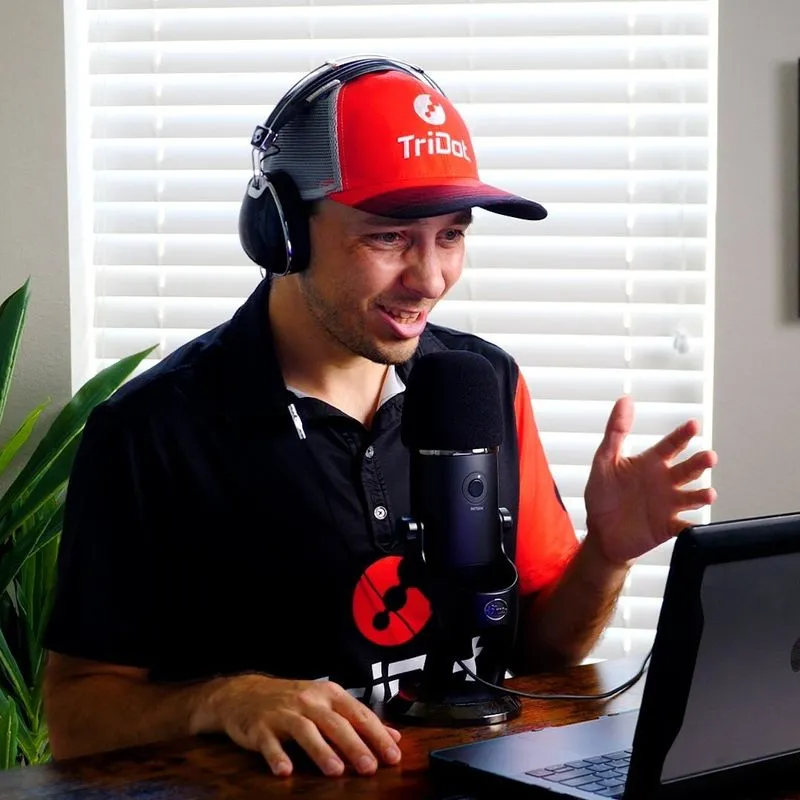

Transitions can make or break your race, and changing between sports are often where valuable seconds slip away. In this episode, we dig deep into the ins and outs of T2 with Coaches Elizabeth James and Ben Sommerville. From getting your legs ready for a run while wrapping up your ride and finding your transition spot fast to practicing the sequence of changing your gear quickly and what amenities the coaches recommend you use or skip in the transition area, Ben and Elizabeth share practical tips and real-world strategies to streamline your next race. Plus, enjoy some unforgettable stories from their own triathlon journeys. Whether you're a first-timer or a seasoned racer, this episode will help you move from biking to running like a pro.
TriDot Podcast Episode 312
Bike to Run: Transform Your Triathlon T2
Andrew Harley: Welcome to the TriDot Podcast. Today, I have professional triathlete and coach Elizabeth James and Coach Ben Sommerville from Precision Coaching. They are joining us to help us tidy up our transitions. And this week, we're specifically talking about that bike to run transition, aka T2. If you watched last week's show, we talked all about T1. So if you missed that one, go back, listen to that one, then catch this one. It's going to be great; 60 minutes on how to nail your T2. I'm Andrew the Average Triathlete, Voice of the People and Captain of the Middle of the Pack. We treat the show like any good workout. We'll start with our warm-up question, settle into our main set conversation, and then wind things down by having our coaches answer an audience question on the cool down. Lot's of good stuff. Let's get to it.
Announcer: This is the TriDot Podcast, the triathlon show that brings you world class coaching with every conversation. Let's get started with today's warm-up.
Andrew Harley: Okay, Elizabeth, Ben, last week, having this transition conversation, I asked Coach Jenn Reinhart and Coach Jeff Raines what sport they think is the most difficult for the referees, the umpires, the people monitoring the competition. And so this week, I'm going to follow that up with a similar one for the two of you. I want to know what sport you think looks the most difficult for the players, the athletes actually competing in the competition. Lots of potential answers, here. Elizabeth, what do you think?
Elizabeth James: I am going to go with gymnastics, and thinking through this, yeah, there's so many different events within gymnastics. This is terrible -- I think they call them events. I honestly don't know.
Andrew Harley: I think you're right. I think you're right.
Elizabeth James: As soon as that came out, I was like, oh, man, I'm probably even misspeaking about the sport itself, and the different ‘events’, or whatever they're called. But particularly, the men's still rings and the women's balance beam.
Andrew Harley: The women's what? Which one?
Elizabeth James: The balance beam.
Andrew Harley: Yes. Oh my gosh.
Elizabeth James: How in the world, I mean, one, with the men, do you have the strength to just hold yourself up there? It's amazing. And then to do flips, and turns, and everything, and land on that tiny little balance beam -- I just am in awe every single time I watch a gymnastics event. Kudos to them. Super impressive.
Andrew Harley: Yeah. If I had to do a cartwheel, with all the room in the world, it would look horrific. And they're doing flips, and turns, and all sorts of stuff, yeah, on a little 6-inch, 7-inch, whatever it is, wide beam, and yeah, great pick here, Elizabeth. Every single event in gymnastics looks impossible to the three of us, I'm sure. Unless Ben is a closet gymnastics, freak ability that we don't know about. Anything, Ben?
Ben Sommerville: Unfortunately not. No. Of all the things I've given a try, gymnastics is not the one. I think I probably would have started a little bit too late. I was swimming by the time I probably should have been doing gymnast instead.
Andrew Harley: Totally get you. Well, Ben, what is this answer for you?
Ben Sommerville: Oh, gymnastics is a great, great option. I think EJ's absolutely hit it on the money, there. But something for me, being sort of a fan of water sports, I think free diving is probably, by skill and sheer superhuman effort, it's both terrifying and awe inspiring to watch. The tension you feel -- I almost hold my breath watching them, the tension I feel for them. Again, just awe inspiring. I don't know how they do it. I much prefer swimming at the surface rather than going all the way down. I see people free diving, and it just, hats off to them, every day of the week.
Elizabeth James: I think my anxiety skyrocketed just saying that. That would be so hard.
Andrew Harley: Yeah, I'm going to pick a water-based sport, as well. But two nominations for me, for similar reasons. Water polo. I mean, swimming isn't my forte in triathlon. I can get through it, and do all right, and look semi competent. I need to go to TriDot Pool School and get even more competent. But either way, you take the sport of swimming, and you add contact, dunking each other, throwing a ball around, like, it’s unreal what they're able to do as a team. And in their sport, they're swimming everywhere, they're not running everywhere. And it just, it blows my mind watching how athletic men's and women's water polo players are to do that sport. And very similarly, I have to give a shout out to synchronized swimming. I was watching synchronized swimming at the last Olympics, and they had a really awesome camera view, where the top half of the camera frame was showing what the athletes were putting forth on top of the water for the judges and spectators to see, and the bottom half of the frame was underwater, and was showing you what they were doing underwater, with their legs, and their formations, and their holds, to make that lift and that formation happen. And that was fascinating to watch. How it looks above the water is incredible, but to see what's happening behind the scenes, so to speak, to make all those lifts, and formations, and acrobatic, and aerial stuff happen --unreal. Unreal. So I think both water polo and synchronized swimming, I'm a mediocre swimmer anyway, and so you take swimming and make it the base of the sport, and then you add more to it -- yeah, that looks hard as crap. Looks hard as crap. I'm out. Not going to happen. Mad respect to those players. Guys, we want to hear what you have to say about this question. So we're going to throw this question out on all of the TriDot social media accounts to hear from you. You can also comment on this video on YouTube, you can comment on this video on Spotify, and our team will monitor those and see what sport you, our listeners, think is the most difficult for the athletes competing. I can't wait to hear what you have to say.
Announcer: Let’s go.
Andrew Harley: Let's go on to our main set, where, today, Coach Elizabeth and Coach Ben are going to help us get better, get cleaner, get faster, get more efficient on our bike to run transition. So just to kick us off today, I want to hear from your own personal race stories. And I asked the same question last week to Coach Jenn and Coach Jeff about their T1, but I want to know from the two of you, from all of your own personal race experience, what was a memorable T2 for you? Whether it was because of just something extra scenic, or something extra cool that happened during that T2, or maybe it was something that went wrong during that T2, what is just an extra memorable T2 from your personal race career? Coach Ben?
Ben Sommerville: This is another great question. All of your questions are so good, and I've raced so many times, I've lost track of all of my T1s and T2s, whether they were good or bad. But one that does stick out is quite recently, actually, earlier this year, my first 70.3 on the lovely Spanish island of Mallorca. I remember just coming into T2, I was under control, I was feeling good, and I just heard the shouts from a very familiar face to us, on our TriDot team, Raya Usher. She was there with us, spectating, and I just remember that feel good feeling, those cheers from the sidelines, and it just put a huge smile on my face, which probably carried me through my very first half marathon in a triathlon. And it was just -- that minute of hitting the ground running in T2, seeing Raya and hearing a shout was just incredible.
Andrew Harley: Yep. Very, very, very good. It's amazing just how one person cheering, right, one spectator, whether you know them or not, in the right spot, saying the right thing, can just change your day, right? Can just absolutely change your day. Coach E.J., what is this answer for you?
Elizabeth James: I feel like I actually have a similar answer to Ben, without even coordinating here. Shout out to our coaches for always being at the right spot at the right time, because mine has to do with IRONMAN Chattanooga, first time I raced it, and Coach John Mayfield. And I came in, I had practiced those transitions over, and over, and over, and I think he must have been surprised about how quickly I transitioned, because just his enthusiasm, and he couldn't even get out words. He's like, “Woah! Fast!” And it was just so cool.
Andrew Harley: “You fast! You are fast! You moving fast!”
Elizabeth James: Either that, or he was telling me to move fast on the -- I don't know. But just how quickly that happened, and his excitement, and having him be right there was just a positive start to the marathon. And so that's instantly what stuck out for me as T2 and kind of what I think of each time I'm transitioning from the bike to the run. I'm all right, be as fast as what John Mayfield would approve of and make him just at a loss of words, again.
Andrew Harley: Let's start coaching our listeners today on how to nail their T2, how to be as efficient as possible. And I want to start, guys, with that moment where you're on your bike, you're almost done with the ride, and whether you're doing a local sprint or olympic, whether you're doing a full on IRONMAN, there's always that moment where you look up, and in the distance, you see the dismount line. You see the big banners, you see the archways, you see the crowd, whatever it is that's there, and you start for the first time processing, oh, I'm almost done with this bike ride. I'm about to start transitioning. As a coach, what do you want an athlete to start thinking about in that moment, as they're approaching the dismount line, before they even start that T2. Coach Elizabeth?
Elizabeth James: If you can see the dismount line, you better already be reducing your speed. My goodness, I have seen so many athletes coming in screaming hot to the dismount line. And this is usually when the accidents happen, because they are just last-minute slamming on the brakes. So if you can see that dismount line, you better already be gradually reducing your speed. Maintain control, but no sudden braking. And then really think about preparing your body for the dismount. And however it is that you've practiced that, because you have practiced it, either removing your feet from the shoes or unclipping one foot, as you would do during a traffic stop. But think about how you're going to get yourself off your bike, because that's the other thing I see. And there's so much going on during these races, but I've seen athletes that come to the dismount line, and they stop, and it's like their brain took a vacation for a half second, and then still clipped in, and they tip over. And it's like, okay, I get it. You are fatigued. I mean, especially thinking about if this is an IRONMAN bike, and you've been out there for hours and hours, still remember that we have to get off safely. So slow down, think about how you're going to dismount. And then once you're off, you can think about the rest. But that's the main thing. Just think about how you're going to get off your bike safely.
Andrew Harley: Coach Ben, anything to add there?
Ben Sommerville: Yes. Let's not forget, the entire point of T2 is not just to get off our bike, it's to get off our bike in a good place and a good physical state to then run. So I'm going to rewind a little bit. I'm going to have us rewind a little bit, before you even see those big banners, before you see that dismount line. What I like to do, and what I like to recommend to my athletes, just drop a gear or two. Just make it a little bit easier, get that cadence up a little bit higher. Just try and loosen up the legs, and as best as you can, you're almost simulating that move from a cycling cadence to a running cadence. And it’s particularly, it's a minor change in that final kilometer, but it can make a really huge difference, just to bridge that gap. And then, once you see that dismount line, your legs are loose, you're nice and relaxed, you can begin to reduce your speed and follow all the amazing tips that Coach EJ has just given you. But just to rewind and just anticipate T2 just a little bit earlier than those final moments.
Andrew Harley: Great advice from the both of you. And I've seen athletes get off their bike with all of the grace of a professional Swan Lake ballerina. I've seen athletes get off their bike and, like Elizabeth said, fall over like a drunken toddler. We've all seen it all. Some of us, we know personally, we've probably had some moments where it didn't go that smoothly. Unclipping, getting a leg over the bike. And it looks straightforward, it should be straightforward, but it's not always straightforward. So just, we've been locked into one position for a long time, we’re wearing weird shoes. There's a lot of different reasons why we can fall over, here. So just talk to us about how to get off the bike and get moving into transition efficiently. Coach Ben?
Ben Sommerville: Yes, so this is obviously, we've slowed down, we're coming towards that dismount line. We're under control of our speed. And again, I just want to reiterate, get control of your speed, particularly for those of you who have practiced and are, experienced or not, with the flying dismount, you're going to swing off your bike, and you're going to immediately start running, as opposed to coming to a stop, moving off your bike, and then continuing to move. If you come off too fast, as in, you get to the finish line, the dismount line, too fast, your legs probably won't keep up with the speed that you're carrying on your bike, at which point, you may either fall over, or you might have a little bit of a tumble against someone else, or a tumble against your bike. And so just practice, practice, practice. Really get control of the speed. Find out for you, and depending on the course, as well, if you've got an uphill finish, a downhill finish, round a bend, how much speed you can or cannot sort of carry towards the end, get control, and then just let that momentum just sort of carry you through, provided you do it in a as safe as possible way, and just give yourself some space, as well. And then you can have a confident and a safe dismount, more than anything else.
Andrew Harley: Yeah, good addition, there, to have us think about what is the course like in that moment? I mean, we've all seen these sometimes be at the end of a long hill. We've seen these where you're coming around a bend. A lot of times, Elizabeth knows, that the Dallas/Fort Worth local sprint and olympic scene, you're often pulling into a parking lot off a road, right? So it's a pretty good left- or right- hand turn, and then boom, you're dismounting in the transition. So you got to know that line is there, on the other side of that turn, and slow down effectively before the turn, even. It can be at the end of a downhill, if you're bombing back towards a beach, or towards the lake, or something. So, good point there, Ben, to know what is the terrain like in that moment, so you can make sure you're ready to handle that well. Elizabeth, anything to add, there, about how to get off your bike smoothly and efficiently?
Elizabeth James: Really not much to add. Ben nailed it, there. I always tell my athletes, practice, practice, practice, but especially with what Ben was saying, practice it in a simulation where it's going to mimic race day. So whatever turn that is, whatever terrain, I've seen transitions that are also going onto the grass. And so it's like, are you going to have to take your bike from the concrete into the grass to dismount? There's another element there of a different surface. So know what is going to be expected of you on race day, and then practice that often, often, often. Because truthfully, the best dismounts come from that muscle memory, when you're already fatigued and you're really just relying on habit to get that done.
Andrew Harley: Yeah. And the both of you, as a pairing, I really like for this episode, because Ben, you have a very strong short course background, racing very competitively in Great Britain at the olympic distance level where draft-legal, every second counts in transition, you're trying to keep up with the pack, so you are doing flying mounts and flying dismounts for every second. Elizabeth, you're racing half IRONMAN and IRONMAN, usually, in the professional field. And so for you, it's a little more measured, a little bit more, “I've been locked in the same position for 2 and a half to 5 hours, so I'm not going to do anything too wild. I'm just going to get off safely.” And so I'll throw this to Ben first, and then Elizabeth. Last week on the episode, obviously, there was some good chatter about who should be trying the flying mount, who should not be trying the flying mount, when is that worth it, who should be deploying that. So same thing dismounting, right? Like, who should be doing those really aggressive, hopping off the bike at speed, your feet are already unclipped, you're literally running, hitting the ground running into transition off your bike versus who should come to a stop, throw the leg over, and jog it in from there? Coach Ben, what do you think?
Ben Sommerville: I mean, there are certainly many circumstances where I try and encourage people to progress as quickly as possible, to the point where they're able to confidently and competently do a flying dismount, more often than I would recommend someone to progress quickly to a flying mount. A flying mount, there is a lot of risk, because there is an element of you and your bike are completely disconnected, and you're also not connected to the floor. But with the flying dismount, provided you're able to safely, in those final meters, this final few hundred meters, take your feet out of your shoes, and then balance your bike, to a certain extent, that you can then come around one side, either with a leg over the front or a leg swinging around the back. I like to progress people as quickly as possible, because it does just keep the momentum going, particularly in larger, busier events. The more time that you spend standing still in those mount and dismount areas, there is potential for someone who's not paying attention to come screaming and crashing into the back of you or into the side of you. The more you can keep moving, the better. And so I like to progress people as quickly as possible. There are lots of different ways to both do the flying mount and a flying dismount, but I like that to encourage people to sort of progress as quickly as possible. Perhaps there's a little video tutorial series there, where we could show people how to do those. I think, for sure, a visual aid for people would be very, very useful, because me just saying do a flying dismount, there's a lot of athletes out there will go, “How?” And so there's always something there, for sure.
Andrew Harley: Is there anything, Ben -- and those kind of tutorials, we would love to capture on video with our team. And we definitely need you on video teaching us that, not me on video teaching us that. But just audibly, what would you say to an athlete at home who hasn't tried a flying dismount, wants to work their way there, what's the way to ease yourself into learning how to do that safely?
Ben Sommerville: Yes, there's many different ways. The easiest possible way you could do it is find a long stretch of soft grass or a soft trail. Stay away from the pavements and the roads, because just like when you're getting on your bike for the first time with cleats and clipless pedals, there is a risk that you might have a little bit of a tumble. So save yourself the pain and land on grass. And whilst you can't carry as much speed on the grass, particularly if you're using a road bike, just try and get as much speed as you can. Stay looking ahead, holding nice and tight on the bars, but not too tight where you're rigid in the shoulders, and then just give it a go. If you normally are a leg over the top tube or a leg around the back of the saddle, just try, sit upright, bring the leg behind you, and then bring it through in front. And then as you approach that line, just put one leg in front of you as if you're literally about to start running. And then just let that foot hit the ground, push the bike in front of you a little bit, so you've got space, and then begin to run. And just start as slow as you really need to, to keep momentum, but don't go all Hail Mary, ridiculously fast, because you might want to taper it a little bit. If you go too fast, you'll continue running, and you might hit a hedgerow or a fence, end up in your neighbor's garden. So I wouldn't recommend that on your first try. And so, as audibly and as simply as I can in just words, that's how I would describe it. For sure, an actual video tutorial, I'm more than happy to do that, will probably be a much better resource for people. But just maybe look at YouTube, find some professional races, and just watch them, just to get an initial bit of inspiration and an idea, and then give it a go on some nice soft grass.
Andrew Harley: Yeah, really good job there, Ben, on the spot, taking a crack at an audible tutorial. And I mean, to your point, when I would work with youth triathletes, back when I coached a youth triathlon team, when we practiced this, we would go to a public park, near where we normally trained, where there was a bunch of soccer fields. And we certainly wouldn't go out onto the soccer fields and affect that grass. But usually those kinds of complexes have well-manicured, short to the ground grass, right? So you find a patch of grass that isn't a field, or isn't close to one of the fields, but maybe is on the edge of the parking lot or something. And that's where we would just get some momentum and practice that dismount, dismount, dismount, in a very, very safe place where there was short, well-manicured, flat grass. So good thought there, Ben. Thanks so much for talking us through that a little bit. And to your point, also, in a race, I have never done a flying mount. I've been a triathlete for over 10 years now. I've never done a flying mount in a T1. Never felt the need to. I'm not trying to win anything. I'm not trying to qualify for Kona. But I've done the flying dismount several times, where you're coming up in a sprint, and it's a lot easier to fish your feet out of those shoes, as you're approaching the dismount line, and throw your leg over at speed than the other way around. So thanks for calling that out, as well, Ben. Elizabeth, being a long-course athlete who coaches a wide range of athletes, from experienced folks all the way to new folks, what percentage of your athletes do you think are doing this versus just unclipping and more calmly going in the T2?
Elizabeth James: I would say that it's probably 50/50 for the dismount. And as Ben alluded to, very few, myself included, do not do a flying mount. Just risk/reward there. I don't take the risk. I mean, I've been on this podcast a lot for things regarding injury, so I think our listeners know that I’m injury prone, and I'm not willing to take that risk on a flying mount. But yeah, the dismount's much easier. And another thing that I have a number of my athletes practice, if they're interested in doing this -- I mean, that's one of the things too, some athletes have no interest. They're like, “I don't need to do that. No thank you.” Okay, that's fine. You don't have to. But if it is something you're looking to do, even starting on the trainer with taking your shoes on and off can be beneficial. So, you're done with your ride. Okay, let's take one foot out as you're still looking forward. Can you do that without looking down at your feet?
Andrew Harley: Yeah, great point.
Elizabeth James: And so that's one of the things that we start with, is you still need to be able to navigate. You need to be able to look ahead and see what other athletes are doing, because you don't want to be one of those people that comes and crashes onto the back of somebody else that's trying to dismount. But, okay, let's try to take your feet safely out of the shoes while still looking up, and then progress to getting off the bike from there. So that can be another step, even before we take it outside, is let's practice this where the bike isn't going to move. Like, it's stationary, and if we feel that we can confidently do that inside, then let's progress it to that patch of grass outside, and then doing it on the road.
Andrew Harley: So once we're actually off the bike, whether we're flying, mounting it off the bike, or doing it in a more controlled manner, either way, there's no right or wrong. It's just faster and a little slower, that’s all. Risk/reward is a good way to put it. But once we're off the bike, we have to run with our bike to our spot on the rack. And this is similar to T1, right, when we're running out with our shoes on. But depending on how we dismounted, some folks are running in bike shoes, in bike cleats. Some folks are barefoot, because their shoes are still on their cleats. While we're running, we're holding our bike. And some folks do this all savvy by the saddle. Some people hang on to the handlebars. Some people use one hand, some people use two hands. There's a lot of ways to do this. You're dehydrated. Your legs feel funny because they've been on a bike for a while. Talk to us about this run. Talk to us about getting from -- we just got off our bike, we got to find our spot on the rack. Is there a right way, best way, or wrong way, worst way, to run to the rack? Is there anything we need to know about this? Coach Elizabeth?
Elizabeth James: Again, here we're looking at how much do these seconds matter? And for some athletes, it's going to be an opportunity for them to walk slowly and really mentally transition from one sport to the next. But if you are looking to make this a very efficient and quick T2, then practicing the entire transition can be incredibly beneficial. So not only are we practicing the dismount, but you're practicing running with your bike, and possibly steering it as you would need to, to your transition spot. And so as you're practicing, include that run with the bike in your hand as you would envision running to a bike rack, or being able to hand that off to a volunteer. I like to hold the bike by the saddle and just small movements with the hand allows that front wheel to steer in the direction that's needed. I know that I, personally, do short, quick steps as I'm getting off the bike. One, because I guess I have tender feet, and I really don't like running barefoot. And so if I don't put a bigger, longer stride and a whole lot of pressure on my feet, that feels a lot better before I'm putting my running shoes on. And then kind of same thing as we were talking about, approaching the dismount line is head up, eyes forward. You don't need to be looking down; the bike will take care of itself. But head up, eyes forward, look at where you're going. Visualize where your rack is. I mean, ahead of the race, you should have also planned your path to the bike route -- or bike rack, excuse me, so you know where you're headed. The only other thing I'll say here, is that for some people that are getting off their bike with their cycling shoes still on, you can get by with running in your cycling shoes for a short distance of time. But some people find this incredibly awkward, and it's almost like a full risk for them. So if you're in that category, where you just feel so awkward running in your cycling shoes, it might be beneficial for you to take those couple extra seconds and take them off as you continue your transition. Definitely not as efficient. But again, we're looking at safety and what's going to be best for you for the entire race, that could be an option, as well.
Andrew Harley: You mentioned that you're one of the athletes that will run holding your bike by the saddle. I think the athletes that do that look so awesome. Forget speed and efficiency. Forget, like you mentioned, oh, it might save you a couple seconds. I don't even care about that. I think it looks fricking dope to just glide through transition with one hand casually on the saddle, steering your bike, as you're pumping arm with the other hand. I can't do it. I literally can't do it. I've tried. I've tried with different bikes. I can come closer with some people's bike. With my bike, my front wheel goes all over the place. So I had to run in my cycling shoes, holding onto my bike with two hands like a chump. But that's just me. Is it slowing me down? Probably not. But could I look cooler if I could figure out how to do the one hand? Sure, absolutely. So anyway, Coach Ben, how do you transition here? And just for max speed and efficiency, how do you coach your athletes to make this run to their spot on the rack?
Ben Sommerville: I think I have the perfect bit of advice for you, Andrew, not just our viewers and our listeners, as well. So I have a little visual trick. I call it remembering your ‘L.’ And so, yes, I'm going to push my bike, I teach my athletes to push our bikes from the saddle. And so for those who are watching, I'm going to raise my hand into an L shape. My thumb, here, will cut gently at the back of the saddle, underneath, quite loosely, and these two fingers here will sort of run down the center, or the spine, of the saddle, and you'll place them fairly firmly. And the most important thing here is, as those sort of fingers lead, a bit like when you're on a bike, if your eyes are looking on the edge of the cliff, you're going to go over the cliff. If your eyes follow the corner, your whole body and your bike will go around the corner. In the same way, head up, eyes forward, fingers facing where you want to go, and just let the bike lead you. And you need a little bit of momentum for this. And no matter how sort of twitchy your front end is, how heavy your bike is or not, where your pedals and your cranks and your shoes are, when they're spinning around all over the place, let the bike lead you. And that's the real trick. And just to hold it maybe half an arm’s to a full arm's length ahead of you, as if it's almost dragging you. The more momentum you have, the easier it is to continue in a straight line ahead. And then, for those shallow turns and bends, you see all those pros just gliding elegantly, they're just making little tilts, little sort of twists on the saddle, and that's all it takes just to move the bike around those shallow turns. But the sort of more steep turns, you know, effectively, when you go to some transitions, you go have to go up and down in like a sort of zigzag shape. You've got to come back on yourself. Push the bike forwards, reach round, grab a handlebar of the top to pick it up like you're doing a cycle across dismount or a mount, and just fling it around the corner with you, and use your body weight to do that. But always keeping a good, strong grip on that saddle with those fingers facing in the direction you want to go. That is, 100%, works every single time. And I perfected it over years, and years, and years racing short course, where there's 30 athletes coming into T2 together. We're all bobbing and weaving to find space, but there's no one there, picking bikes up in a straight line. We're all just pushing it from the saddle. So give that a go, Andrew, and let us know how it goes.
Andrew Harley: I will do that. I will do that, and I will report back to you. Absolutely. I’ve got my eye on a couple different races for 2026, and my new goal, audibly, Coach Ben, committing to you, I hope to, with Coach Ben's tutelage, be pushing my bike from the saddle like Pro-triathlete Elizabeth James can do, effortlessly gliding through transition. I'm going to try it. I’m going to try it, Ben. So there's two different types of transitions. There's clean transitions and there's dirty transitions. If you listen to the show last week, you heard us teach and talk through the two differences there. And so Elizabeth, Ben, for a dirty transition, where our gear for the race, our run shoes, our bike gear, our swim gear, everything is kept right by our bike in transition, how should we arrange -- and in this episode, we're talking about the bike to run transition. So how should our run shoes be, our run gear be arranged that when we pull in with our bike, we rack our bike, we're most efficiently getting our bike stuff off and stored and getting our run stuff on and moving. Talk to us about just the organization of our stuff and T2, Coach Elizabeth.
Elizabeth James: I mean, no offense, Ben, but I was hoping he'd come to me first, because when we talk about the organization of this stuff, I get excited. And man, I think I send my athletes–
Andrew Harley: Nerd. Nerd.
Elizabeth James: I know. Nerd. Pictures and checklists and here's how we want to have it organized. Yeah, Andrew's probably seen all of this. But really, having this organized does make a difference. And so I think about this as making sure that it's organized by the sequence of use. So you want to arrange your gear in the exact order that you're going to use it as you're coming into T2. And so I always start, you know, basically from the toes up. And so have your running shoes there, that are closest to your bike. If you're wearing socks and again, that could be a time saver, depending on the distance, depending on your comfort level. Those should either be right next to the shoes so that they go on first, or just right inside the shoes so that they're ready to be put on, and then the shoes right after. And then next to that, you want to have your race belt with your bib that's already been attached. And then next to that, or sometimes even inside of your hat or visor, I put the race belt. And so truthfully, the biggest thing I do when I come into T2 is swap my shoes, and then grab the rest of it and go. And so I just make, you know, a nice little basket with my hat. Usually I wear a hat, and in there I have the race belt and bib ready to go. I've got my visor or, excuse me, my sunglasses in that hat or visor, and then any nutrition, as well. So you want to have it in the order that you're going to grab it. Keep your shoes pointing away from you so that they're ready to put on. Have elastic laces or quick tie shoes so that you don't have to spend time actually tying the laces. And then minimize the clutter. As much as you can put small items together, that you can just grab as a group instead of individually, that's going to be great. And so that's where I just almost use my hat as the catch-all of race belt, any extra gels, if I'm bringing a handheld bottle. If I need to grab any Tylenol, or Pepto Bismol, or something to stuff in my kit pocket just in case, that's all just in my hat.
Andrew Harley: So, Elizabeth, word for word, exactly how I do it. And we're runners, right? So we're eager to get off the bike and get on the run. And there is, admittedly, a little bit less, logistically, to T2 compared to T1. You're in T1, you're taking off a lot of swim gear and putting on a lot of bike gear. And T2, you're taking off a lot of bike gear and putting on running shoes. And if you've done it right, like Elizabeth just said, you're just grabbing your hat, that has all of your stuff in a ball, and you're doing everything else on the run. But this is a spot where I'll very organically plug, my elastic shoelace of choice are Caterpy laces. I freaking love Caterpy laces. I have Caterpys on every single one of my running shoes, whether they're just my daily trainers or my race shoes. They are far and away my favorite. I've got my wife using them, I've got my whole family using them. They're just so easy to thread through your shoes, and set it, and forget it, slip on your shoes, slip off your shoes. Elizabeth, I think you tried Caterpy and they weren't your favorite. And are you still using Lock Laces?
Elizabeth James: I am. I've tried a couple different ones, and I mean, even took you up on your suggestion. It wasn't for me. So I'm still using the Lock Laces.
Andrew Harley: All right, Coach Ben, what is your elastic shoelace of choice, and what else do you have to add to setting up your gear in a dirty transition?
Ben Sommerville: Thankfully, I've not got much more to add in terms of tips for a dirty transition. I think EJ covered absolutely everything. It's something I've had to learn not very much about, unfortunately, because doing short course races, you don't really have a lot of stuff on the floor. Everything's attached to the bike or is on me to start with. But my elastic lace of choice has actually changed recently. I used to go for the elastic laces with the little clasp that you then sort of push up and down to tighten them. Too much time. I didn't like the sort of the faff and the time wasting. And there's a new brand released, I think here, in the UK and in Europe, called Suspense Performance Laces, where you get a tube of individual little elastics of different sort of strengths and widths, so you can effectively custom lace each ridge, each ladder of your shoe, with a particular lace. And so you can cut. And they've got all kinds of cool colors. You can get bright pink ones, you can get green ones, you can get spotty ones. So giving those a go, they're really good. But not much more to add in terms of tips. The only thing I would add is something I discovered recently. Obviously, now wearing socks for a run, as opposed to never wearing socks doing a short course race, is half rolling up the socks and putting them gently inside of your shoe. So all you got to do is put your toes in the sock, and then you just basically grab the rest of the sock, and just yank it all the way around the foot, and up and up past the ankle, and then up your leg. Once I learned that, it was amazing, because I was spending so much time in my race simulations before, doing a 70.3, putting on a sock right from the beginning. With wet, sweating hands, it's just a no. It's not going to happen. And so that's, you know, just a little, after the marginal gains for a super quick sock change, that's the way to go.
Andrew Harley: Yeah. Very, very good. And just, we can spend 20 seconds each on this. But in which distances are you putting on socks, and in which transition are you putting on those socks? And for example, for me, if I'm doing an IRONMAN, I put on socks in T1. I would probably be fine the whole bike ride without them, but I was like, you know what? It's going to be 6 hours out there. I'm going to just go and put on socks, whatever. But short course, sprint and olympic, no socks the entire time, for me, I just stay barefoot. At a 70.3, I'll put on socks in T2 to have socks on for the run, but I'm not going to put them on for the bike. Anything different for you guys there? E.J.?
Elizabeth James: The only thing that sometimes changes for me is based on the temperature. And so, same thing. Sprint and olympic, never wear socks. 70.3, I will put them on in T1 or T2, but where that happens depends on the temperature. If it's a cold swim and my toes are numb, I'm likely to put socks on in T1, just to try to get my feet warmer earlier. Otherwise, I'll save it for T2.
Andrew Harley: And Ben, you race short course almost exclusively. So are you just a no socks ever guy?
Ben Sommerville: Historically, yes. No socks for sprint and olympic. There's no time for socks, unfortunately. As comfortable as it would be, there's no time. Now that I've gone a little bit longer, I've dabbled with some 70.3 racing, I will put socks on for T2, for the run only. I'm more than happy doing a flying mount into my shoes and wearing no socks. Just loads of baby powder in the shoe to help your foot go in nicely. That's another little top tip. As I've never attempted an IRONMAN distance, I don't know when I would put socks on. I will find that out in the next couple of years. Whether it's a T1 or a T2, we'll find out, and I'll let everybody know.
Andrew Harley: Ben, are you wearing socks right now?
Ben Sommerville: I am, yes.
Andrew Harley: All right, cool. So let's move on to a clean transition. And this is a transition where there is nothing by your bike. The only thing allowed at the rack is your bike. Your gear is either in a tub somewhere or it's in a gear bag somewhere. You're usually going to a rack and finding your gear bag, and then going somewhere to put on your gear, whether it's a change tent, or benches, or whatnot. So we'll go Elizabeth first, because she loves organization. Then we'll go Ben. But talk to me about – and I ask this because it seems so straightforward. You just throw your stuff in a bag and you're good to go. But then the first time you actually use gear bags for races, you're like, oh, these bags are very vertical in their orientation. How do I stack my stuff to put it on efficiently. So, EJ, what do we do with a clean transition when our stuff's going into a gear bag?
Elizabeth James: Awesome. Yeah. And you said, it sounds so straightforward. And then you watch some people that have done this before, and you're like, oh, yeah, they have this down. There's a method to this. And the first of those is, if it's allowed -- and some races allow it, some don't -- but if it's allowed, to use something specific to help easily spot your gear bag, because they all look the same. And so if there's a way that you can just differentiate yours a little bit, if there's a ribbon on the top or some brightly colored duct tape, maybe writing your number on there 4 or 5 times instead of just the number sticker that you get when you pick up your bag, that can help in just finding it before you even go into the change tent. So you're not wasting those precious seconds trying to fiddle around with, oh my gosh, what is my gear bag? Or wait, what's my number? So locating it would be the first part of that. And then in the bag itself, separate your items, again, by use. So you want to pack your bag, basically, in reverse order, so that the items that you need first are the easiest to find, and they're on top. So, for example, my shoes and socks will be on the very top of my T2 bag. And then underneath that, I would have the hat with everything else in it. And then here's where there's a little bit of an exception. If I have any nutrition or hydration that could possibly leak, I put that at the very bottom. That way, if something happens and that were to spill, it's not going to spill on top of my shoes and get everything soaking wet or sticky and disgusting. It would just be at the bottom of the bag. Still gross, sticky, wet, disgusting, but hopefully not over the rest of your gear, like your shoes and your hat that you hope to be wearing for the run. The other thing that I'll do is use some small Ziploc bags, or clear bags, for some of those items that may or may not be needed. I do this in T1, as well. But for me, I am absolutely blind without my contacts. And so in T1 and T2 bags, I always duct tape, to the inside of them, a spare set of contacts. Because I'm like, if, for some reason --
Andrew Harley: Just in case. Yeah, just in case. I do the same thing.
Elizabeth James: I don't know how I would finish a race without that. I am so blind without them. So I put those in the bag, but they're duct taped on the side. Hopefully, I don't need them. Hopefully, I don't have to rummage through them. They shouldn't be in the way, but they're there if I need it. And then, same thing. I'll have a little, tiny Ziploc bag of some Tylenol, or Pepto Bismol, hoping that I won't need it, but if I do, then I don't have to rummage around and look for where it is. So there's a little baggie of that, as well. And then practice packing your bag, too, and going through it. So if you're practicing all of these other things with transition, with the mount, the dismount, grabbing your gear, putting that on, let's also practice getting it out of a bag to do that, because I've seen so many, they pack it all up nicely, and they get into the transition tent, and they just turn this whole thing upside down and dump it out. I suppose that's effective, too. And then one last thing. Sometimes you will have a volunteer that's there, in the T2 tent, to assist you. And me and my checklist, and I realize this is a little over the top, but I've also had a checklist of everything I've needed to do, and I get in there, and I just hand that to the volunteer, and so they're reading down, “Shoes, socks, hat, nutrition, go.” And so they're just making sure that I have everything I need, that way--
Andrew Harley: Your personal assistant for 40 seconds.
Elizabeth James: Yeah, exactly. In my state of fatigue, or franticness of wanting to save all those seconds, I'm making sure that I don't run out of T2 without my race number belt, or if I had a hydration bottle or gel that I really needed, I'm not going to have to double back, because I've got that whole checklist. Either I can read off it real quick, make sure I'm good to go, or that volunteer could help me out.
Andrew Harley: Yeah, really great, Elizabeth. Ben, again your most of your racing experience is short course, where, in draft-legal events, I think you have a bin next to your bike in these scenarios, but you also, I'm sure, have used gear bags. Anything to add here? Fill in any gaps from what Elizabeth said on things that either you do, or you tell your athletes to do?
Ben Sommerville: I will admit I thought I was a really organized athlete, but I think I've just been outdone by EJ, because everything she's just gone through is what I do to the nth degree. Just the checklist that they hand to a volunteer, that is genius. I might have to try it out, because I am victim of still treating a long course transition, with the gear bags, a bit like a short course transition, where I will be Hail Mary at full speed, and I will just be that person who chucks the bag upside down and lets everything just clutter on the floor.
Andrew Harley: You start grabbing stuff.
Ben Sommerville: Exactly. And so I'm just going to give a couple of final little things, that I found, that have really worked for me. It doesn't happen very often where you're given two bibs, and where you may want to put on a different bib number for the run versus the bike. Potentially, you might have an aero one for the bike, and then you've got one for the run that might have little loops and pockets on to hold things. I always just make sure that whatever bib is in whatever bag, this is a T1 and a T2 tip, sorry Jeff and Jen. Just make sure it's clipped together and step through the belts. And you're not having to, whether you've got cold or sweaty hands, or warm hands, you can just step in and just bring it up to your waist, and then you're done. And then something I've done for some 70.3s, I like to bundle my gels with little elastic bands, and then I can either carry them like one little bundle in each hand, or I'll just pop them down the front of my tri suit, and just have them just sort of sit above my waist where the race belt is not tight, obviously, I don't want to restrict my breathing and my chest, but it just kind of sits there. It doesn't bounce around very much. So they're just those final little icing on the cake. But if anybody listening or watching takes anything from the last two questions, just listen to everything EJ's done, and then you're good, because that pretty much hits it on the nail on the head.
Andrew Harley: I'm going to hit EJ one more time, as a long course athlete, get your thoughts here, as coach/athlete. And Elizabeth, you go start to finish in your race kit, your full sleeve tri kit. What do you think about athletes that want to, in T2, and I think we see this more in T2 than T1, but want to do a full on wardrobe change. And many athletes prefer to run a marathon, or a half marathon, in running shorts, in a running singlet, as opposed to staying in a tri kit for that. And we've even seen this at the professional level. Lionel Sanders, I think most famously, will usually change into, for long course, into run shorts and a run singlet, and he does just fine. And he takes the time to do that. So it's certainly a viable strategy. Elizabeth, who is this for? Who's this not for? What do you tell your athletes about this, if they're interested, in T2, on doing a wardrobe change?
Elizabeth James: Yeah, great question. I'm so glad you brought that up, because as you mentioned, I race in the same thing from the gun. So I don't often think about this, but it is a discussion I've had with a number of athletes, and it really comes down to personal preference, and what they're going to be most comfortable in. And I have had athletes make a full change in T2, and they are so glad that they did, because they're just that much more comfortable running. And as we look at the pros and cons of doing it, if they're not messing around with their kit the entire time, and they can run more comfortably and more smooth than running clothes, ultimately it might even save them time in the long run of it. So I'm all for doing what makes an athlete comfortable, especially in those long course races. You're going to be out there for a while, and so you want to have something that is going to be conducive to being comfortable, being confident, for the rest of that day.
Andrew Harley: Not to talk about bathroom breaks on an episode where we don't need to talk about bathroom breaks. But just thinking to my one IRONMAN, I've said in the podcast many, many times as it's come up, I didn't know what my body was going to do taking in gels and electrolytes for that long. And so I, the second half of the run, really struggled with some GI distress. I was in and out of the port-a-potty multiple times, trying to get my stomach just out of knots, so to speak. And I would have saved time if I was wearing running shorts, doing that, and just shucking them down, shucking them back up, shucking them down, shucking them back up. And instead, every single time I went into a port-a-potty, I was having to undo all of this top, shimmy it down, try to get some pressure off of my gut. And then you're shimmying a soaking wet, sweaty tri suit back on, burning energy, burning time. So if you think, if you have a history of GI distress, or you're not sure how your body's going to respond that deep into your first IRONMAN, like me, might be worth it, as well. So thanks EJ for addressing this.
Elizabeth James: I'm going to jump in here once more. There's a good case for a two-piece tri kit, right there, too.
Andrew Harley: Also true. Also very true.
Elizabeth James: And I've seen athletes that will also wear the tri shorts for the entire time, but I mean, depending on their race, they might have their tri shorts on underneath their wetsuit, and then before they bike, they put on more of your short sleeve cycling kit, and then they throw a tank top on for the run, and so they might have half of a wardrobe changing.
Andrew Harley: Great point.
Elizabeth James: But then they also have a two-piece kit. They have enough comfort and padding for the bike, but then they also have better accessibility for bathroom stops on the run, too. So that's another option.
Andrew Harley: Yeah, good point. Coach Ben, I'll throw this one your way, let you go first for the first time in a little bit, here. I want to ask about the shoe change in T2. And when we talked last week about T1, I think that the two big gotchas in T1 is getting out of your wetsuit smoothly -- that neoprene can just snag a foot, it could snag an arm, and you can have a hard time getting that. That's the gotcha of T1. And we talked a lot about getting your wetsuit off cleanly. The gotcha in T2, it's just that shoe change, right? You can save time or lose time on how smoothly that shoe change goes. Cycling shoes off, run shoes on. We already talked about the elastic laces, we already talked about rolling up the socks. But Ben, is there anything else you can say, additionally, to an athlete who might be worried about that one gotcha moment? Maybe they have a history of not getting those shoes on cleanly. Anything else that we can add to that moment to alleviate that as a potential hazard in our T2 flow?
Ben Sommerville: For sure. And I think for anybody, no matter what method they choose to implement during their race -- and we'll go through a couple of tips now, the most important thing is practicing it. For those flying dismounters, you've got one less thing to worry about, because your feet are already out of one pair of shoes. For those of you who are still wearing your bike shoes, a little bit of brute force and some momentum will probably get your bike shoes off quite easily, provided you've loosened any of the boa dials, the Velcro straps, any of the ratchets as wide as you possibly can in those final moments, either whilst you're still on the bike before the discount line, or once you reach your racking spot in transition. In terms of getting your run shoes on, much like we'd want to have some talcum, or some baby powder, in our bike shoes for T1, I replicate the exact same thing for my run shoes. Whether you're hot, warm, cold, wet, dry, your feet are swollen, your feet are sweaty, your hands maybe not be as functional as normal -- you may not be, just generally, as functional as normal, depending on how you've come off the bike and starting your T2 before the run. And so just a little bit of talcum powder, and perhaps some Vaseline, petroleum jelly, I've tried, just on the heel where you sort of cup your heel into the back of the shoe, just to help ease your shoe in. You will still have to use a little bit of brute force and some momentum to get your feet in, particularly in a panic and if you are in a rush, but just try and slow it down. And if you've got elastic laces, just try and open up the shoe, pull the tongue out as much as you physically can, just to make that sort of, effectively, that tunnel, that entry point for your foot, as wide as possible. And then whether they're laces you then have to secure again, just take a couple of seconds just to do so. If they're not, you can just recenter the tongue if it's got a bit caught in some laces, and away you go. Your sock choice can play a part, as well. Thick socks versus thin socks may impede or help you get into your shoes. So again, just practice, practice, practice. Find what really works for you. And it may then be course-dependent, as well, what you choose. If it's a hot day, you want thin socks; if it's a cold day, you want thick socks. And so there's just a few little things that you always need to consider. From the minute you enter that race and find out all about the conditions and the environment you'll be in, just think about these things. They'll make a huge difference on race day. That decision fatigue, if you can eliminate that on the day, you're in for a great run, whatever the distance.
Andrew Harley: A great place to practice this, Ben, is -- for athletes using TriDot for their training, you usually, in your training week, have a bike session with a run off the bike. And usually, it's 20 minutes. When you get more in the race mode, sometimes it goes with 40 minutes. But that's a great place to practice getting off your bike, making that shoe swap, just like you would on race day, and getting out the door. I'm not always in a rush when I do that. I don't dilly-dally and take a 15 minute break. It is supposed to be a run off the bike, but I do get off the trainer get my cycling shoes off, and then immediately put my running shoes on, just to kind of simulate that a little bit. So that's a good place to practice this and go into race day with confidence. Two more questions here, in the main set, and we'll move on to our cool down. I asked this last week on the T1 episode. I'm kind of curious to hear y'alls response, as well, here, for T2. But, Elizabeth, many races have the option in T2 of port-a-potties or even some tables with nutrition, right? Some electrolyte, some water, some food. Is T2 a spot where you're okay with your athletes taking the time to use these amenities, or do you want to see them getting through transition quickly, getting out onto the course, and then maybe using those amenities a little bit farther up the road? Elizabeth, what do you think?
Elizabeth James: Most of the time, it's get out of transition. Let's get onto the run as soon as possible. But it can be a very strategic decision, and it does depend on race goals, the athlete's pacing, and then certainly, personal comfort, as well. I was breaking this down as to when should you use T2 for those amenities and when to skip them? And what I came up with was, if there's an urgent need, if you really need to use the restroom as you're getting off your bike and there's a port-a-potty that's open, yeah, take advantage of it. Don't wait a mile, and then be like, oh, man, now there's three people in line. So, yeah, if it's an urgent need and it's open, let's take care of that. Because certainly, any GI distress that you're feeling, or that need to use the restroom, that's going to slow you down in the run, as well. I really like the athletes that I coach to be well fueled getting off the bike, so they're not necessarily needing to refuel in T2. But again, there's oftentimes where there's a water table or something as you're exiting T2, and depending on the weather that day, that might be an opportunity to even grab a cup and start cooling yourself off and pouring it over your head. I mean, your head has been in the helmet for hours and hours, especially if you're doing a long course.
Andrew Harley: Yeah, great point.
Elizabeth James: So, that might be a case of, yeah, you are taking something in T2, but it's not necessarily that you're stopping to do it. But you're quickly grabbing something to help you start some of those cooling protocols as you're going on to the run. And then I think, for the most part, if you can skip it in T2 and take care of it as you're on the course, on the run course, that's great. But those are a couple scenarios where I'd say, let's forego that. Maybe make it a mental reset, make sure that you're set up well for success to start the run.
Andrew Harley: Yeah. Great. And the last question I want to ask here, on the main set, is you guys have given us so much wisdom to get us off the bike, get us to our rack, get us changed, get us running out of transition, and so when an athlete hits that moment where they're actually exiting transition, they're entering the run course, they're starting the run split of their triathlon, what should our mindset be as we're settling into our cadence, we're settling into our pace? What body cues should we be paying attention to, just to make sure we're starting that run in the correct headspace, with the correct focus, at the correct pace? What do you tell your athletes about that moment of the race? Exiting T2? Coach Ben, give us 60 seconds, EJ, 60 seconds. Go for it.
Ben Sommerville: For sure. And I have said this before in other podcasts, but I will never not be an advocate for the power of quality and controlled breath work. It's the quickest and the easiest and the most efficient way to get control of both your mindset and, obviously, your physical state at the same time. I practice breath work and I encourage my athletes to practice breath work for a variety of both sport performance and lifestyle reasons. If you can, from the moment you're coming off the bike, get control of your breath with long, slow, controlled breaths, what it will do is reduce that panic, reduce that tension. It will clear your mind. You'll be able to make good, sound decisions. You'll be smooth, you'll be efficient, you'll be comfortable, and you'll be ready to run. And then provided you can maintain that as you then begin your actual run, just breath work, breath work, breath work, 100%, every day of the week.
Elizabeth James: Man. I mean, it's tough to follow Ben's advice. I'm like, man, that's good. That's good. I'm taking notes here, myself. I'm actually going to steal a little bit from Craig Alexander, because I've been at a couple of camps that he's led, and then working with him on some of our coach education materials, he talks a lot about core and cadence. And that's something that I've really taken to heart and have passed along to my athletes, as well. That you want to think about running tall, and so you want to think about making sure that your core is engaged and you're not slouching over. And so there's really a big posture element to that, which is going to lend itself nicely to that good breath work that Ben was just talking about. And then cadence. I mean, as you get off the bike, you've practiced it before, but it's still a weird feeling. And legs are going to be tired, you've been pushing it on the bike, and so just making sure that you get into that good rhythm, which again, can fall nicely into timing that with the breath. So, I mean, as Ben was talking about this, I was like, oh, man, this is perfect. It goes right into these other two. And so you can think about your core, cadence, and then how that goes in with the breath work.
[Transition Sound Effect]
Andrew Harley: On to the cool down portion of our show, where I'm going to ask one question from a member of the audience. And Elizabeth, I chose this one because you are on today, and I believe you have the answer here. Our triathlete, Clement, who is a coach, wants to know, “How do I start my coaching business after becoming a certified coach and get my first paying clients? I, personally, don't have any friends or family to help me, or that need my coaching services. So what advice do you have for getting started?” And Elizabeth, you work very closely, and Ben, please chime in with what I think you have, as well. You work with a great team of coaches, with Precision Coaching, in the UK. But Elizabeth, you work on our staff, helping coaches get their business going and get certified with ESCI. So please, what would you say to Coach Clement, here, today?
Elizabeth James: Well, first of all, Clement, congrats on becoming a certified coach. That is an awesome first step. And with the network that you have, we've got the resources to help support you. So TriDot has the Coaching Excellence Program, and this includes our CBA, which is the Coaching Business Accelerator. And it does exactly what Clement was asking about. It helps coaches start their business. And this, I would say, is one of the most difficult parts for someone that wants to get into coaching, because they love triathlon, they love helping people, they go and get the educational requirements to do that, but then you have to have people to coach to make it a viable business. And I'll be the first to put my hand up and admit that this is the part that doesn't necessarily excite me. If I could not do any of the business stuff ever, I would be happy. I love the sport. I love helping people. I love coaching them. I don't want to do any of the business side of it, but we have a fantastic team that does like that stuff and has outlined resources to help coaches take those steps and make it a viable business for their passion.
Andrew Harley: Yeah, I love it. It's not a 60-second answer, and that's why we have courses, and small groups, built for that within the TriDot coaching ecosystem. So great plug there, Elizabeth, for the Coaching Excellence Program and the Coach Business Accelerator that we have, under the roof of TriDot, with some wonderful coaches working on that. Ben, in your personal experience as a young coach, any tidbits you would add here to encourage Clement today?
Ben Sommerville: I think first and foremost, as a graduate of both the CBA and the CEP, I 100% recommend it. So do get involved. It will make a huge difference, just to give you that accountability and to allow you to not only focus on your actual practice of being a coach, but also the practice of being a business person at the same time. You've got to have that balance of both to build a viable business. The thing for me, obviously, as a young coach, is that as I was coming onto the scene, so to speak, is finding a network beyond those who are immediately close to you. And so that might be another coaching organization, another coach, or perhaps a triathlon club in your local or your regional area. Even if it is just to start with volunteering to help with the triathlon club, to help with their members, it isn't necessarily a direct lead to paying clients, but it is an excellent way to both increase your coaching experience, but to create that network. And with that network, you'll get a great reputation for being a great coach. And with that, when you continue to progress and support your local triathlon community, there are athletes out there who will want them to work with you one-to-one, on a paid basis. So find a club, find another organization that you can work with, and just support your local triathlon community. They really do need it.
Announcer: Thanks for listening to the TriDot Podcast. Help us out by leaving a rating and review on your listening platform of choice. For more opportunities to learn from our coaches, check out our YouTube channel and follow @TriDotTraining on social. Ready to train with us? Head to tridot.com and get started for free. Until next time. Happy training.