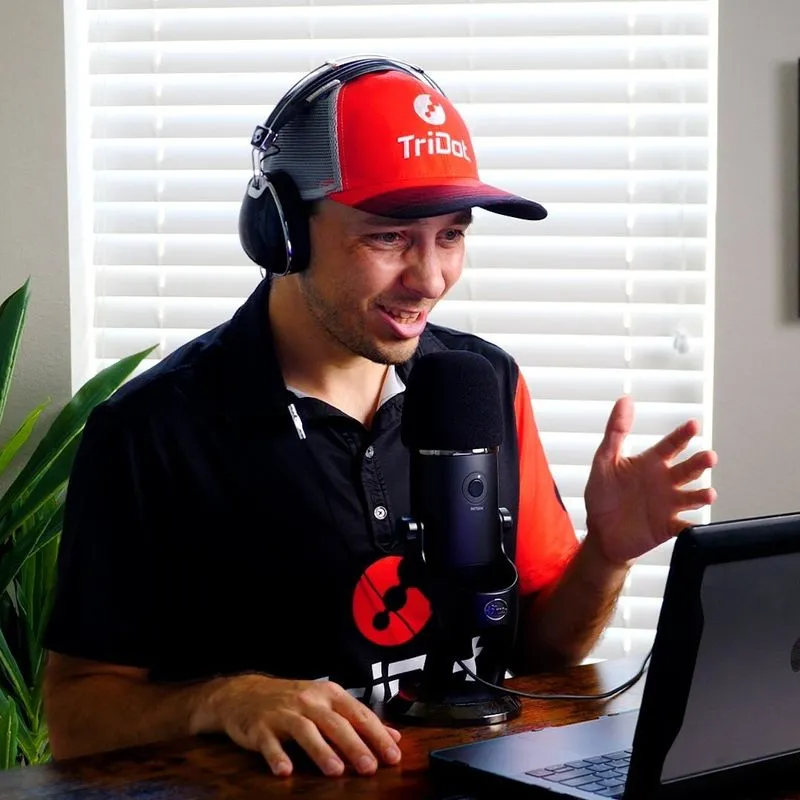

What happens when the swim, the first leg of your race, gets cancelled? Fresh off their experience at IRONMAN 70.3 Little Elm, coaches Julie McPhilomy and Tony Washington dive into the reality behind a scenario some athletes dream about…and others dread. From unexpected changes in pre-race fueling to the mental shift required on race morning, they unpack how a cancelled swim can throw off your rhythm, emotions, and overall race strategy. They also break down the practical side: how pacing on the bike needs to adjust, what logistical challenges arise, and how to stay adaptable when race day doesn’t go as planned. With a mix of expert insight and personal stories Julie and Tony explore what really happens when the race you trained for suddenly changes and how to handle it like a pro.
TriDot Podcast Episode 339
What to do When Your Triathlon Swim is Cancelled
Andrew Harley: Welcome to the TriDot Podcast. Every so often, when a triathlon event comes around, the swim sometimes, occasionally, gets canceled. And your triathlon that you've been dreaming about, training for, becomes an aquabike, or a duathlon, or something different, depending on what's canceled and what's happening. But today, I've brought two TriDot coaches on to talk to us about what to do, as an athlete, when the swim of your event gets canceled. There's a couple variables, here, that we're going to learn from Coach Tony and Coach Julie. They are the co-founders of No Coasting Coaching, based in Chicago, Illinois. Coach Tony and Julie have over 40 years combined in the sport, and just a few days ago, they had the swim canceled in their very own race. So Tony, Julie, welcome to the show, and tell us, what happened to the swim at 70.3 Little Elm?
Tony Washington: Great to see you, Andrew. Yeah. Swims get canceled at all sorts of different times, and this is the latest I've ever seen. We were wetsuits on, goggles in hand, walking down to the swim start, about 20 minutes before we were getting ready to swim, when the swim was canceled. They announced-- there had been rumors about it for the last, probably 45 minutes. And we're like, oh, what should we do? And I'm like, let's keep on getting ready, and when they make an announcement, we'll hear the announcement, kind of thing, so we can hear it. Thankfully, they were just reading the message that was on the IRONMAN Tracker. And so yeah, so about 20 minutes before the start of the swim, they canceled. Pretty interesting. They announced that the pros were going to do a short, short swim, using a time trial start, and then we were going to be canceled, and then expect to start about 8 in the morning.
Julie McPhilomy: They originally had a little bit of a rumor that we were going to be shortened, as well. So there was a lot of confusion, on everybody buzzing around their bikes and getting ready, whether it was going to be shortened or what was going to happen. But in the end, it was all together, nothing for the age groupers, and 350, I think, 350 meters for the pros. So a little disappointing, but that happens.
Andrew Harley: It happens. Yeah. I'll try to hold my follow up questions, and hold my own personal stories for the main set, when we're talking about what to do when your swim is canceled. But on this particular event, so my house, where I live, is 23, 25 minutes from Little Elm, where the race site was. So I definitely wanted to make sure I came out and supported a little bit. Full disclosure, we had a family weekend. Our daughter turned three, so we had her three-year-old birthday party on the Saturday before the race. We had a lot of family in town, and so I knew I couldn't be there like all day, like I normally would be. And so I was definitely not going to wake up super early in the morning and get out there to be there at the start of your race, but I wanted to be out there while all the athletes were running and finishing. So I woke up at a normal wake up time and checked my phone, and that's when I started seeing a lot of my triathlon friends posting about swim is canceled, swim is canceled, swim is canceled. And I was like, yep, that kind of makes sense. But we'll talk more about it in a little bit. I am Andrew the Average Triathlete, Voice of the People and Captain of the Middle of the Pack. Today on the show, like always, we'll start with our warm-up question, settle into our ‘swim being canceled’ main set topic, and then we'll wind things down by asking Coach Tony and Coach Julie an audience question on the cool down. Lots of good stuff. Let's get to it.
Announcer: This is the TriDot podcast, the triathlon show that brings you world class coaching with every conversation. Let's get started with today's warm-up.
Andrew Harley: Coach Tony, Coach Julie, for our warm-up question today, I was thinking about other sports, right? Because if you're in triathlon, you're athletic, you are competitive. Most triathletes have probably dabbled in some sort of other sport in their lifetime, and competed, and sometimes excelled, sometimes not excelled. I'm curious today, of all the sports you've tried in your athletic journey, what was the sport you were the worst at? Not the best. What was the one you were the worst at? Let's have a little fun today. Julie, what do you got?
Julie McPhilomy: Oh, this one came immediately to my head, and it is darts. I am a terrible, terrible dart player. Terrible. I have played a lot of sports in my life, and I just assumed that I would be okay at it. I didn't have to be great, but just okay at it. And I am lucky that--
Andrew Harley: You put a lot of holes in the wall?
Julie McPhilomy: Yeah. I am lucky I can hit a dart board, which is bizarre. But anyhow, that was what immediately came to my head, was darts.
Andrew Harley: I like that answer. Have you ever watched darts on TV? Like on ESPN2 or something? It is dope. It is so dope. The energy, like the crowds get hyped, the competitors get hype. It's pretty cool to watch, actually, surprisingly, somewhat. Tony, what's this answer for you?
Tony Washington: So I've been super lucky. I've been very good at almost everything I've tried.
Andrew Harley: Good for you, my man.
Tony Washington: Except for tennis. And I know you're both big tennis players, I know. And this was highlighted, I've always known I've been horrible at racquet sports, but in the taper for 70.3-somethings, about 10 years ago, it seemed like a fantastic idea that my taper activity would go play Julie some tennis for about an hour.
Andrew Harley: That sounds like a bad idea.
Julie McPhilomy: It was a great idea.
Andrew Harley: Tapping into some muscles that you haven't used in a long time, my friend.
Tony Washington: 100%. My knees and ankles were on fire. Julie's standing in the middle and not doing anything. I'm running all over creation. The ball, I think we started with 12 balls, and we ended up with just one. They're all over the place. They're probably one still floating in Lake Michigan. It was horrible. And you've seen me, I'm pretty long. I can get to the ball. Well, I just can't hit it with the little racket. So tennis is, same thing, it immediately came out as my ‘I am not good at that.’
Andrew Harley: Julie, do you ever look at Tony -- and so Julie and I, if you have never seen us, we're not tall. Julie and I are both shorter, for tennis players, especially, Do you ever look at Tony and think, if I was, if I had one of your feet tacked onto my body, my serve would be so fire. Do you ever think that?
Julie McPhilomy: I think it about almost everything, because five foot 3 doesn't get me very far. And I would love to just shave down a little of his height and take a little back, just to have anything. But when I think of his reach up to net like I am like, how? How can you not hit it?
Andrew Harley: How do you lob him? You can't.
Julie McPhilomy: You can’t. But he lobs me very easily, so there you go.
Andrew Harley: Yeah. But this answer for me, I am very bad at basketball. I'll say that one. I've never played in a competitive league, but just pick up with buddies. I'm extremely bad at basketball. I can be annoying on defense, because I'm fast, and I'm just going to try to get on your nerves and poke at the ball. But I can't shoot to save my life. I'll steal the ball on defense, I'll run all the way down the court, there'll be no one around me, I'll go for a layup, I'll just be moving too fast to make the layup. I'll miss a layup off the bat. I'm just not a good shot. The sport that I actually played in a league and was the worst at, as a kid, I was horrible at baseball. I was good in the field. I could catch, I could throw. I had good, quick reactions. Could not hit the ball to save my life. It was just an absolute horrible batter. Which I don't understand why, because, again, tennis player. So it's not a hand-eye coordination thing. I'm a good returner in tennis. But anyway, ball’s smaller, bat’s smaller. Yeah. Horrible at baseball, as well. Those are my answers. We're going to throw this out to the TriDot community. Find us on the socials. If you're watching on YouTube, watching on Spotify, you can comment right below. I like seeing what everybody's saying and poking responses back to you guys. So let us know, of all the sports you've tried, can't wait to hear this one, which one is the one you are the worst at?
Announcer: Let’s go.
Andrew Harley: On to today’s main set. We're going to talk with Coach Tony and Coach Julie about what to do if our swim gets canceled. Now, we talked to the top of the show a little bit about this happening to the both of you at the inaugural IRONMAN 70.3 Little Elm this past weekend. If you don't know, you see the word Little Elm, that basically means the north, north, north, north end of Dallas. Both of you raced, you were both there, on site, as the athletes were finding out there would not be a swim. What was the vibe from the race field, and the athletes around, you when the swim got canceled? What were people saying?
Julie McPhilomy: I think it was a really mixed emotion bag, if you will. We were lined up with quite a few first timers. The race itself had 70% first timers. So that was a pretty high number. Yeah. And so they were more like, “Well, how's this going to go? And what we're going do?” And I think they were a little bit nervous about, because the winds were so strong, just even in transition, to do anything, to get your stuff ready. So I think they were a little nervous, in general, about how is this going to go? And it seemed to ease people's minds when the rumor was about a shortened swim. Like, “Oh, okay, good, we can do that. We can do that.” And then altogether, it kind of changed their mindset to, “Well, how are we going to do this? And how is the bike going to go?” So, I don't know around us, per se, if there was a lot of disappointment, as much as I don't know how to handle this. That seemed like more of the vibe that I experienced around me.
Tony Washington: Yeah, definitely that mixed feeling was with everybody. Some people were disappointed. “Well, now it's not a triathlon.” For the first timers--
Andrew Harley: Yeah, true.
Tony Washington: --well, you're still here. You did the work. Definitely some relief, right by me. Somebody was like, “I was very afraid to make the swim cut off, so I know I'm a bike/runner.” I’m like, “Well, you're going to be great.” So just that huge range of emotions. And then as the reality hit, how are we going to deal with this? So it was definitely a mixed bag of emotions for every folks.
Andrew Harley: Yeah. And I know TriDot Podcast regular, TriDot Coach, TriDot staff member Elizabeth James was racing that day in the pro field. And Elizabeth is very open about the fact that for a female pro, she fits right in as a runner. She fits right in as a cyclist. She's a little bit of a weaker swimmer, for a female pro, and she knows that. She's not a bad swimmer. Elizabeth can swim circles around, probably, all three of us. Definitely me, I can admit that. And so it actually, it played in her favor, and she was excited about, okay, we're still swimming, but it's a shortened swim. So now I cannot lose as much time in this race and really be in the thick of things on the bike and run. So it's interesting how, even at the pro level, that there's probably a mix of reaction, just like what you're talking about. Now, in Little Elm, it was a windy day, and those high winds led to very choppy conditions in the lake. That, honestly, it was, when I looked at the forecast, I think it said gusts up to 20, 30 miles an hour. And then as the day got on, it was supposed to become gusts up to 40, 50, 60 miles an hour. Now, in Dallas/Fort Worth in the spring, 20, 30 miles an hour is very typical. 50, 60 is not very typical. That's got some extra juice. And when I arrived on site, it felt like a normal Dallas day. It was windy, but it wasn't absolutely wild. And like while athletes were on the run course, it just turned on a dime, and the wind got bonkers. Right? It got absolutely bonkers. We can talk about that in a little bit. But anyway, you know, the race director of this event is a very experienced race director, who's from the state of Texas. She knows Texas lakes, she knows Texas weather. And interesting, I didn't realize how close you were to the race starting when they finally made that decision and called it off for the age groupers. But just in general, to get away from this certain race and get just a triathlon training and racing, in general, for the rest of our audience, in your experience, in your years of being on site at these events, what are some of the different reasons you've seen a swim get canceled? In this case, it was wind. But what are some of the other things an athlete might need to be on the lookout for heading in the race weekend?
Tony Washington: Definitely. There's several different races I've been to that race has been, swim has been canceled. One was IRONMAN, or 70.3, of Racine, probably 9ish or 10ish years ago, caused by wind. Swim was in Lake Michigan, and had a wind shift, and the water on Saturday went from 68 degrees to 49 degrees Sunday morning. When the winds shift like that, it literally blows all the hot water away, and all of the cold water wells up, in an early season race, in Lake Michigan.
Andrew Harley: So it's water temperature?
Tony Washington: Water temperature driven. I've had another, I did a shortened swim in Alcatraz several years ago. The current was so strong that-- the Alcatraz current swim is unique anyways, but it was so strong that they were afraid people weren't going to even be able to make it to the swim exit. So they lined up the boat along the shore, and the visibility wasn't awesome, also, so that you could actually see something, so you could see the shore. And it was, to just jump off of a boat, raft of Alcatraz, it was a very, very, very strong current. In fact, people were -- somebody had done an overlay of a bunch of Strava routes from the boat to swim exit. I was the furthest most left person. People were almost a half a mile off course to my right, going to be swept out--
Andrew Harley: With a shortened course.
Tony Washington: Yeah, with a shortened course, being swept out to Hawaii. That's how strong the current was. And then, despite that very strong current, I was still-- I'm a decent swimmer-- I was still barely able to get out, just past the swim exit, when I essentially swam for 10 or 15 minutes in place. And then a person on a paddle board just said, just go to the beach. And essentially, went with the current to the beach.
Andrew Harley: Like, I'm trying to.
Tony Washington: Yep, exactly. And then ran back a quarter of a mile back to swim exit. Some people overshot that swim exit by over a mile. That's how strong the current was.
Andrew Harley: If you're going under the Golden Gate Bridge, you've gone too far.
Tony Washington: You've gone too far. If you see this bridge, you turn around. So had they not gone to that modified start, people would have been, we'd still be looking for them.
Julie McPhilomy: One of the big things for me is, and I'm usually okay when they cancel it, because of this, is poor water quality. Sometimes a storm or something, the heat, because if it's not wetsuit-legal and it's too warm, it creates all this disgusting bacteria, sometimes. And sometimes, I'm okay with that, going, “Yeah, you know what? My body will thank me later.” And there's nothing they can do about that. It's just, that's Mother Nature doing its thing. But yeah, it's still disappointing, nonetheless. But, yeah, poor conditions, water quality. Yuck.
Tony Washington: So there's been rumors of other races being, swims being canceled for wildlife.
Andrew Harley: I saw one recently. Did you see one recently? I think it was IRONMAN-- I don't remember if it was IRONMAN or Challenge Family, but it was a major race in Australia that had the swim canceled for a crocodile. A saltwater crocodile sighting.
Julie McPhilomy: Maybe I'd be okay with that, too.
Andrew Harley: Yeah, I certainly would be. I certainly would.
Tony Washington: There’s drone shots of another race that probably should have been canceled for wildlife, because it literally showed two giant sharks swimming close to some folks. Very close. Probably only about 50 yards away, for a shark bigger than me. And there's even mention of sharks in the athlete's guide for Alcatraz. There's never been an issue. So wildlife might be another reason to cancel.
Andrew Harley: Yeah. The first time it happened to me, it was actually a local sprint triathlon, here, in the Dallas/Fort Worth Metroplex. If anybody watched the PTO Dallas event a few years ago, Lake Carolyn, a little lake in an urban area outside of Dallas, I was doing a sprint in that lake, and we had just had a ton of rain in the Dallas/Fort Worth Metroplex, and so it had caused some of the sewage systems to overflow. And so they tested the water quality and, hey, there is too much poop in the lake from all of the -- This is really good podcast fodder, right? Everybody's really enjoying hearing about lake sewage breaches. But, Julie, I mean, my reaction, I think it was supposed to be my second, third, fourth triathlon. It was pretty early in my triathlon career. And so obviously I was excited to do a triathlon, but my reaction was like, it's so good to know that I'm getting into, as I get into the sport, that they do test, and they take those tests seriously, and they don't just say, “Oh, well, we'll hope it goes okay.” It's good to know that even at the local level, they're testing the water quality. It's got to pass certain thresholds for them to put swimmers in the water. And that was kind of good to know. The second time I had my swim canceled was the inaugural Half IRONMAN in Waco. The swim is in the Brazos river, and kind of same thing, Central Texas had a ton of rain before. The Brazos river was much higher water levels than normal. The current was just pretty wild going down. And as soon as we were pulling into town and crossing over the Brazos river on I-35, days before the race, you just saw the water flowing, and you're like, yeah, we're not swimming. And it was for good reason. So anyway, something that athletes might have happen, and you both mentioned earlier, in Little Elm, there was some talk of, well, maybe they'll shorten the swim. And this does happen periodically. The swim doesn't get canceled outright. It just gets shortened. It almost happened at Little Elm. It did happen at Little Elm, for the pros. I remember TriDot Coach April Spilde was on the podcast a number of years ago, and we were talking about her IRONMAN Alaska race. And because the water temperatures were so cold, they let them swim, but they shortened the swim to limit everybody's exposure to that cold water. So anyway, for some of the reasons we just mentioned, sometimes they can just shorten it and not fully cancel it. When this happens, what should our approach be, both physically and mentally, to now pacing that shorter swim distance, and just wrapping our heads around, okay, the swim isn't as long as I was preparing for?
Julie McPhilomy: For me, I am not the stronger swimmer of the two of us. I'm very mid-pack-y on that swim, so I don't change a lot. For example, they said the rumor was about 750 meters, which is average of a sprint. However, the rest of the race is not going to be a sprint. So the thought of swimming as hard as I would in a sprint, which is different than what I typically swim in a 70.3 or a full distance. So for me, I wouldn't have changed a whole lot, I think, in my approach. Just being the type of swimmer that I am. Knowing that I have 56 on the bike and a half marathon to run, I didn't want to use up all that energy that I would possibly use to save myself for what was going to be the windy bike course. I knew a lot of energy would have been taken out of me, there. So for me personally, I don't think I would have changed a lot on that. And just try to stay calm and keep that heart rate down as much as possible. That would have been my approach.
Tony Washington: I'm with you. Same thing. Part of the end of the swim, for me, is helping to manage how my heart rate's going to be on the first couple of miles on the bike. If I were to go very hard on a swim, that's going to be even harder to manage that heart rate back down. So same thing, I would come out, I'd swim solid. But manage, manage, manage so that I'm using the same protocol I'm used to, to manage the heart rate as it comes back down off the swim. Sometimes the peak heart rate of a whole day is the long run out of the water to your bike. There's plenty of races where it's a long race. Alcatraz, I had just mentioned, it's way over half a mile to run. In Puerto Rico, which was, actually, happened to be the same day that Little Elm was, it's a long run over cobbles, and doing it in a wetsuit with slippery cobbles is stress inducing. And there, it's like 90 degrees already, by then. So your peak heart rate might be there. And if you start out with a high heart rate, of something you're trying to advantage from a short swim, that might be detrimental for the rest of your race. So I would just keep with the same pacing, solid swim, keep in your plan for the normal half swim, and then press on.
Andrew Harley: I think what one thing I'll say here, is it's good to remember that the swim was shortened for a reason. And when you're in the water, you are dealing with that reason, right? The water's either colder than it needs to be, or it's choppier than it needs to be. A current is stronger than it should be. And so if it's me in the water, it’s like, okay, maybe I can push a skosh harder, because it's a little shorter. But overall, let's pay attention to this extra environmental concern, or this water condition, that's causing this race to be shortened in the first place. And let's make sure we don't get ourselves in trouble by pushing too hard in water conditions that are more challenging than normal. Let's focus on the challenging water condition, and let's get through that unscathed. That would be, I think, what I would be thinking in my head.
Tony Washington: Perfect.
Andrew Harley: Now, oftentimes when a swim is canceled, it's not a shock, right? I shared about Waco. We could see, driving into Waco, yes, we are not swimming today. Sometimes it's 50/50, right? You guys were on the beach, in Little Elm, looking at the water, maybe hopping in in 20 minutes, maybe not. And you just didn't know. So before a race, when it truly is 50/50 like that, and you kind of shared, Tony, for you, you guys are just like, “Okay, well, we have to act like it's going to happen, because we're here, and it might happen.” Talk to our athletes about that moment. How should we approach? Do we truly just treat the whole race morning like normal? Do we treat it like normal with some caveats, of hedging some bets, for having a plan B for if it doesn't happen? How do we treat race morning, when it's really 50/50, up until the end like that?
Julie McPhilomy: I think for me, I always go into it with a plan B. I go into every race with a plan B, and it may not even be swim related. But for this case, for sure, I went in thinking, how are they going to handle that, and how am I going to handle that? How do I approach the bike now? How do I approach these things now, nutrition-wise? All those different little things that happen that disrupt your morning. Sometimes, when they cancel a swim ahead of time, you may be able to wake up a little later, because you already know about it. So how are you going to adjust there? So there's always a plan B rolling in my head. And that's something I also discuss with other athletes that I work with, of just not being shocked by something, and let that rattle the rest of your day, because it can be very disrupting, and nerve wracking, and you use so much energy stressing about these little things. So I try to always have, this is my ideal plan A, and this is a very good plan B. And have those two things that I'm very okay with going into a race.
Tony Washington: Definitely, when you've thought about those things, literally, that just reduces the amount of cognitive load you have in that morning. The morning's already busy. You're like, okay, hey, this might be a problem. Putting on a wetsuit can take a long time, should take a long time. So, as you're putting on your wetsuit, thinking, hey, this is going to happen. I'm going to have a full swim. I might have to deal with some conditions. Let me think about how those things are going to happen. It's cold, it's windy. How is my sighting going to change, because these winds are going to be coming from this? Those kind of things. How am I going to get blown off course? What was I looking at when doing the practice swim? How's that going to look like during this, if there's a big crosswind or something? And, what am I going to do if this is canceled? Okay, so I might have an extra port-a-stop in the transition. Thankfully, in Little Elm, they had a whole bunch of extra port-a-johns that they opened. Yes, exactly.
Andrew Harley: Shout out to the race director for that.
Tony Washington: She did amazing. Every port-a-john in North Texas was in Little Elm on Sunday, so those were opened up, made the lines relatively short. Had some great conversations, in those lines, about what going to be happening and getting ready for the day, once it finally did happen. But yeah, for me, putting on that wetsuit's almost the start of a ritual and thinking about that. But while that wetsuit was hanging out at my waist, okay, what's this going to look like if we do swim, and the sun's starting to come up? I'm like, okay, I’m probably not going to swim, but how is this race going to start if we do not? So we started some of those conversations and helped ease some minds as the decisions were made, eventually.
Andrew Harley: Yeah. And we'll talk about what the new race start looks like in a moment. But before we do, I want to just visit about the emotions first. We talked about earlier, when you guys were hearing other athletes around you react, some people were happy, some people were disappointed, some people were, oh man, it's not a triathlon anymore. Some people, well, it's still the race that I'm given, so I'm going to go do it. There's a wide range of emotions that we can feel. And I know, for me, the first big race, my first IRONMAN scale event, that I had that swim canceled was 70.3 Waco. I think I just rolled with it, and I was fine. It didn't really phase me, because it was just a half IRONMAN down the road for me. It was 90 minutes from my house. Whereas the times I've traveled, right, I went to IRONMAN Greece, I went to IRONMAN, or half IRONMAN New Zealand. If I had traveled halfway around the world for a race, and then the swim gets canceled, and that was my A-race, my big dream race for the season, I would have been very disappointed. And so even you as an individual athlete, you can react one way to a certain event having the swim canceled or shortened, and then you can react a whole other way to a race you care a little bit more about, or have been dreaming about, or have a big goal around. You might have a time goal. Oh, I want to go under six hours today. Well, now that's totally thrown out the window, because there's no swim. How would you coach an athlete to handle just the possible range of emotions they might feel when they lose the chance to do the full race?
Tony Washington: Right. You start with those things, exactly. And thinking about things before, and then I always have a sense of optimism. Hey, at least we're racing. I've done, and been to places plenty of times, where there's no race. You get an alert at 3 o' clock in the morning that definitely the thunderstorm flipped everybody's bikes upside down and the city is flooded, so we probably shouldn't race.
Andrew Harley: Where was that? New Orleans?
Tony Washington: That was in Milwaukee last year--
Andrew Harley: Milwaukee?
Tony Washington: Yeah, for nationals. So we had done the sprint on Saturday, and we're getting ready to do the olympic on Sunday, and there was a massive, massive, was it 12 inches of rain overnight? So the city's underwater. All of emergency personnel in the city were working to help manage that, and probably shouldn't have a triathlon through the middle of their city in the middle of all that. The transition is underwater. The expo is underwater.
Andrew Harley: You can just swim straight to T1. Just swim all the way down.
Tony Washington: Exactly. Yep. Probably nobody around and available to test that water. That water probably was not awesome. Then IRONMAN California was canceled overall because of the bomb cyclone years ago. So we helped, we're actually in person there, with a friend of ours, and helping manage her emotions, like, well, I flew all the way to California from Chicago to deal with this. So you're managing those emotions, like, okay, I'm not going to get to swim, using this particular event, but we're still going to be able to bike, to run, and we're going to, hey, this is how we're going to deal with the, you know, the ‘win’, the big star of the whole race, this is how we're going to deal with this. And thankfully, like we mentioned, there's 70% newcomers. Thankfully, the race director made up very, very good, positive decision to keep everybody safe, out of that water. I'll swim in a hurricane, but I do not want other people to swim in a hurricane. And it was not safe. I think one of the key drivers for that decision was the emergency personnel on the water weren't able to stay in place. A stand-up paddleboarder can't stand up in a 40-mile-an-hour wind and waves. So that really helped drive that.
Andrew Harley: And that, Tony, is a really good point that I think not every athlete realizes when they're on site. You might be a good swimmer, the pros might be good swimmers. And that's why often the pros can go when the age groupers are held back, is because, okay, we're trusting they can all swim to a certain degree. But the race director has to consider the entire field, and not just the good swimmers. And they have to consider what the conditions are going to be like out there for the emergency personnel. Those are two factors that they are making that call for, the weakest swimmer in the water and for the emergency personnel. It's not necessarily about what the experienced end of the field is going into. Julie, anything you'd like to add, just about what emotions you could have and how to handle those in the moment?
Julie McPhilomy: Yeah, I think a few people, especially the stronger swimmers of the group, and that we're looking to say, maybe, grab a world championship slot, they're going, “Hey, that's my advantage. That's where I gain my advantage over my competition. And I would place higher if that was the case, because I can get out of the swim 10, 15 minutes faster that than that individual.” So if all your eggs are in this A-race basket to go to a world championship event, that is a lot of emotion to deal with. And in our case, it was right before you were to leave. And so I think for me to tell somebody else, or an athlete, or even myself, is control what you can control. And one of the things that is big on that, saying, okay, well, nutrition-wise, or pacing-wise, or all of those little things that might go right, wrong, or in racing, you never know what's going to happen there. But really, really put the focus on those things, because if that gives you the advantage on the bike, or advantage going into the run, really take those emotions to, “Uh oh, the swim is not there anymore for me. How am I going to try to get that slot the best I can?” And really try to refocus those emotions to a positive thing for yourself, and get your headspace around it, and saying, all is not lost just because you thought that that was going to be the reason that was going to get you that slot. You have to be trusting yourself, that those other disciplines are there to help you, as well.
Andrew Harley: Yeah, I think, to Michielle Jones, coaches with TriDot, she's from Giddy Up Racing. She's got the Giddy Up Edge Podcast, comes on the podcast regularly. IRONMAN World Champion, Michele Jones. She's got some credentials to her name. But I love a quote that she says all the time, where she says, “Celebrate the race you had, not the race you wish you had.” And that's on the backside of a race, right? That's like, you crossed the finish line, maybe it didn't go the way you wanted it to. Something went wrong, something slowed you down. Celebrate the race you had. You did what you could with what happened out there. To me, it's like the inverse of that. Race the race you're given. You can't dwell on every single detail. Tony, like you said, we still got to race, it just wasn't exactly what we think. I think, too, in my family, I have two sisters and a brother, so there's four of us, and then we grew up right across the street from two of my cousins. And the six of us were all within a couple years of each other, all going through middle school at the same time, high school at the same time. And so fast forward, we're all getting married in the same couple years, right? And the six of us all had outdoor weddings. And at one of my cousin's wedding, it was just a pouring rain, thunderstorm, muddy event. And the rest of us had beautiful sunny weddings. And so my dad says it really well. He's like, “You know, the odds are, you have six outdoor weddings, four of them in Florida, we actually came out okay, only having one of you guys having a rainy wedding.” And so the longer you're a triathlete, the more races you do, eventually, you're probably going to have a swim that's shortened or canceled. And if you set that in your head now, when you encounter it, it's going to be, oh, here it is. I knew this was coming. And maybe that'll just help you flex with it and roll with it. And I did have, I had one race, Tony, like you mentioned in Milwaukee, I had a race in Key West, Florida, that I traveled to, that the whole race got canceled because of a thunderstorm that happened to roll through right at the race start. And I just went back the next year and did it the next year. And it was what it was. Anyway, getting back to logistics of handling a race where the swim is canceled. One of you mentioned this earlier, but the rhythm of the race, the schedule of the race, literally changes, right? Maybe you were scheduled to, the rolling start for the swim was going to start at 7:00am. Well, now we're going to change it to a bike start at 8am. It can be literally a whole hour, 30 minutes, 45 minutes, 2 hours—literally, the schedule of the day is going to flex a little bit. And in your case, you found that out the morning of. Sometimes athletes find that out the day before, depending on why the swim is canceled. But when we look at the changes to the schedule, we've all done the math on when we need to eat breakfast, when we need to visit the port-a-potties, when we need to do this to our bike, and this in transition, and this over here, and have our last gel. When the schedule flexes, what do we need to think about and do to flex with the changing of the schedule?
Tony Washington: Definitely, there's a bunch of things. So for us, we found out late, and it was going to be about the time we were going to be coming out of the water, because they timed it well. Road closers are based on how the permits they put in. So they have all of the support staff closing the roads, and those kind of things. So you got to do that on time. We can't slide those things back too much. So we, once everybody got settled in, like, oh, hey, it's going to be canceled, everybody relaxed a little bit, had some sips, double check their bike, like, okay, now what I'm going to do? Put my wetsuit away, put my goggles and cap away, redid their transition, as you're thinking about the schedule. And I had had my pre-race bottle anyways. I hadn't quite finished it, so I finished it. And then promptly had to go jump in the line, again, to go to the bathroom. Thankfully, the port-a-johns were open, not too, too long of a-- but it definitely influenced the timing of that nutrition. You think about, hey, that big meal, like you alluded to, that you had, supposed to be at three hours before race start, it’s now four hours. What has happened? You haven't burned that hour of energy swimming. Now, you've been sitting, using a little bit for your brain, as you've been thinking about, but it's definitely nothing like swimming in a murky lake in Texas. So that timing of nutrition, and the timing of standing around on your feet. That's the other thing, it’s like, hey, it's an extra hour of standing around on your feet. If you're preparing for, getting ready for a full, standing around for another 45 minutes or so on your feet can definitely add to your load.
Julie McPhilomy: I think, too, is we got a little caught last minute with it, but I call it the fluid intake. My pre-race morning usually has an electrolyte bottle. I have my breakfast, I have all those things, but as I'm doing things in the morning, I'm constantly sipping on this electrolyte bottle, trying to top it up before I go in for a long day, especially if it's going to be a hot day. And all of a sudden, you're like, uh oh, there's no swim, and I’m immediately going to get on my bike, and will I have to stop at that first aid station? I mean, that's a thought process that you may never have to stop at an aid station on a 70.3 bike. But if you've been sipping on that bottle all morning, and not sweating, and not doing activity, and so on and so forth, so that's a consideration. It's weighing those options for yourself. I tended to go more towards the gel route, in general, just because I know myself, and I know how I react to things. And so gels were my friend in the morning, as I sat there. But as Tony mentioned, I tried to stay off my feet. I found a little place I could sit down at, or even at my bike, that, yeah, you're going to be sitting on your bike for however long you ride it’s going to be--
Andrew Harley: Don't walk around for an hour and get an extra hour on feet.
Julie McPhilomy: Yeah, it really does make a difference when it comes to the run. You can feel that morning time on your feet. So for me, I tried to take a sit someplace and just wait and see how they're going to do it, and where we're going to go, until those decisions were made. And then kind of last minute, got popped up at my bike and off we went.
Andrew Harley: If you're on the race site, right, and you're already going through the motions, and it gets pushed back, it's just resetting the clock, and okay, let's take another gel, or whatever nutrition is. Let's drink a little more fluids. Let's visit the bathroom, again. It's just replaying the motions you would do, just again. And if it's a day prior, you're probably seeing what the new schedule is in advance, and it's just pushing everything back.
Julie McPhilomy: That gives you an extra hour's sleep.
Andrew Harley: That's my dream. That's my dream, right there. I'm a sleepy-head in the morning. Now, both times this happened to me, both in my local sprint and at 70.3 Waco, at the IRONMAN level, they changed it to a rolling start on the bike. And so instead of a rolling start on the swim, it's -- they can't do a mass start. They can't have everybody just take off, on their bikes, at once. So it's a rolling start on the bike. I think in both instances it was by bib number. Rolling start on the bike. Is that what they did in Little Elm? Is that what the normal new start of the race looks like?
Tony Washington: They did. By bib number, which when you think about it, it's completely random. In the swim, that tends to spread everybody out. If you're a faster swimmer, you might be in the pointy end, and then we'll be spread out, and some of those folks are stronger cyclists. But by bib number, completely random. There's other races I've heard of, when it's canceled a day or two out, where it might be, hey, what is your estimated bike time, if they have that information? I don't know if IRONMAN asked that anymore, but these days, it seems to be all by bib number. And we were given the, hey, it's at 8 o' clock, line up two by two, here are the racks, you’re going to go--
Andrew Harley: Roll, roll, roll, roll.
Tony Washington: Exactly, roll. And every five seconds, two people left. So it's is really well organized to try to spread everybody out best you can. But it definitely was a different dynamic from the normal swim.
Julie McPhilomy: Yeah, our bib numbers were in the 500s or so, so we were towards the front end of the race. Which for me, actually made me thankful that I went early to get my bib, because it was a little extra, less time out there for me, and I guess maybe in my brain, anyway, in the heat. So the longer you're standing around to start, the hotter it gets on the run and things like that. So for me, it was like, okay, I may be starting even a half an hour, 45 minutes, which can make a huge difference on just those variables. So for me, I was like, well, woohoo, I'm in a earlier number, that's winning for me.
Andrew Harley: And that's a really good point for, if you're going into a race, and there's a chance it could be canceled, either due to just what the weather forecast is looking like, or just what the race water venue, what's happening there. I mean, if you know it might be iffy, maybe get to that registration, race check in, as early as you can, to try to get the lower bib number, to try to get the earlier start time, should something go awry. That's next level triathlon chess there, Julie.
Tony Washington: And definitely a benefit for the folks who are All World. Didn't make it for 2025, so the All World athletes all have in the first about 200 or so racks.
Andrew Harley: People, I think, with VIP passes get earlier racks. Sometimes if you're with a tri club, they give tri clubs the earlier racks, as well. Really interesting. So when I got there, like I said, I slept in. I didn't worry myself too hard to wake up early and get down there soon. But again, I was trying to time it, where I would arrive on site as athletes were about to finish the bike and get on the run, so I could see a lot of people. And as my dad and I were walking up to the race site, we had parked, we would walk down, the very first person I saw who I knew, shout out to TriDot Ambassador Tim Farwig. Tim Farwig is a USAT official, so he travels around -- he races himself throughout the year. But he will serve as a race official, just at a variety of events, every single year. I see Tim all over the country, when I travel for TriDot, and he's always there. Now, for this particular event, he was on one of the motorcycles patrolling the bike course. And so he had already come in, and he had his motorcycle parked, he'd served his shift, if you will. And I saw him, I walked up, and he and I were catching up for a little bit, chatting for a little bit, and I asked him, hey, how was it out there? And he was like, he goes, “With the rolling bike start, it was a little more challenging than normal. We had a lot more things to keep an eye on.” And literally, it was interesting to me, the two things he said, one, obviously the bike course is a little more crowded, because you don't have to swim breaking all the packs apart. And then two, the strong cyclists were all over the place. Because instead of the strong athletes out swimming everybody, getting out of the water early, and getting on the bike early, because it was just by bib number, you had strong cyclists starting all across the field. And so there was a lot more passing, being passed, overtaking, packs getting in the way of athletes trying to overtake than would be normal. And so I never would have considered that, right, as an athlete. I never would have considered, oh, there's probably a lot more stronger cyclists behind me than usual. I need to keep my head on a swivel. What did you experience out there? What would you tell an athlete out on the bike course to just keep in mind, for a race where the swim is canceled like this?
Tony Washington: Definitely. For me, I had alluded to a little before, when you're trying to manage your heart rate coming out of the water, this first little bit might be managing your heart rate. No issues with that. I looked at my heart rate as I put my foot in there, it was 68. I'm like, let's go. I have a 100 beats a minute to catch up. I went out hot. There was a very strong tailwind. I settled down into my race watts, and I was going almost 30 miles an hour. There was some people less sure in the wind, who were not going that fast. And I believe, just kind of looking at it, in the first hour, I passed over 200 people. So it was a continuous flow of people going by. I'm going over 40 miles an hour in some sections, and some people are going in the teens, down some little hills, with some of the crosswinds, with me in aero, hammering. And it felt, well, it was very invigorating, having everybody coming to me. But I could definitely -- and people were giving a lot of room. So thankfully, that worked out really well, even in the big room. But those, definitely, groups of folks just being easy and riding with, almost together, in sympathy, and the winds are just holding on. But I was a 560 number or so. But there’s 2,300 folks racing. So you talked about, if you're number 2300, and you're a 220 biker, you're going to probably pass 1000 people, maybe more, and then come up on packs, and come up on groups. So I didn't have a lot of—
Andrew Harley: Coming up on aid stations with a lot more bikes around.
Tony Washington: Yep. Yeah, exactly. There was one aid station off a little out and back, on one of the busier roads, they put the outback there. So you biked into the aid station, going 1,000 miles an hour into the wind, and then turned around, going zero miles an hour into the headwind, and then seeing all the other people you just passed. And it was pretty busy dealing with the wind, and talking about the wind, specifically, and riding. Plenty of people were stopping to grab a bottle of water, because it was dangerous to pull your water bottle out and ride with one hand. I did a good job of keeping on my nutrition. I think people, there seemed to be a lot of carnage later. So possibly, some people didn't stay on plan for their nutrition because of that specifically. It ended up being a relatively warm day, and then because of the wind, it probably added 20 minutes, half an hour, to some people's bikes because of just dealing with the wind. You have a great tailwind, but you're spending almost two hours into that headwind and just dealing with that. But yeah, some of the, definitely, parts, there wasn't very technical parts. There's a couple of hills. You got a hill and wind coming home. I had been--
Andrew Harley: That's the combo, right there. That's the combo.
Tony Washington: Yeah, exactly. Had been going 40 miles an hour 40 minutes ago, and now I'm going 4 miles an hour up this hill.
Andrew Harley: Up the hill, into the wind.
Tony Washington: Exactly. There was those pictures from the folks on the, the finisher pics, that people were walking that hill, because the wind was so bad.
Andrew Harley: I actually like taking nutrition in those moments.
Tony Washington: Exactly. I do the same.
Andrew Harley: Because I'm already going slow. It's going to slow me down, sure. But what's the difference between 4 miles an hour and 3 miles an hour? Just as long as I can go just fast enough to stay upright, I'll pop a gel. Let's do it. Let's eat.
Tony Washington: Exactly. And for me, what I think about also, is it lets me manage my watts. I will be less tempted to hammer the hill if I am taking a drink. So that's how I treat those hills, exactly like that. And that's how I was able to keep up with my nutrition. But for packs alone, like I said, we were in the first couple 500 people or so. Didn't see a lot of big packs, but I suspect it was very pack-y in the back, back there.
Julie McPhilomy: Yeah, I was behind Tony, but I had two different experiences. One, I finally worked my way up-- I'm a decent enough cyclist to get into a nice pack, that I finally got there and had a very violent, rocket-launched bottle of all my nutrition. I am surprised I did not take somebody out behind me. And that was at mile 12, so I had to make a decision to go get it or to leave it. And I went to go get it, because I thought no nutrition is bad news later on. So anyhow, I went to go get it. So then I had to work, again, hard to get back up with people. So that's a lot to manage around a lot of people that are not the same level as you. But then, at that point, while I was doing that, all of a sudden, I could just hear this noise, and I was like, uh oh, somebody's coming. And it was a pro athlete, a male pro athlete, hammering-- I mean, we're standing still, right? So he's going by me. Apparently, had a mechanical in the beginning, which I must have missed. He was off to the side, waiting for a new wheel. And I felt bad for that poor guy, because he had to go around all of us, versus be with his people. And we were very different cyclists than they are. And I'm going, well, if that guy can do it, and keep, what seemed, very calm -- he was very calm, just passing everybody – kind of ride that calmness, and do the same thing as you go by. It takes a little experience to be okay with it, but for me, I tell athletes, and told myself, just be verbal. Tell people what you're going to do. Whether it be at an aid station, or—
Andrew Harley: Ride predictably, communicate well.
Julie McPhilomy: Yes. And as long as you tell them, people will react accordingly. And then when you're going by somebody that might be struggling a little bit in the wind, give them a little encouragement. That's always a bonus on a day like it was out there, is to give those people encouragement, like, hey, we got this, today.
Tony Washington: Definitely.
Andrew Harley: Yeah. And a good reminder as you're talking that, if your swim is shortened, just keep in mind in the water, you're facing conditions that caused the swim to be shortened, and so keep that in mind. When you get to the bike and the run, you often are still, in this case, it was a windy day. It might be an extra cold day. It might be, whatever caused the swim to be canceled, you might encounter, be reckoning with, those same conditions on the bike and run. And so just keep that in mind. It’s really interesting.
Tony Washington: Definitely.
Andrew Harley: So the first time my swim was canceled, I said it, we do the rolling start, we get going on the bike, and myself and so many of my friends racing that day, we all talk about the same thing later. We went way too freaking hard on the bike. Because you feel good, you just popped an extra gel, you just got an extra bathroom break, you got an extra hour to chill before the race started, you didn't swim for 30 to 60 minutes before you got on the bike. And so we all felt great. And so you just start time trialing. This is, for me, it was before I was a TriDot athlete, and so I didn't have RaceX telling me what my plan should be. I was just going off feel and vibes. And I, probably mile 5 of the run, started paying for it. And so talk to us about, for the bike leg in particular, which is so vital to any triathlon, because it's such a good portion of the race. What do we need to tweak in our pacing when the swim is canceled, and we didn't have that extra little bit of energy sapped out of our legs before we get going?
Tony Washington: For the TriDot users, that bike-to-run balance has still got to be there. You may have not had to swim, but that 2-hour, 3-hour bike for a half, 3-hour, 4-hour bike for the half, or maybe 6-, or 7-, or 8-hour bike for a full, man, you have to have swum well enough to relax, and then settle into this bike pace. So I would change almost nothing in that bike. You just felt very fresh. Talk about super tapered feeling, getting on the bike, like I said, very relaxed—
Andrew Harley: Bike the same, but then run better.
Tony Washington: Exactly.
Julie McPhilomy: The feel and the vibes were there, for sure. When you started that-- at least for me. I mean, you feel fresh, you go out. I actually felt-- I knew, just even leaving and turning that first corner out of the parking lot, it was one of those days when you get on the bike, and you're like, oh, it's going to be a good one. Like, you already know. And that was harder for me, to go, okay, well, I got a tailwind, I feel good. The vibes are good. Everybody's ready to roll. And really staying within myself. Like that, that is a-- but I kept saying to myself, you have 30 good miles of a tailwind. Like, use those 30 good miles to your benefit. And when those 20-- because the last 26, they're going to hurt, so be prepared for that. So I really had to tell myself, like, oh, you feel good, but keep it in check. And that was a constant look down. Like, am I in check, to that? Because it just felt amazing. But that, I think is a huge-- because even if you don't have a tailwind, or you don't have anything, you are going to start as fresh feeling as that. And that is a misnomer. That is like, it's lying to you about what-- you're excited, you're ready to go, and that's when you look down, and you're like, whoa, I am not in plan. So that's when you really have to have that reality check with yourself, to not delve into those moments where you feel amazing.
Tony Washington: When you're talking about dealing with those conditions, this race happened to be for the wind, and it did have a contribution to how the bike felt, or if it was cold or something, like you said, for whatever reason, the swim got canceled. We, thankfully, started with a tailwind. If we started with a big headwind from the front, everybody's attitude off the bike might have been a little different, but it felt very, very, very strong. And then halfway through, I'm like, oh, that's right. We got to come back into this wind, and there's going to be some running after this. One of the things, specifically, in dealing with those things is, especially having ridden almost all our serious rides inside on the trainer, and now having to deal with this big, giant tailwind, crosswind, and headwind. The core muscles and the engagement of everything--
Andrew Harley: Yeah, the core muscles, the shoulder muscles, those arms.
Tony Washington: I got cramps in my pinkies holding on for dear life. I'm hanging on. I chose to use a disc still, and I'd still probably do that, but my pinkies were cramping coming in, trying to be the tiny, littlest person, to be aero, just like Andrew, that'd be fantastic. But I'm not. I'm a giant, as big as a house, come through. I have all the watts, but I have a giant barn door of aero, coming into the wind. And so the pinkies, and it turns out everything, on the run, that I'd used to hold myself up on the bicycle, hurt in the run. I felt fantastic for about 7 miles or so, and then not. So that effect held on. It probably wasn't due to bike pacing. It was just overall, muscles that cramped that had never, and I kept right on nutrition, that I'd never thought about before, because of the holding myself up in the wind.
Andrew Harley: For me, when I do a half IRONMAN, or an IRONMAN, it's like I'm just trying to do the best I can, for myself, to ride from 56 miles, 112 miles. But for my friends who are faster, and are chasing age group podiums, and that kind of stuff, they say that, very often, when you're in that mindset, that you're on the bike, the race doesn't start until mile 40 of the half. Or on the bike for a full, the race doesn't start until mile 80. If you're watching Kona, or the World Championships, and you're watching the pros, they say, the pros are just going through the motions until the last seventh inning stretch, so to speak, of the bike. And that's what separates who's going to do well that day versus who's not. And I love, Tony, your approach of, okay, the swim is canceled. You're looking at your bike plan. Your bike plan might, just throw out a number, you're going to average 180 watts for these 56 miles. My instinct, I think, as an athlete, would be, well, let me maybe bump that up 10%, because I'm not swimming first, right? And I think that's what most of us would do. But I like your approach of, hey, keep it the same, and especially for a half, in this instance, for the first 40 miles. On a full, for the first 80 to 90 miles. And then, if you're still feeling extra good, maybe that's when you kick up that extra 10% for the back portion of the bike. But don't start off too hot and then fade. Or, maybe just keep the bike planned the whole way through, and let your run be the beneficiary of the fact that you didn't swim that morning, instead of trying to be a hero on the bike, because you didn't swim that morning. I think that is such great advice, here. And just to move us to the last portion of the race, when the swim is canceled, does anything need to change about our run plan? Or do we just give it the full beans that we got with whatever energy we have left?
Julie McPhilomy: I think if you, especially if you're a runner, if you're like, hey, I feel like I have a little extra, what have you. But like you said, the back half. Don't go out, and, woohoo, we're running now, and go out the front half thinking this is your time. Ease into it. Do a negative split on how that is going. This was a 3-lap course. Do the first lap how it’s your plan. How do you still feel after the first lap? Because we know, in any race, the first couple miles of the run can be a liar. It can be one of those, you either feel amazing, or you don't, and then all of a sudden, it really does flip. So, for me, it would be more of a, if you feel good and you can negative split it, go for it. But I, personally, it really depends on how I ride. Because those first couple steps-- I have over-biked a time or two that I shouldn't have done, and that was because of a mechanical, and I thought, I got to make up that time. Silly me. And those first few steps off the bike, when you over-bike, you know, right from there, this doesn't feel the same as it should. But if you come off and you feel amazing, I'd say, dial it in for those first few miles, see how you feel, and then just tick it up. I mean, that is, don't tick it up a minute per mile, but 15 seconds, and see how that feels. See if you can hold that, and really focus on that nutrition on the run, and take in the things that you need. So again, the back half of that run stays nice and strong. Where the first half may feel amazing, you want the second half to even feel more amazing than that first little bit. But for me, I'd keep it pretty standard in the beginning and then see what you got.
Tony Washington: Yeah. And continuing with the theme of Little Elm, the wind decided to turn 180 degrees.
Andrew Harley: It sure did. Gosh golly.
Tony Washington: And then brought the cold. It's still pretty hot while we're racing. We got very cold later in the afternoon, and evening, and on Monday, but we were still dealing with the conditions that we started with. It's windy, and now we're dealing with the wind, again. And so literally, the water's getting splashed onto the run course from the lake. It was something to deal with all day. Thankfully, folks, this is why you run with sunglasses, to keep the dirt, and trees, and all the things that were blowing in the wind. Folks with allergies, I had put something out on Circle and Facebook pages concerning allergies. If you're coming from a colder climate, where there’s still snow on the ground, the allergies were out in force, and then the wind brought everything. So on the run, perfect for Julie's perfect 3-lap plan. Let's go. See how the bike went for you. Tick it up a notch on the next lap. And then the last lap, see how your nutrition went, see how you dealt with the wind, see how the bike planning went, and go all out. I think several TriDot coaches did a fantastic job with that, and we saw them taking the podium, and taking their world championship slots, that afternoon. So they dealt with it very, very, very well.
Andrew Harley: I think, in my time in the sport, I've probably been on site at 70 to 80 triathlon events. A portion of those, me racing, a larger portion of those, supporting TriDot athletes and being there for the brand presence. That was the windiest race day I've ever seen. Not at the start -- I mean, it was windy at the start, but again, it was normal Dallas, spring, windy day. And it got berserk. It went berserk, just on a dime. Y'all were running, and we're all talking underneath the tents, and where the TriDot tent was, there was all the other club tents in a row, and on a dime, it was like someone turned on an enormous high-powered fan, and we all scrambled to -- we had five or six TriDot staff members holding the tents down, while a couple of us tried to get them taken down and bagged up, because the tents would have blown away. IRONMAN was taking down the merge tent. They were pulling down the on-course flags. And during all of that, the athletes are still running. You still got a job to finish. So anyway, we go back to those stories, because while we're talking about this topic, those stories are fresh from the weekend, and you guys lived that. But anyway, my last question for our main set is when the race is over, in going with the main topic today of the swim is canceled. So your swim is canceled, when the race is over, did you do a triathlon? Did you do a duathlon? Did you do an augmented triathlon? What did we accomplish? Can the 70% of the field, that this was their first 70.3, can they say they're triathletes? Or are they just multi-sport athletes, because they didn't get to do? When we reflect on what happened out there, what would you, as coaches, and as triathletes yourselves, say was accomplished at one of these events?
Tony Washington: For me, race day is just graduation. The event that happens on Sunday, during race day, is just the culmination of your work. The 6 months, year, two years you got to get there, that's what's life changing. That's what's changed you, your family, everybody around you. And you were ready to swim. The fact that we didn't get a swim, you are still a triathlete. You are still a changed person. That is what the journey is all about. Sunday morning, whatever happened Sunday morning, whether you didn't swim, whether you didn't finish. Whether you had a bike crash, you didn't finish, you couldn't walk out of a cramp. Name your thing. That's just one day of the 180, 365, 800 days you took to get ready for race day. Don't let the events of what happened race morning affect that. You are still that person that showed up race day. If you choose to choose another race, some people do that right away. In canceled races, I know there's a certain Jeff Raines who may have ran a marathon on a treadmill during a canceled race for California a couple years ago. Because why not? There was some people who were going to possibly go to their hotel and swim 1 million laps in their 16-yard hotel pool that afternoon. But the journey that got you there, race morning, you're a triathlete, you're an amazing person. That's life-changing stuff. And move forward.
Julie McPhilomy: Yeah, absolutely. And think about that. You're not the only one that it was canceled for, and you have to look at it was canceled as a whole and as a unit. And one thing I love about racing is you kind of become this family of racers that race morning. So it's happening to all of you. It's something that you all have to live with, pivot with, do the things race day, and it doesn't make you ‘less of’ because that was chosen for you that morning. You didn't choose it. It was chosen for you and for the safety of you. As Tony said, you've trained hard for it, but safety is paramount. And if it's chosen for you, it is what it is for the morning. But embrace the rest of it. Embrace that family that you're racing with, that you've become, now, friends with the person you might have been racked next to, that you wouldn't have gotten the chance to have that extra little chat with. Or somebody I met at a practice swim. I got to check in with him during the day, and how he was doing, because he was very afraid of his first swim, but he was having a great day. And I think, looking at the positivity of what your day is, still, is the most important thing, because, as Tony said, it is just the graduation part of all the hard work you did. But all of us were dealing with the same thing, and it wasn't just you as an individual.
Tony Washington: And huge shout out to the volunteers who, we started to talk a little bit about it, but the folks out there-- we're racing, they are there supporting us, They're trying to hold the cups down. No amount of coke in a cup is going to keep them from blowing off a table next to a lake in Little Elm. So those guys dealt with that weather. Huge smiles, cheering everybody on, great attitudes for the people we saw there. And there's hundreds of people in the background we never saw. So those folks did a fantastic job supporting the event.
Julie McPhilomy: Absolutely.
[Transition Sound Effect]
Andrew Harley: Onto the cool down question for today's episode. And normally, I ask the coaches on the show a question from our audience, but today I'm going to ask you two a question from me. I am hijacking this segment, if that's okay, for today. And basically, because, like I said at the top of the show, you two are the co-founders of No Coasting Coaching, and one of the coaches of No Coasting Coaching, Nolan McKenna, just had a really awesome race opportunity, where he represented Team USA at the Ultra-marathon World Championships in India. He raced the 50k distance on roads in India, representing Team USA. And he's a coach with your team. The two of you coach him, personally. We've already gone a little long today on this topic, but just in a couple minutes, I want to hear from the two of you. We did a RunDot Podcast and a TriDot Podcast episode with Nolan to hear about his training, hear about the race coming up, and the opportunity he had. So that was just a few episodes ago. And so two things, for the both of you today, getting him ready for that event. 50k is an unconventional distance to train an athlete for. How did you guys use RunDot, plus your coaching, to get him fit for that? And then, how did you feel watching him just have an amazing race day over there in India?
Tony Washington: RunDot and TriDot, the engines that work to provide all of our training in our zones, they work for everybody. From couch to 5K, to Nolan, who's one of the fastest runners in the world. So he's explored this 50K distance. And so on Saturdays and Sundays, I would give him a 2, or 2 and a half hour run on Saturdays, and a 2 and 2 a half hour run on Sundays. Sometimes the intervals would come on Saturdays, sometimes on Sundays, sometimes it would be replaced by a progression run. And because he's otherworldly in speed, when you give somebody who's that fast a 2-hour run, he runs 19, or 20, or sometimes-- with intervals. With intervals, one of the ones was 2 and a half hours, and he ran 28 miles in 2 and a half hours and finished up with some 5Ks that we would all be extremely envious of. A lot of our long runs, they'll have some, say, 5K, or maybe 10-minute intervals. Well, Nolan, deep into a run, can still run a 16-minute 5K. But the long, easy stuff is what got him the endurance there. His long, easy stuff is 5:15 pace or so. He's extremely efficient. If you look at his Instagram page about some of his stride numbers, he and I have the very same critical power, according to stride, except for he's 40% more efficient, and out I outweigh him by half of a car. So that is what turns him into a guy who can knock out a bunch of 17-, 18-minute 5Ks for three hours. So ran the 50K in 2:58, came in 17th overall, in the world, and brought the podium to Team USA for the race. The locals had brought a whole lot of folks, and he was able to, essentially, negative split, very close to negative split, the whole event to come in 17th overall, and clinching the third podium step for Team USA for the race. Absolutely amazing.
Julie McPhilomy: Yep. I couldn't be more proud of Nolan, especially with the travel to India. That wasn't something he's done before, and that was a huge factor for him, especially since a lot of his travel had to go through Abu Dhabi, and places that he had to pivot on that. But most importantly, he never lost his faith on how he could execute this, and he actually beat his RaceX number by a minute over 31 miles, which I think is pretty amazing to do that.
Andrew Harley: Can we talk about how accurate that is, for a 50k race, for RaceX to come within a minute of what his finish time would be?
Tony Washington: It's absolutely crazy.
Julie McPhilomy: Crazy.
Tony Washington: Yeah, it's under two seconds per kilometer.
Julie McPhilomy: But overall, couldn't be more proud of him, and what a great way to represent our country.
Announcer: Thanks for listening to the TriDot Podcast. Help us out by leaving a rating and review on your listening platform of choice. For more opportunities to learn from our coaches, check out our YouTube channel and follow @TriDotTraining on social. Ready to train with us? Head to tridot.com and get started for free. Until next time. Happy training.